Did Japan's Nippan Sell Books to Anthropic? What the Controversy Reveals About AI Training and Copyright
Hi, this is AIB.
On September 18, 2026, it was reported that Nippan Group Holdings, one of Japan's largest book distributors, may have sold a large number of books to Anthropic, the US AI company behind Claude.
The story traces back to a copyright lawsuit filed against Anthropic in the United States.
One of the questions in that case was where and how Anthropic gathered huge numbers of books to train its AI. When people went through the court documents made public during the case, they found “Nippan Japan” listed as one of the sources of books.
In response, the Japan Book Publishers Association (JBPA), an industry group with about 380 member publishers, sent Nippan a letter asking it to confirm the facts. The association wants to know whether books from its members were among those that went to Anthropic, and how much Nippan knew about what the books would be used for.
It may look like a dispute over a single company's deal. But it reflects a much bigger question the world still hasn't answered: “How does AI learn from books, and how should copyright deal with that?”
Why AI companies want books
Generative AI has mostly been trained on text collected at scale from the internet.
Lately, though, the web has been filling up with low-quality content generated by AI itself, often called “AI slop.” As human-written and AI-generated text get mixed together, securing high-quality, human-made training data has become a new challenge in AI development.
That's why printed books are getting a second look.
Anthropic's internal documents also put weight on getting high-quality text written before generative AI went mainstream, especially text from before 2022. After ChatGPT arrived in late 2022, AI-generated text spread rapidly across the internet.
In other words, on today's web it's more likely than ever that “one AI ends up training on text another AI wrote.”
Books published before that point, by contrast, are very likely to have been written by people and shaped by editors. Their value as a high-quality data source, less touched by AI-generated content, is being reassessed.
Ironically, the old analog book is being rediscovered as a “treasure of the AI age.”
From pirated copies to mass buying
The numbers revealed in the US court documents were bigger than anyone expected.
In a class action brought by author Andrea Bartz and others, it came out that Anthropic had downloaded more than 7 million books from pirate sites such as LibGen and stored them as a digital library. At 80,000 words per book, 1 million books is about 80 billion words, and 7 million books is about 560 billion words.
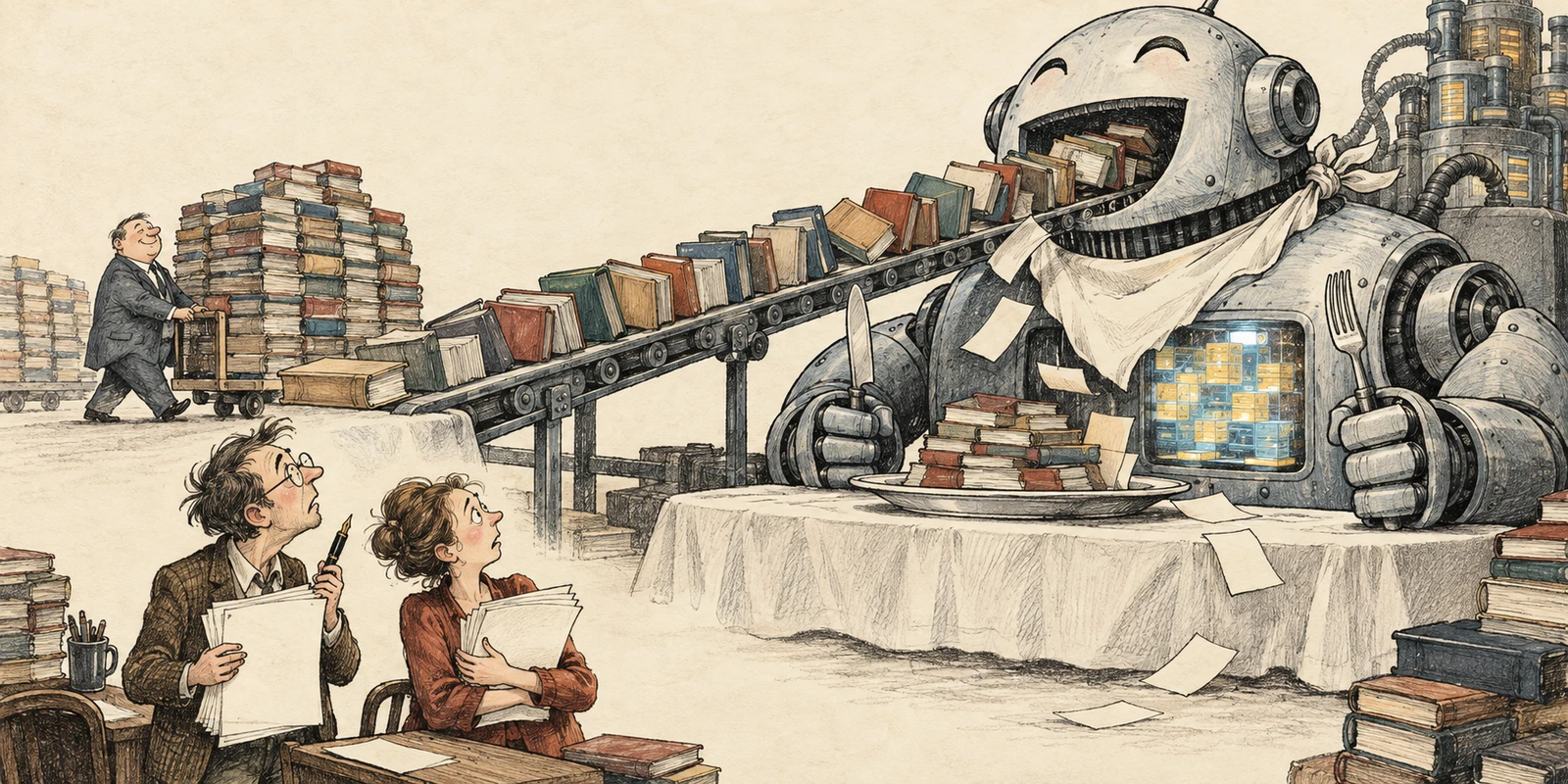
Anthropic also hired Tom Turvey, who once led partnerships for Google Books. The company then set up a large-scale operation to buy printed books legitimately in bulk, cut off the bindings, scan the pages, and dispose of or recycle the originals after digitizing them.
Spines and bindings sliced off, pages scanned one sheet at a time.
It is, quite literally, a dedicated factory for turning paper books into data AI can use.
Some have suggested that the reported deal with Nippan may have been part of this effort to source books for AI training.
$1.5 billion: the largest copyright settlement ever
Over the issue of obtaining books from pirate sites, Anthropic agreed to a settlement with rights holders in 2025.
On July 20, 2026, a US federal district court gave the settlement final approval. The settlement fund totals $1.5 billion, paying roughly $3,000 per work for about 480,000 covered works. But here's the key point: the $1.5 billion is not payment for “training AI on the books.”
The settlement covers books obtained illegally from pirate sites. For printed books that were bought legitimately, the price of the book itself was paid, but no extra compensation for using them to train AI went to authors or publishers.
To put it simply:
Pirated books led to a massive settlement as a result of the lawsuit.
Legitimately purchased books bring no extra payment for the “new use” of AI training beyond the price of the book.
That is exactly what the Nippan case raises.
Is the price of a book sold as a book really the same as its value as AI training data?
And who should capture that new value, and how should it flow back to authors and publishers?
In Japan, AI training is allowed without permission under certain conditions
What makes this especially interesting is that Japan's copyright law has its own approach to the issue.
Article 30-4 of Japan's Copyright Act, introduced in a 2018 amendment and in force since January 2019, allows copyrighted works to be used without the rights holder's permission, to the extent considered necessary, when the purpose is not to “enjoy” the thoughts or feelings expressed in the work.
Japan's Agency for Cultural Affairs has also explained that collecting and using copyrighted works as training data for AI development can, in principle, fall under this provision.
It's a flexible rule designed to encourage innovation. But as AI has advanced quickly, a new question has emerged: “How should the value of works used for training be returned to rights holders?”
The Nippan case is a symbol of that question.
Once a book is sold as an ordinary book, the sale price is paid. But even if the book is then used for something else, like AI training, there's no system that automatically gives authors or publishers extra compensation for that AI training use.
If it's legal, why the uproar?
So why has this deal, which can't be called illegal simply because the books were used for AI training, caused such a strong backlash?
The issue isn't only “legal or illegal.”
Who knew what, and what did they tell whom?
In other words, it's about transparency and accountability, which sit outside the law.
The JBPA isn't simply trying to prove Nippan broke the law.
It's asking for an explanation of how the deal happened: whether books from member publishers went to Anthropic, whether they were sold in bulk without publishers' consent, and how much Nippan knew about the buyer and the intended use.
Nippan, for its part, has declined to comment on individual transactions, while stating that it did not sell books knowing they would be used for AI training.
At the heart of the case is a distrust in the transparency of book distribution itself: “Did our books quietly turn into a different kind of product, with a different economic value as ‘training data,’ without authors or publishers knowing?”
“Legal” and “fair” are different questions
As competition in AI development heats up, the value of high-quality Japanese-language data, not just English, is likely to rise in relative terms.
And as major public web data gets used for AI training again and again while AI-generated content keeps spreading online, high-quality human-made data that hasn't been fully used yet may become even more precious. Books are one of the prime examples.
So:
- Can the high-quality text people newly write keep up with the enormous amount of data AI needs?
- When fresh, high-quality human-made data runs short, how will AI progress change?
- And when your own work becomes valuable as AI training data, how should you, as a rights holder, assert your rights and what compensation should you ask for?
The Nippan–Anthropic issue isn't just about “Was it okay to sell the books?”
In the AI era, who gets to use the knowledge and expression humans create, under what rules, and who should the value go back to?
For Japan's publishing industry, this looks set to become a test case for rethinking how deals are made and what gets disclosed.