Free AI for Every Citizen? How Thailand, South Korea and Japan Are Taking Different Paths
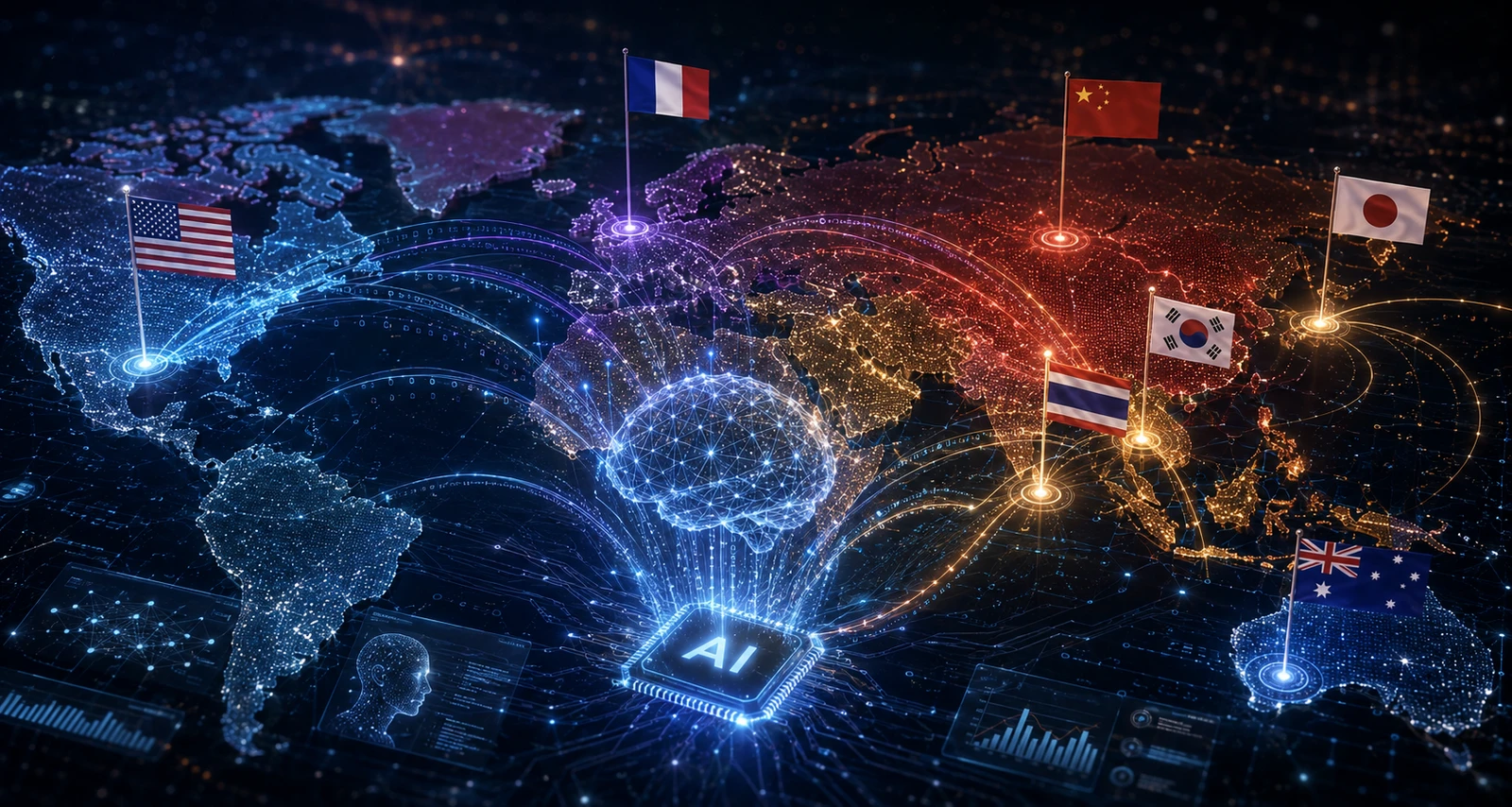
Hi, this is AIB.
Governments around the world are wrestling with the same question in the AI era:
“How do we get more of our citizens using AI?”
Thailand and South Korea have come up with almost opposite answers.
Thailand chose to bring in proven global AI and hand it to its people.
Korea chose to build a public service of its own, centered on homegrown AI.
Japan, meanwhile, is taking a third route. We'll look at that at the end.
1. Same problem, opposite solutions
On August 31, Thailand officially launched its AiPASS service.
Up to 5 million Thai citizens can use 33 models from 15 providers, including global AI like ChatGPT, Claude, and Gemini, on a single platform for free for one year.
Korea is heading in a somewhat different direction.
On August 28, Korea's Ministry of Science and ICT selected three consortia, led by SK Telecom, Kakao, and KT, to run “AI for All” (모두의 AI), a program offering free AI services to the entire public.
At least 50% of the AI models used must be Korean models that meet the criteria of the country's sovereign AI foundation model program, and of those, at least 30% must be Korean models from other companies.
Thailand: “Bring in AI that already works well and get people using it fast.”
Korea: “Grow our own AI while building a service for the public.”
Which direction is closer to the right answer?
2. Proven models vs. homegrown models
| Thailand: AiPASS | Korea: AI for All | |
|---|---|---|
| Approach | Rental model that bundles global AI models | Service built around Korean AI models |
| Structure | 15 providers, 33 models | 3 consortia: SKT, Kakao, KT |
| Share of domestic models | 1 Thai model (Pathumma ThaiLLM) out of 33 | Korean models 50%+, with other companies' Korean models 30%+ |
| Budget | Contract worth 1.621 billion baht (about ₩66.9 billion), later adjusted to payment based on actual usage | Government to fund operating costs from 2027; exact amount not yet set |
| Duration | 1 year of free use | Launch within the year, then upgraded to AI agents from 2027 |
3. Thailand's approach: strengths and weaknesses
(+) People get good AI right now
The biggest advantages are probably speed and stability.
Building an AI model takes not just technology but enormous capital. And it isn't easy for a domestic model to catch up with global frontier models that have already proven themselves.
It takes time to reach good enough performance and to be tested in real-world services. On top of that, generative AI can give different answers to the same question, so getting it stable takes a lot of trial and error.
Using models like ChatGPT, Claude, and Gemini, which already compete in the global market, lowers these technical risks considerably.
(+) Data protection is built in
One of the main reasons “domestic AI” matters in the first place is the risk of citizens' personal data, or corporate and government secrets, flowing overseas. Because AI learns and improves from data, this is an especially sensitive issue.
Thailand is using foreign models, but the government has officially stated that AiPASS subscriber and profile data is stored inside Thailand in an encrypted database and is not used to train the AI providers' models.
(–) The money spent doesn't build much domestic AI capability
From a long-term industrial policy perspective, though, the weakness is clear.
Of the 33 models on offer, only one, Pathumma ThaiLLM, is Thai. Most of the rest are from the US and China.
People will gain more experience using AI, but the gap between foreign and domestic models will likely keep widening.
Another key thing to watch: once the support period ends, will people keep using AI and pay for it themselves, or will it become a service that, like social welfare, needs ongoing tax money?
4. Thailand: “Learn as you use, and unlock more as you learn”
Personally, the most interesting part of AiPASS is something else.
It bundles free AI and AI education into a single service.
New users start at the “Beginner” level. They can use basic AI chat, but to unlock more powerful features, they need to earn points by completing educational content.
A short 1-minute video is worth 40 points, a 5–10 minute video 100 points, and documents, articles, and quizzes each earn points too.
Reach 100 points and you move up to the “Creator” level, which gives you 10,000 credits a day and unlocks advanced chat and coding, image, video, and music generation, deep research, and more. It also includes 17 courses provided by Microsoft, Google for Education, and OpenAI.
Giving people AI and helping them actually use it well are two very different things. Building an effort to close that gap right into the service structure is something other countries can learn from.
5. Korea's approach: strengths and weaknesses
(+) The money leaves assets in the domestic industry
Korea's biggest strength is that government support doesn't just end up as AI usage fees. It goes directly into Korean AI models and the service ecosystem around them.
At least 50% of the models used must be Korean, and to keep any one company from dominating, at least 30% must be Korean models from other companies.
The idea is to give Korean AI a strong push while preventing a monopoly by any single company.
If it “succeeds,” Korea can expand public AI use while also building up real users, operating experience, and service know-how for its own models.
In a recent assessment, the global AI evaluation firm Artificial Analysis rated Korean AI models highly, placing Korea third in the world by country, after the US and China. That doesn't mean Korean AI already matches the world's top models, though. How competitive it is in real services and real-world use is still to be tested.
(–) In the end, quality is everything
The risks are just as big.
What matters to the public isn't whether an AI is “Korean” but whether it actually works well.
How large is the performance gap between global AI and Korean models? Is it noticeable in everyday life? Are speed and stability good enough? Huge numbers of users will now judge all of this for themselves.
Another major challenge is how to reliably serve Korean AI to the entire population in a country with relatively limited GPU resources and data center infrastructure.
6. What about Japan?
Japan currently has no nationwide program, like Thailand's or Korea's, in which the government pays for AI usage and offers it directly to millions of citizens.
Instead, Japan is focusing on “the ability to build AI” and “the government's own ability to use AI.”
A key example is GENIAC, run by the Ministry of Economy, Trade and Industry (METI) and NEDO.
Launched in 2024, it has supported the computing resources Japanese companies need to develop foundation models. It has since expanded to cover data preparation, robotics AI, and real-world deployment.
The thinking behind it is to reduce dependence on foreign AI and keep the capability to develop and run AI inside Japan.
The other is “Gennai,” the government AI of Japan's Digital Agency.
It started being used inside the Digital Agency in 2025 and, in 2026, expanded into a large-scale pilot covering about 180,000 staff across all ministries and agencies.
The point isn't just to make government work more efficient. The Japanese government positions AI use within government as “the starting point for putting AI into society.” It tests AI in real administrative work, checks its performance and problems, and feeds that back to developers. And by procuring AI on an ongoing basis, the government aims to create stable demand for Japanese AI. That's why, alongside foreign AI, it is also trying out Japanese AI developed by NTT DATA, Fujitsu, Preferred Networks, and others in real government work.
So Japan isn't trying to make everything domestic.
The goal is the ability to choose and keep using the AI it needs, without relying too heavily on any one country or company.
The Japanese government describes this as an open form of “AI sovereignty.”
7. It's not just about “which AI you hand out”
As the world competes over AI technology and its use, governments are making different choices.
Thailand chose fast adoption: give people world-class AI right away, get them using it, and raise their skills through education at the same time.
Korea is pursuing technological self-reliance and adoption at once. It may be the harder path for now, but it's a bet that providing AI to the public can itself become a chance to grow the domestic AI industry.
Japan is building the foundation for AI development under government leadership before handing AI out directly.
It's still too early to say which policy is better.
Especially as AI models rapidly converge in performance, what matters more and more to everyday users isn't a few points on a benchmark, but whether the AI does what you need, how fast it is, how easy it is to access, and how much it costs.
When the internet and smartphones first spread, what mattered wasn't the devices or the technology themselves.
What changed the world was what people could do with them once they had them.
Won't AI be the same?
An era where anyone can use AI is just beginning.