AI Basics Through History: Can Machines Learn on Their Own?
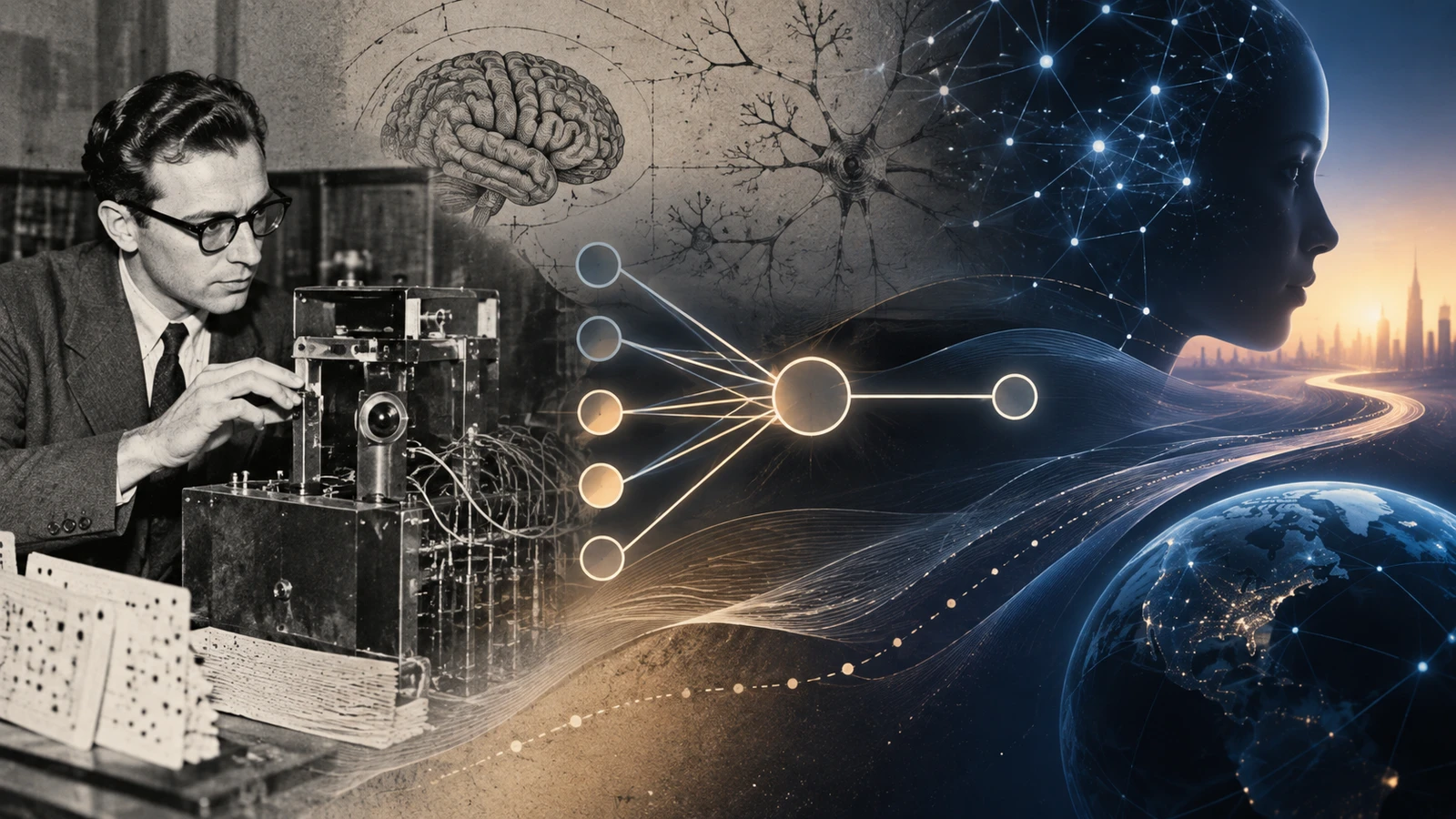
Let's start by reading a line from an old newspaper story.
“Walk, talk, see, write, reproduce itself and be conscious of its existence”
This line appeared in an article in The New York Times on July 8, 1958. It wouldn't sound out of place in a launch announcement for the latest AI model.
The headline read: “New Navy Device Learns by Doing.”
The New Yorker went even further, describing the machine like this:
“The first serious rival to the human brain ever devised”
The man behind it was Frank Rosenblatt, a psychologist who was just days away from turning 30. And the machine was his Perceptron.
Sixty-eight years later, it seems people's worries and hopes about AI haven't changed much.
Every time a new AI comes out, we get a flood of headlines like “A machine that thinks for itself has arrived” and “Human jobs are at risk.”
The Perceptron: A Machine Modeled on the Brain
In 1958, Rosenblatt published a paper titled “The Perceptron: A Probabilistic Model for Information Storage and Organization in the Brain.”
Interestingly, it didn't appear in a computer journal. It was published in Psychological Review, a psychology journal. That's because Rosenblatt wasn't a computer scientist. He was a psychologist who studied the human brain and mind.
The paper opens with three fundamental questions.
-
How does a living thing sense information about the outside world?
-
In what form is that information stored?
-
How does stored information influence recognition and behavior?
Rosenblatt argued that the brain should be understood through probability theory rather than explained only by clean-cut logical rules. Drawing on how the brain works, he set out to build not a simple calculator that always gives the same answer, but a learning machine whose decision-making changes with experience.
How the Perceptron Works
Picture yourself in the morning, trying to decide whether to take an umbrella.
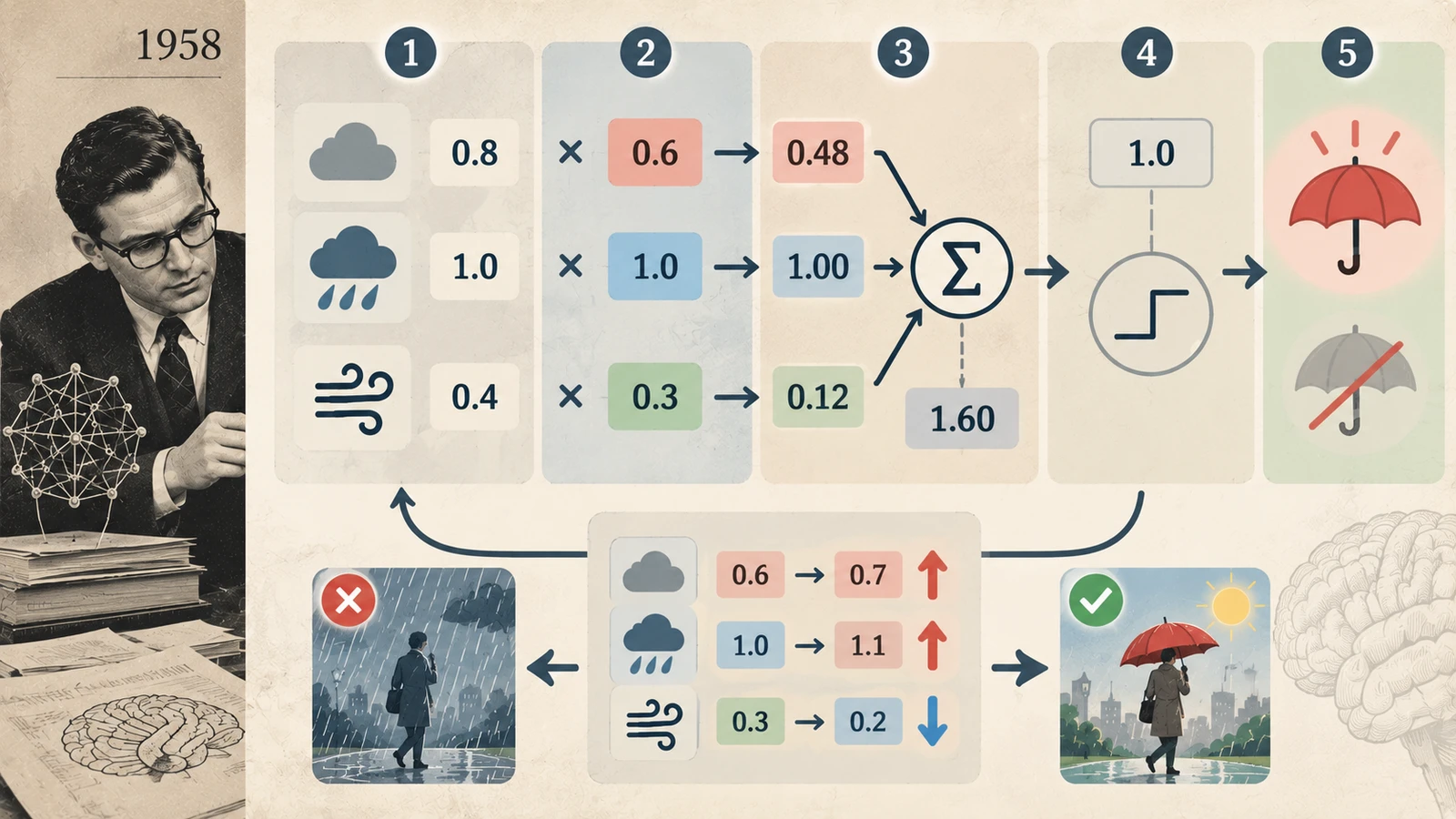
-
Turn the clues into numbers.
Take clues like“Is it cloudy?”, “Does the forecast call for rain?”, “Is it windy?”and enter each one as a value, such as cloudy 0.8, rain 1.0, wind 0.4. -
Multiply each clue by how important it is.
Important clues like rain get a large weight, less important ones get a small weight.
For example, you might give weights of0.6 for clouds, 1.0 for a rain forecast, and 0.3 for wind. -
Add everything up.
Combine them into a single score:0.8 × 0.6 + 1.0 × 1.0 + 0.4 × 0.3 = 1.60. -
Compare it to a threshold.
Check whether the total is above thethreshold of 1.0. -
Make the call.
If it's above the threshold,take the umbrella; if not,leave it at home. -
Adjust the weights based on the right answer.
If the result was wrong (it decided you needed an umbrella, but you didn't), nudge the importance of each clue a little.
Checking the result and adjusting the weights to make the next decision better: that's the basic way a perceptron “learns.”
Back when people wrote rules by hand, the idea of “Don't give the machine the rules. Show it examples and let it find the rules itself” was revolutionary.
It's one of the key starting points of what we now call machine learning.
A Giant Machine That “Learns” on Its Own
At a 1958 U.S. Navy press conference, a program based on the perceptron was demonstrated on an IBM 704, a five-ton computer that filled an entire room.
After about 50 trials, the computer began to tell apart cards marked on the left from cards marked on the right. It looks like a trivial problem today, but it was a breakthrough because no one had programmed the computer with “the rule for telling left from right” itself.
Rosenblatt didn't stop there.
To bring the perceptron idea into real hardware, he built a dedicated machine using light sensors and electronic circuits: the Mark I Perceptron.
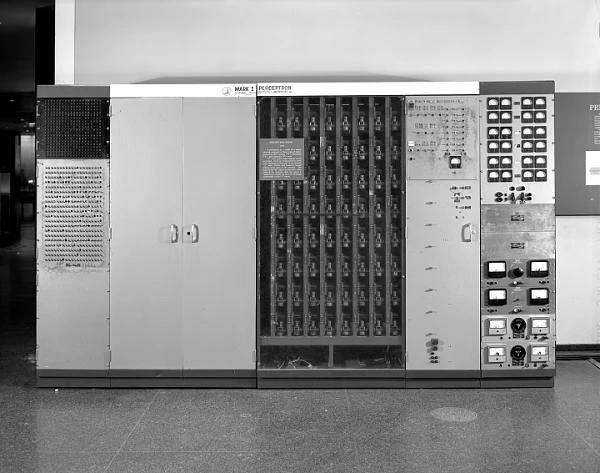 Mark I Perceptron
The Fall of the Perceptron and the “AI Winter”
The more excitement the perceptron generated, the more skeptics it attracted.
One of them was Marvin Minsky of MIT, who would later be called one of the “fathers of AI.”
Rosenblatt and Minsky had attended the Bronx High School of Science in New York, one year apart. The two often clashed publicly at conferences over what the perceptron could really do.
Then, in 1969, Minsky and his colleague Seymour Papert published a book called Perceptrons.
It was named after Rosenblatt's machine, but the book was a focused analysis of the perceptron's mathematical limits at the time.
A simple perceptron was good at problems where the data could be split by a single straight line or plane. But not every problem in the world splits that neatly. Some problems couldn't be solved no matter how long you trained it, because of limits built into its structure.
The book hit neural network research hard and became one of the symbolic events in the field's subsequent decline.
On top of that, machine translation research that fell short of expectations, government reviews of research results, huge computing costs, and shrinking research funding all piled up, and enthusiasm for AI research as a whole cooled quickly in the 1970s.
The Perceptron's Legacy
But Rosenblatt's idea itself didn't disappear.
In the 1980s, researchers began developing better ways to train neural networks with multiple layers. In particular, a 1986 paper by David Rumelhart, Geoffrey Hinton, and Ronald Williams made backpropagation widely known in neural network research.
Backpropagation calculates how wrong a result was, then passes that error backward through the network, adjusting the weight of each connection a little at a time. It took Rosenblatt's idea of “if you're wrong, fix the weights” and made it work for much larger, more complex multi-layer networks.
As a result, problems that a single simple perceptron struggled with became solvable with multi-layer networks and new training methods, and neural network research regained its momentum. Then in 2024, John Hopfield and Geoffrey Hinton received the Nobel Prize in Physics “for foundational discoveries and inventions that enable machine learning with artificial neural networks.”
Of course, the ChatGPT, Claude, and Gemini we use today don't run on the same structure or learning algorithm as the 1958 perceptron.
But the big-picture idea carries on: give countless connections their own weights and parameters, and during training, nudge those values in the direction that reduces error.
In Rosenblatt's Mark I Perceptron, electric motors physically adjusted the values of variable resistors. In today's AI, GPUs compute and adjust an enormous number of values called parameters. The form, scale, and performance are completely different, but the idea of learning by changing the importance of connections through experience lives on.
The idea behind the AI we use today appeared 68 years ago. It just took more than half a century for computers, data, and training methods to catch up and make it work at a large enough scale.
Try It Yourself: How Does a Perceptron Learn the Answer?
Let's use TensorFlow Playground to see how a perceptron works with your own eyes.
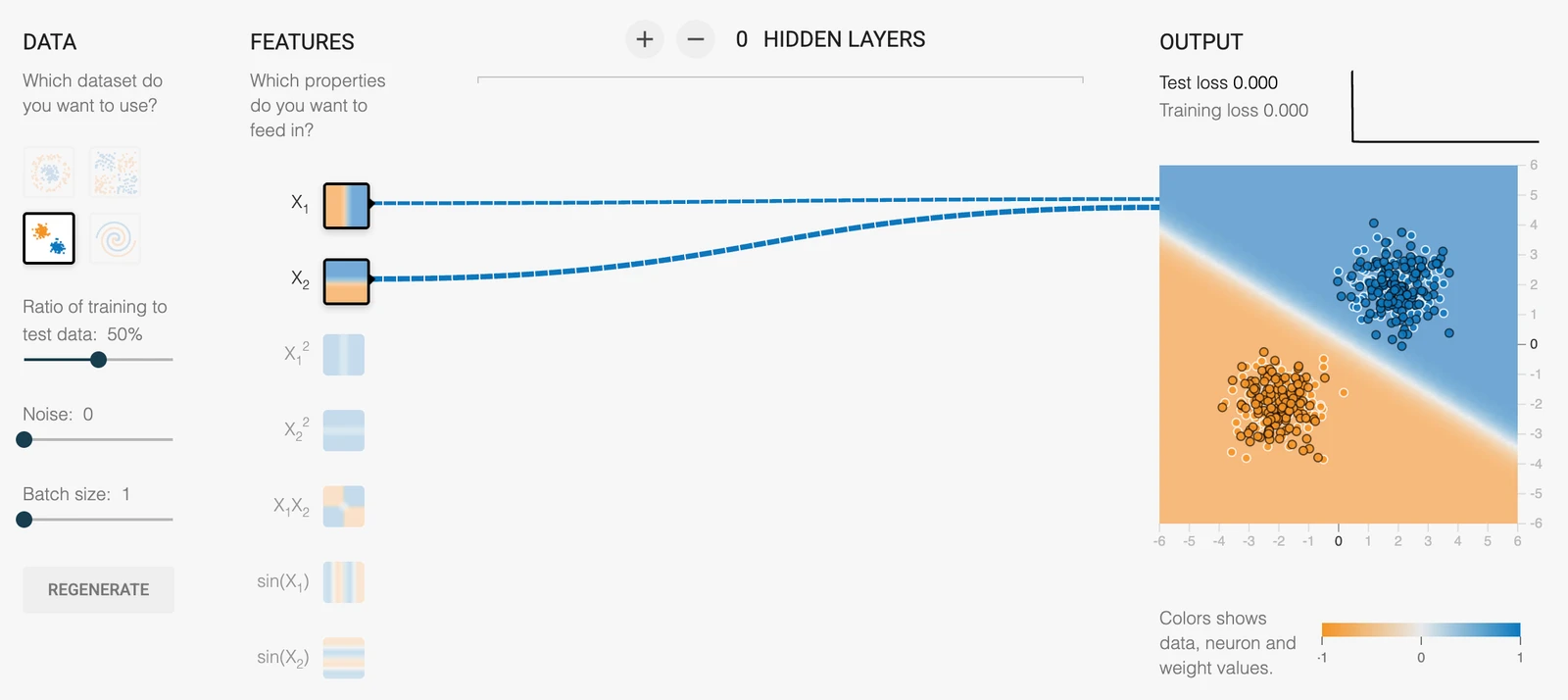 You'll see a lot of numbers and technical terms on the screen, but you don't need to understand all of them.
We only need to watch three things: the blue dots, the orange dots, and the boundary that separates the two colors.
① Pick the simplest problem
Under DATA on the left, choose the dataset where the blue and orange dots form two separate clusters.
Think of the blue dots as one kind of answer and the orange dots as another.
For example, you could think of them as:
- Blue = days you needed an umbrella
- Orange = days you didn't
The goal is for the machine to look at these examples and figure out, on its own, the line that best separates the two groups.
② Make the machine as simple as possible
Under FEATURES, keep only X₁ and X₂,
and set HIDDEN LAYERS to 0.
Now it's no longer a complex neural network, just a very simple structure that looks at two clues and gives one answer.
In the umbrella example, you can think of the two clues as:
- X₁ = how cloudy the sky is
- X₂ = how likely it is to rain
③ Find the “boundary” on the screen
Look at OUTPUT on the right.
There's a faint boundary between the blue background and the orange background.
Put simply, this boundary is the machine's decision line. Anything on one side, it calls blue; anything on the other side, it calls orange.
Before training, this line may be in a completely wrong place.
④ Train it one step at a time
First, press the ↻ button to reset. Then, instead of pressing the big ▶ button, press the single-step button next to it, one click at a time.
(If you press ▶, training finishes almost instantly and it's hard to see what's happening.)
Once. Again. A few more times. You can ignore the other numbers.
Just watch how the boundary between blue and orange moves.
At first the boundary doesn't separate the dots well, but it gradually shifts its angle and position until the blue dots land in the blue area and the orange dots land in the orange area.
That change is “learning.”
⑤ So what did it learn?
We never told the computer, “Draw a line here, at this angle.”
All we showed the machine were examples: “This dot is blue,” “This dot is orange.”
The machine starts with the wrong rule, but by comparing its results with the right answers, it adjusts that rule bit by bit. Eventually it lands on something like, “If I draw a line about here, in this direction, I can separate the two groups best.”
That's the core idea of the perceptron:
Instead of giving the machine the rules directly, show it many examples with the right answers and let it find the rules within them.
The boundary line slowly moving in TensorFlow Playground is exactly that change, showing up on your screen.