Agentic AI Joins SETI Signal Search
- •Breakthrough Listen and the SETI Institute deploy agentic AI at the Allen Telescope Array to search for extraterrestrial signals
- •Nexus system handles 2.4 terabits per second on NVIDIA RTX PRO 6000 Blackwell GPUs
- •Pipeline records first real-time AI detection of a pulsar in the Crab Nebula
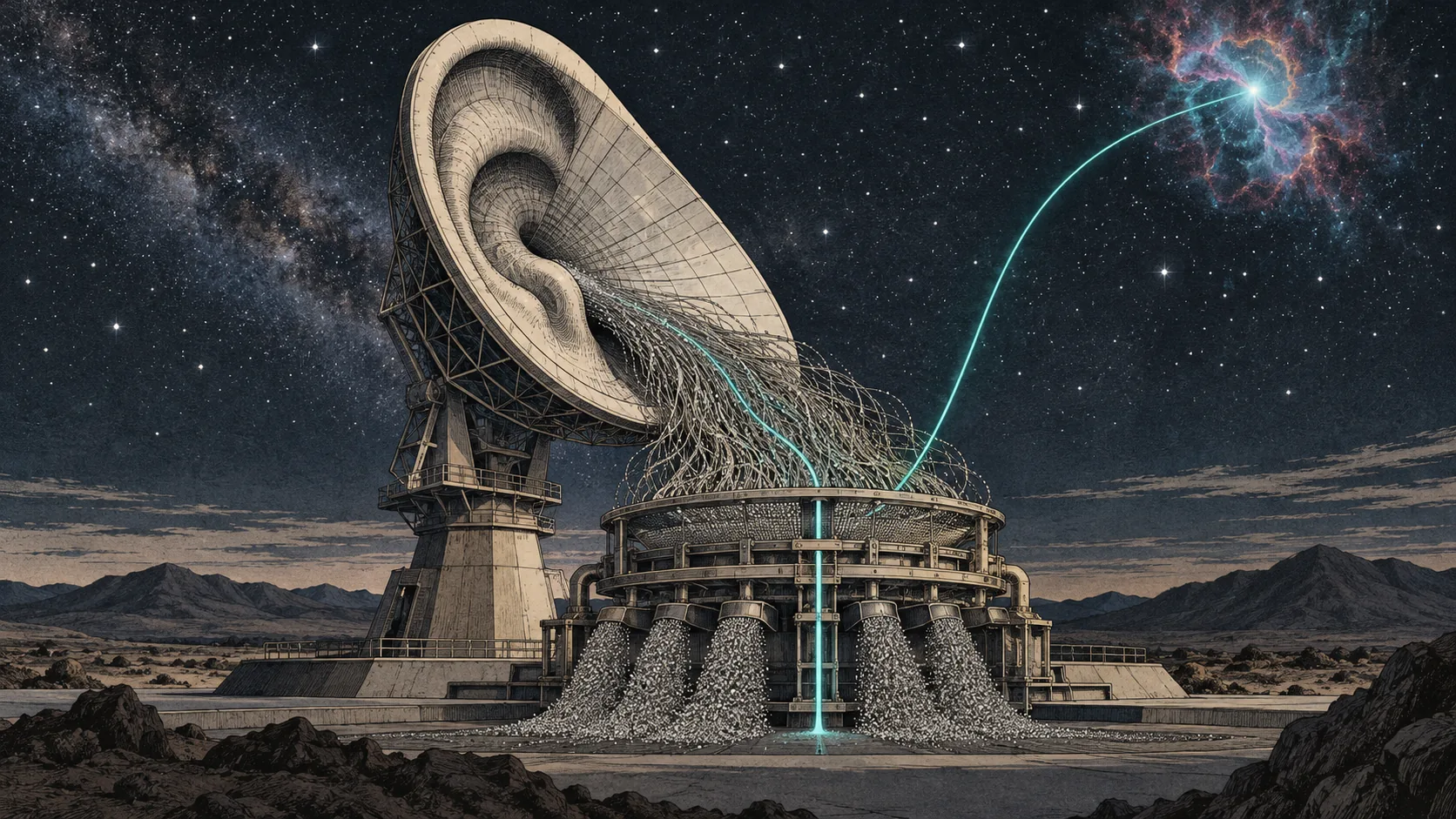
Breakthrough Listen and the SETI Institute are using agentic AI at California’s Allen Telescope Array to search for signals from extraterrestrial life and technology. With one natural-language request, agents can steer the telescope, correct and enhance incoming data, and apply AI models to the live stream. NVIDIA Holoscan processes sensor data as it arrives, allowing agents to act on it during observations. Andrew Siemion, SETI Institute chair for SETI and Breakthrough Listen principal investigator, said the signals found by agentic observatories may have more in common with the agents than with their human creators, calling this a “breakthrough in translation.”
The telescope’s DAQIRI library moves terabits of sensor data per second directly into GPU memory, so observations are processed in flight instead of filling hard drives. The SETI Institute’s CyberEther signal-processing framework uses NVIDIA CUDA-X libraries, including cuFFT and cuBLAS. Nexus, a web-based observatory orchestrator, gives agents a shared view of instrument state, computing resources and pipelines. Researchers can monitor packet loss, view live spectrograms and rewrite signal-processing blocks through natural-language prompts. On NVIDIA RTX PRO 6000 Blackwell GPUs, the system handles 2.4 terabits per second, with inference running on premises beside the telescope. The combined system can steer and focus the antenna, calibrate the instrument, correct data errors and plot results; tasks that take people weeks or years can be completed in hours.
The pipeline has already achieved the first real-time AI detection of a pulsar in the Crab Nebula. The team is evaluating open models, including NVIDIA Nemotron, for work where data locality and turnaround time matter, and for observatories that could someday operate offline on the far side of the moon.