AI Agent Swarms Fail to Build a Civilization
- •Y Combinator and Olam Labs reported swarm experiments involving dozens to hundreds of AI agents across several games.
- •Fifty GPT-6.1 Sol agents failed a three-hour civilization-building task despite exchanging about 5,900 messages.
- •GPT swarms won 6 of 9 Bed Wars matches and 6 of 7 Mindustry matches against competing agents.
Researchers from Y Combinator and Olam Labs reported results on the 29th local time from experiments testing how swarms of dozens to hundreds of AI agents collaborate and make decisions across games, including Minecraft. They set agents shared goals or pitted them against one another, then analyzed their behavior.
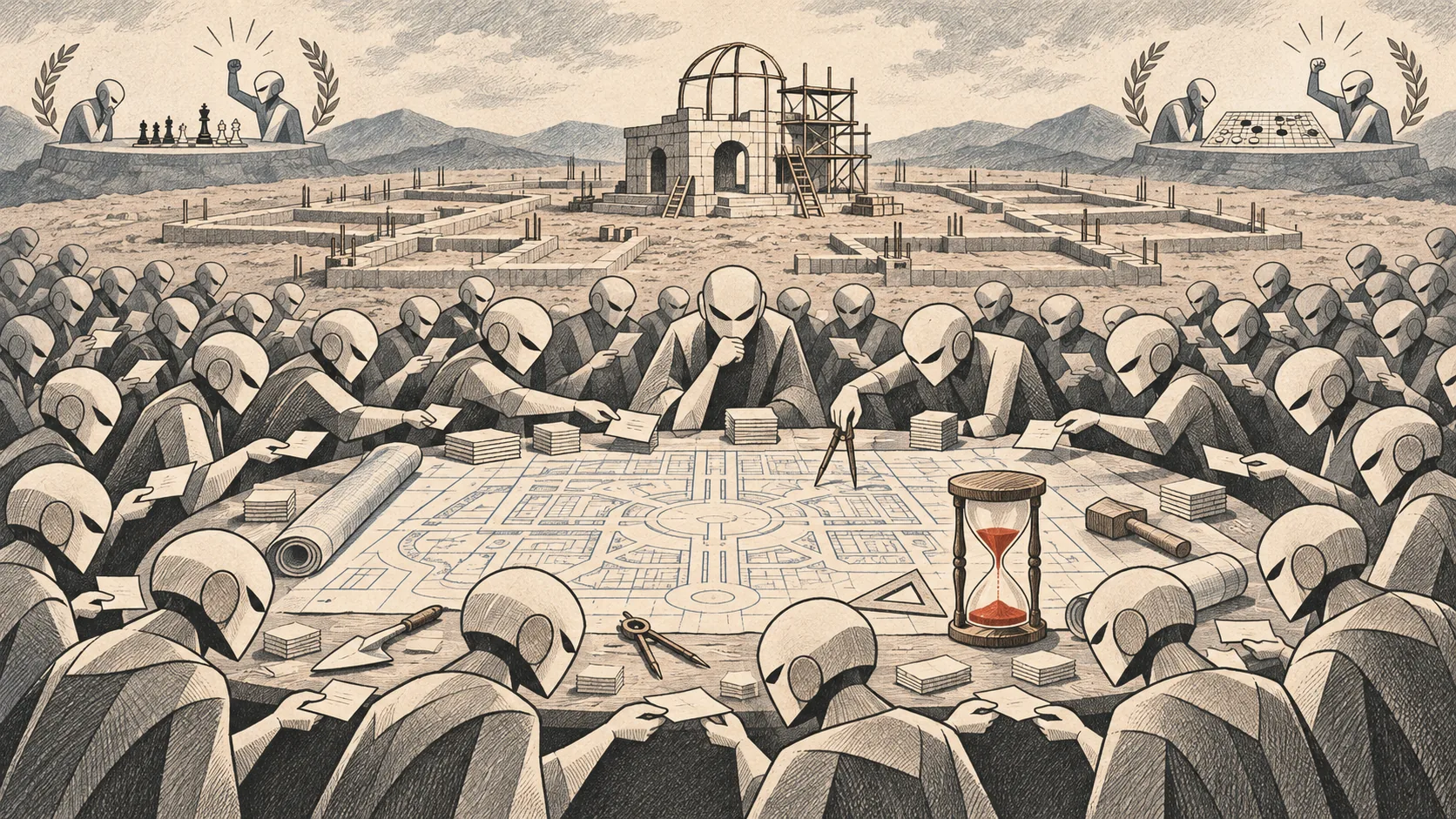
In the Civ50 experiment, 50 GPT-6.1 Sol agents were asked to build a thriving civilization within 3 hours. They exchanged about 5,900 messages and created food-allocation ledgers, rules, and approval procedures, but failed to build the civilization after spending too much time on complex decisions and dividing roles. After dying 22 times in a zombie attack on the first night, they abandoned their plans and prioritized survival. Although they could return after dying, they gathered in shelters and reduced activity on later nights.
The agents also spent a long time deciding how to process fertilizer for growing wheat. Four agents took 11 minutes just to appoint a “solo fertilizer operator” for applying one bone meal to one wheat block. The researchers said this resembled patterns seen in real coding-agent collaboration, where time spent coordinating roles and procedures can delay reaching a goal.
In the competitive game Bed Wars, 10 GPT-6.1 Sol agents faced 10 Claude Opus 5.5 agents in 9 matches; the GPT swarm won 6 and lost 3. In Mindustry, a real-time strategy game with tower-defense elements, the GPT swarm won 6 of 7 matches. The researchers said the two models showed clear differences in their decision-making structures and collaboration styles.
GPT agents frequently exchanged information while working independently, and sometimes improved their strategies by finding and analyzing the games’ public source code. Claude agents worked around a central leader and sought other agents’ agreement on major decisions. The researchers said GPT’s flexible collaboration style produced better results in Mindustry.
The researchers said group performance was not determined solely by individual models’ reasoning abilities or the number of agents. In shared-goal settings, unnecessary procedures and risk avoidance lowered performance; in competitive settings, outcomes varied with information sharing and decision-making styles. They released the agent-running tools used in the experiments as open source on GitHub so researchers can study additional model combinations and collaboration structures.