AI Agents Advance Integer Multiplication Result
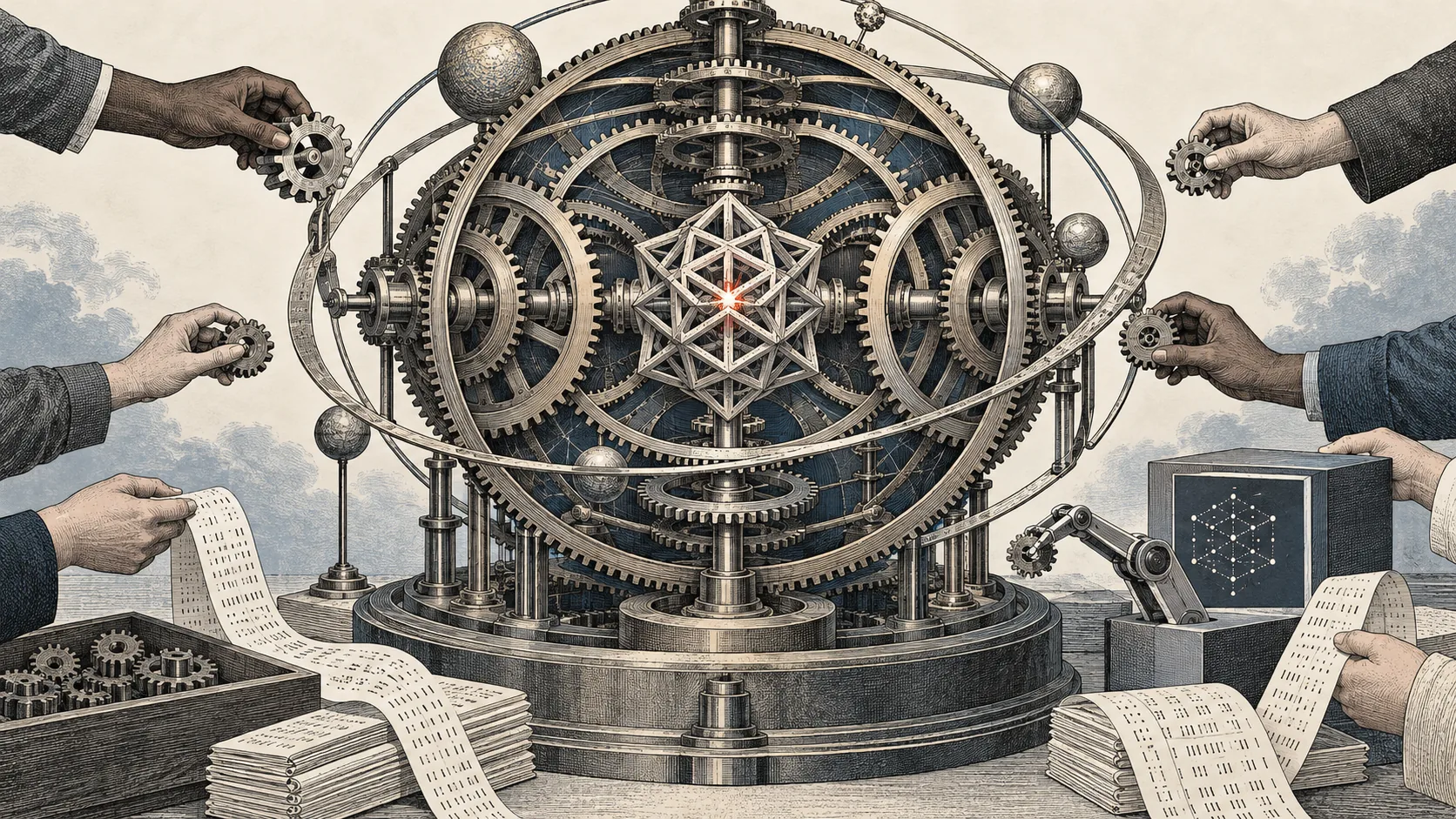
- •Human and AI contributors raised κ in OpenAI Math Drop Problem 109 from 2^−182 to 0.00129 within 24 hours.
- •The GitHub repository received 151 PRs and more than 260 million lines of test and optimization code.
- •Codex was marked on 89 PRs and Claude on 48; Jacob Sussman introduced E8 lattice geometry as κ neared 0.001.
An open-source community of mathematicians, developers and AI agents raised the parameter κ in OpenAI Math Drop Problem 109 from 2^−182 to 0.00129 within 24 hours, according to a report published by 36Kr on October 13. The problem concerns a conditional lower bound for integer multiplication, and κ represents the algorithm’s exponential saving rate. The community worked in the CrocSwap/integer-mult-bounds GitHub repository, where contributors submitted 151 pull requests (PRs) and added more than 260 million lines of test and optimization code. At the peak, the repository received a new solution every minute, and code optimization briefly outpaced verification.
Doug Colkitt began advancing the result through code and mathematical changes, moving κ from 2^−182 to 2^−108 and then 2^−78. On the night of October 7, he reduced a layout-routing swap to O(d) using a “non-adjacent axis swap,” reaching 2^−78; in the early hours of October 8, he reached 2^−34 and went to sleep. The article says the resulting repository activity surged after researchers, including Rohan Arun, launched dozens of Codex- and Claude-powered agents through platforms such as GetSupers. The agents read papers and code, searched for optimizations, wrote code, ran a verifier, and submitted a PR when a candidate passed.
Developer Dugongue submitted a PR that first pushed κ past 10^−3, and Doug later verified and merged a PR from Rohan Arun, advancing the result to 0.00129. Of the 151 PRs, 89 were marked as using Codex and 48 as using Claude. Arun described Codex Astra high as faster at rapid iteration and cost optimization, while Claude Opus 5.5 contributed the leading result on the leaderboard and helped make structural advances when progress stalled. The report says teams also competed through targeted optimization and repeated patterns, calling the activity a decentralized research effort.
As κ approached 0.001, the article says gains from code optimization alone began to diminish and the agents reached a local optimum. Researcher Jacob Sussman then introduced E8 lattice geometry, a mathematical structure for sphere packing in eight dimensions, and proposed reconstructing the input’s “paired cube transformation” from that perspective. The article presents this human mathematical insight as the move that changed the optimization effort’s direction.