Review Assesses AI in Nutrition Care
- •A 2026 narrative review assesses AI applications and clinical translation challenges in nutrition and dietetics
- •Food image tools may match human portion and energy estimates under controlled conditions, but validation and food diversity remain limits
- •Chatbots have accuracy, nutrient omission, and empathy concerns; review says evidence does not support replacing dietitians
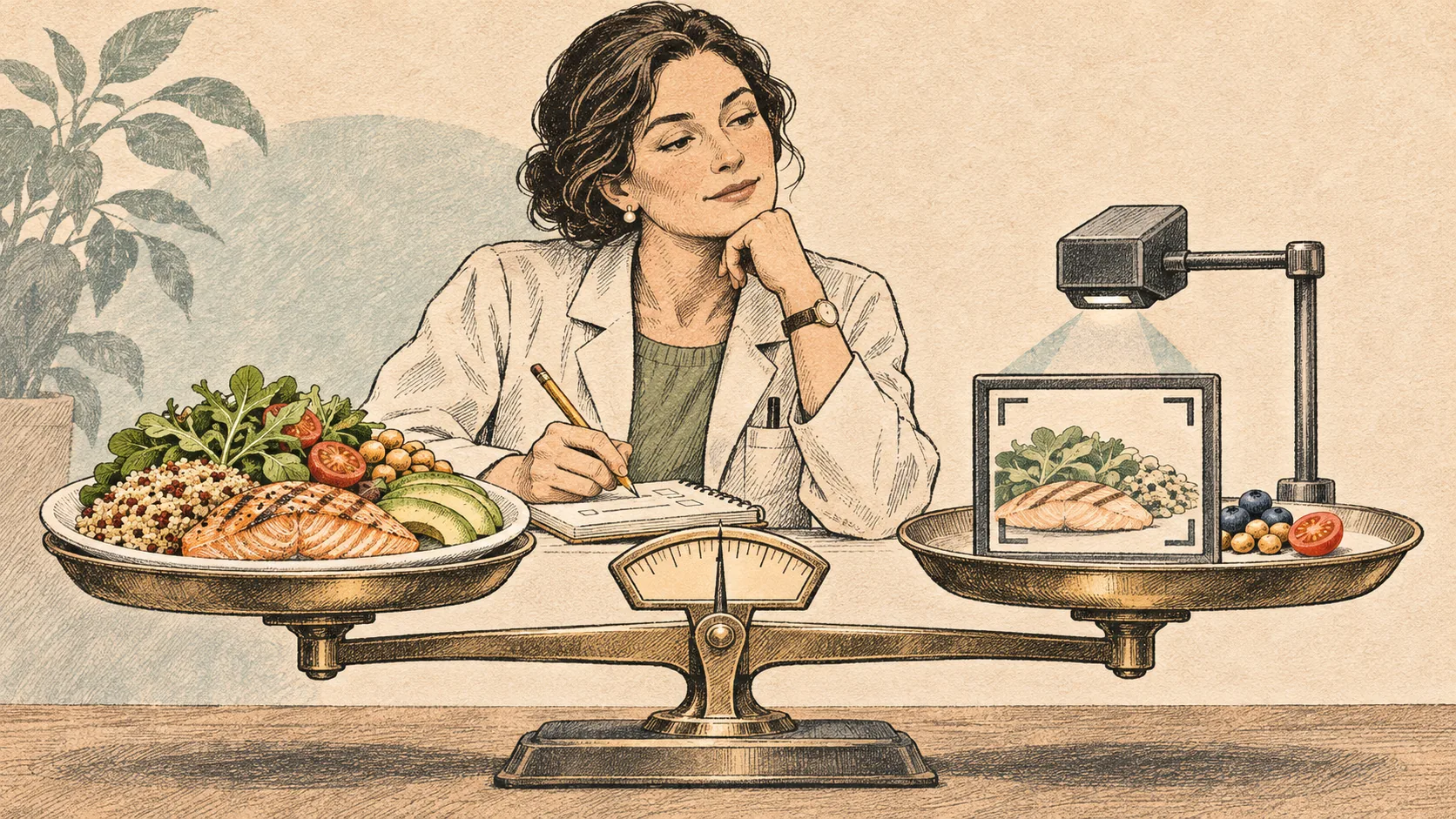
A 2026 narrative review in the Journal of the American Nutrition Association assessed AI applications in nutrition and dietetics, including dietary assessment, precision nutrition, generative AI counselling, and barriers to clinical use. Its evidence synthesis covered food image recognition and portion estimation using convolutional neural networks, machine learning predictions of postprandial glycaemic response (PPGR), and large language model chatbots for counselling, meal planning, and behaviour change. The review considered clinical outcomes, model performance, validation, and implementation barriers.
AI-assisted dietary assessment may improve access and match human assessment for portion and energy estimates in controlled conditions. Limited external validation and under-representation of diverse foods constrain how well those results generalise. Machine learning models combining anthropometric, clinical, dietary, and gut microbiome data can improve individual PPGR prediction; a limited number of randomised trials reported beneficial glycaemic or metabolic outcomes from machine learning-guided personalised diets.
Large language model chatbots can provide broadly satisfactory dietary guidance and support conversation, but they can be inaccurate, omit micronutrients, and show lower empathy than human dietitians. Rigorous randomised controlled trials with clinically meaningful, long-term outcomes remain limited. The review also identifies algorithmic bias, data privacy and security risks, limited explainability, and evolving regulation as barriers. It says current evidence does not justify replacing registered dietitians or nutrition professionals, and calls for standardised validation, rigorous clinical trials, greater model transparency, and equity-focused governance for safe integration into routine nutrition practice.