AI Scribes Save Time but Leave Burnout Unresolved
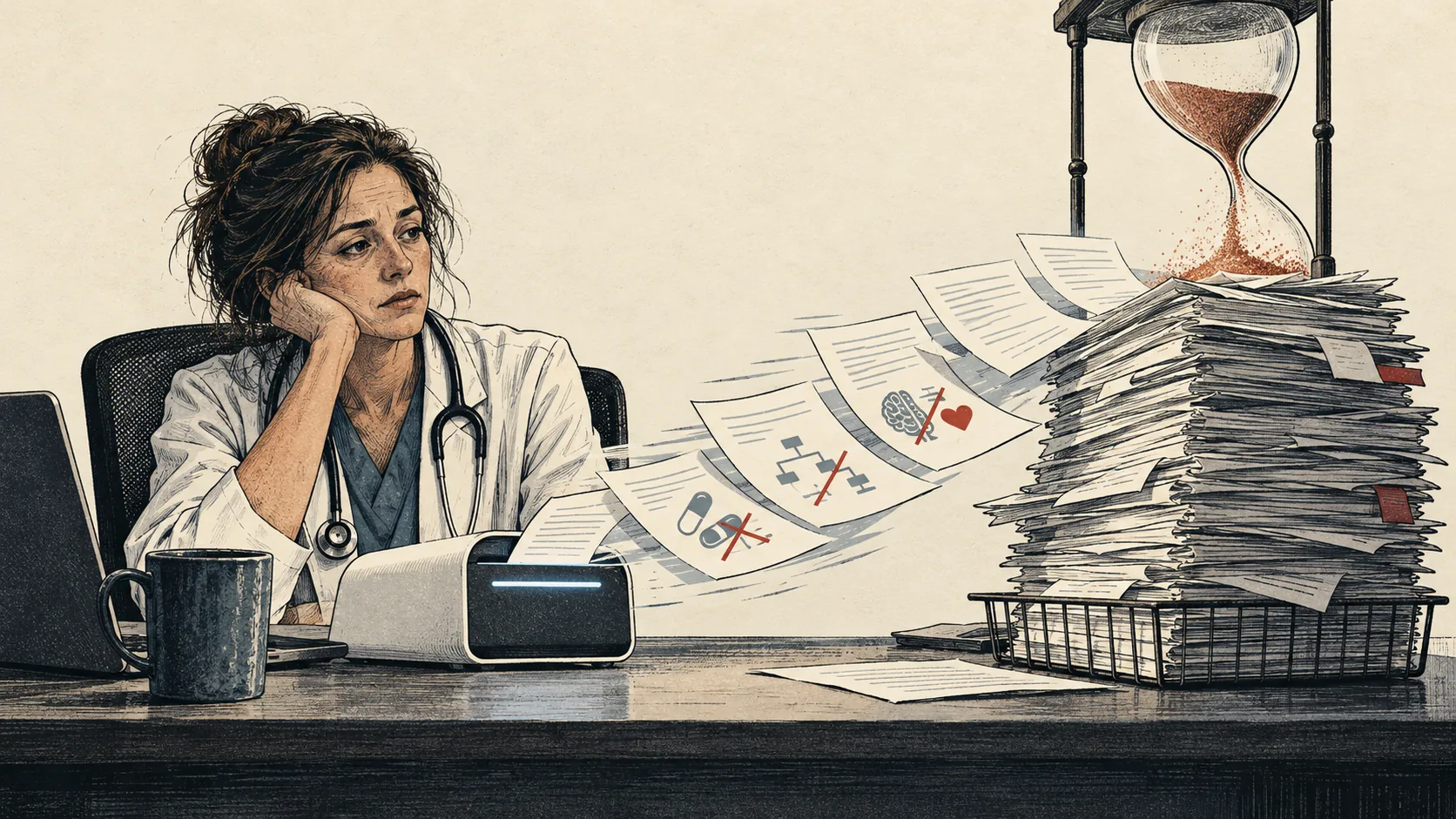
- •More than 12,000 Canadian primary care clinicians enrolled in a national AI scribe program; almost 60% report less administrative time
- •In tests of 20 approved Ontario AI scribes, 12 recorded wrong drugs, nine invented treatment steps, and 17 missed mental health details
- •Authors propose GRACE principles and an adoption matrix, urging health systems to track burnout, safety, and whether saved time returns to clinicians
More than 12,000 primary care clinicians have enrolled in Canada Health Infoway’s national AI scribe program, about 5,000 Ontario physicians use AI scribes, and roughly one in five Canadian physicians use AI tools. Almost 60% report less administrative time. AI scribes listen to clinical visits with patient consent and draft physicians’ notes. The authors, an emergency physician and an organizational psychologist, say the tools save documentation time but can add work without organizational safeguards.
Physician burnout stems from mismatches in workload, control, reward, community, fairness and values, rather than paperwork alone. One study attributed 6.8% of differences in clinician burnout to electronic health record design and use; when chaotic work environments and limited workload control were considered, the figure rose to 36.2%. Emergency physicians are interrupted 7.9 times an hour, and prescribing error rates nearly triple with interruptions, which scribes do not address.
Time saved often goes to other tasks. In Canada’s national program, half of clinicians used saved time for other administrative work and one in five added appointments. Across five U.S. health systems, AI scribe adopters saved 13.4 minutes of daily electronic health record time and delivered 0.49 more visits per week.
Errors can require physician review. In two simulated tests reported by Ontario’s auditor general, most of 20 government-approved AI scribes made errors: 12 recorded the wrong drug, nine invented treatment steps, and 17 missed key mental health details in at least one test. The province says there are no known reports of patient harm. OntarioMD said physicians know they must review every AI-generated note; the authors say that safeguard itself adds work. In one U.S. health system, AI-drafted patient-message replies did not reduce response time because physicians still edited them for accuracy.
The authors describe additional burdens from disconnected systems and continual learning. In one emergency department, starting a night shift required logging into six systems, including an AI scribe outside the patient chart, which required copy-and-paste after each interaction. Thirty-nine percent of Canadian physicians named better-connected, interoperable systems as a priority. The authors call the pressure to keep up with workplace AI tools “AI fatigue.”
They propose GRACE, a five-principle framework: govern adoption with clinician input and pilot stop rules; respect clinicians’ choice among vetted tools; advance access by integrating tools into clinical records and funding access fairly; cultivate competence with paid learning time and peer “AI champions”; and evaluate burnout, after-hours work, note accuracy and whether saved time returns to clinicians. Their AI Adoption Matrix assesses access and skills (“enablement”) alongside policies, oversight and accountability (“governance”).
The authors support AI adoption in health care but urge organizations to manage it responsibly because patient safety is at stake. They say success should be measured by physicians’ well-being at work, not only by the number of patients seen per shift.