Alibaba Introduces Qwen4-Max AI Model
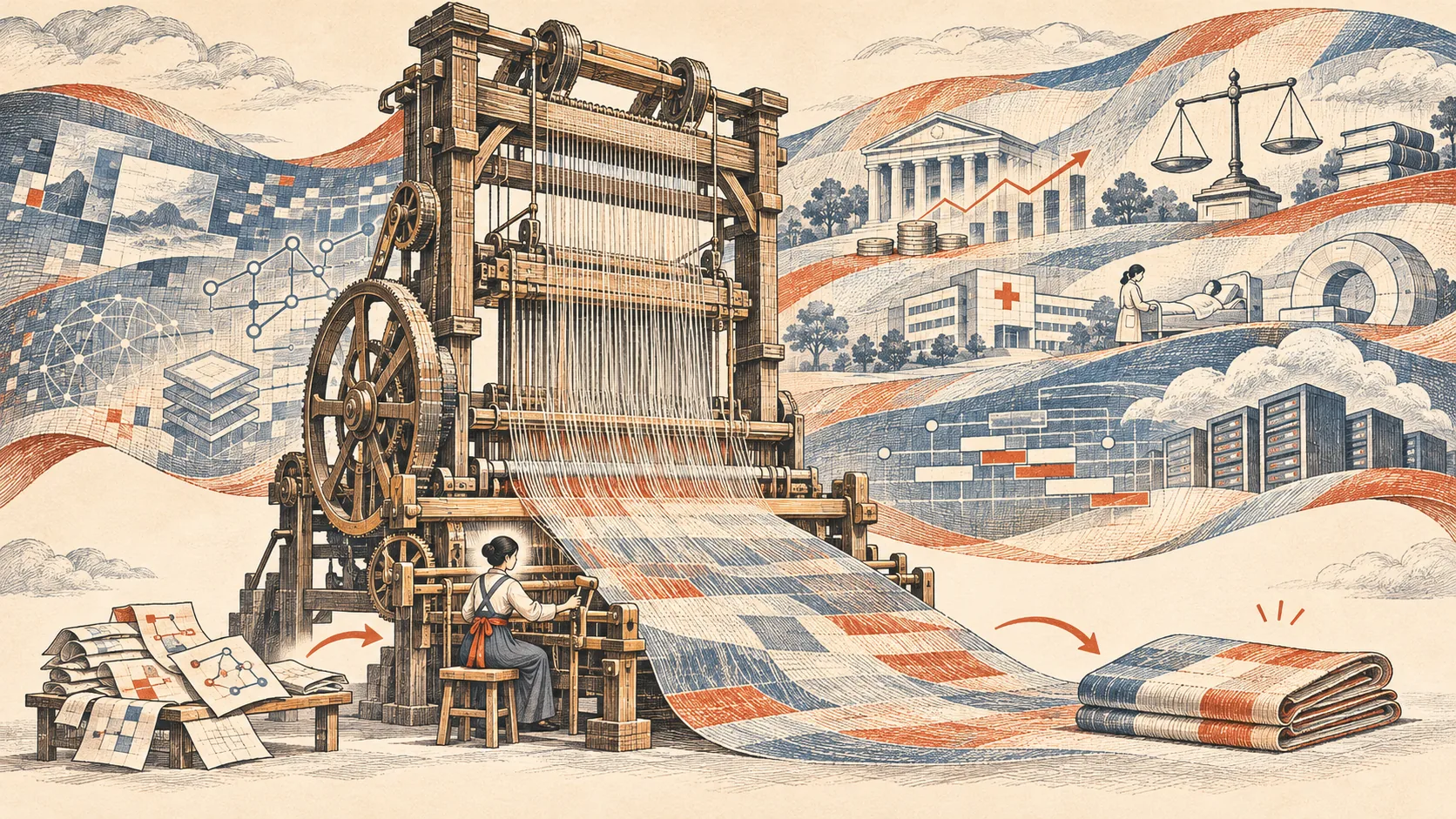
- •Alibaba introduced Qwen4-Max, a 2.4-trillion-parameter model with native vision and a one-million-token context window.
- •Work360 score rose to 52.69 from 47.74; average task cost fell 62%, from $4.43 to $1.67.
- •Alibaba reports 95% less workpiece programming time and describes deployments spanning finance, law, healthcare and cloud scheduling.
Alibaba’s Qwen team introduced Qwen4-Max on November 16, 2026, presenting it as an AI assistant for work, creativity and research. The model uses the Qwen4 architecture, with 2.4 trillion backbone parameters, 71 billion activated per token, 328 billion additional N-gram Embedding parameters, native vision capabilities and a one-million-token context window. The company says it improves tool use, long-running task execution and deliverable quality compared with Qwen3.8-Max.
In Alibaba’s Work360 evaluation, Qwen4-Max scored 52.69, compared with 47.74 for Qwen3.8-Max. Work360 covers 26 Tier-1 domains, 182 Tier-2 subdomains and 721 Tier-3 fields. Qwen4-Max used approximately 24% fewer tokens at Xhigh effort and 35% fewer at High effort on Work360; on Terminal-Bench 4.0, token use fell approximately 48% and 49%, respectively. In Work360, average cost per task dropped from $4.43 to $1.67, a 62% reduction. Alibaba also says Qwen4-Max API prices are lower than Qwen3.8-Max’s, particularly for cached input.
Alibaba attributes the model’s training stability to architecture and optimization changes. Qwen Sparse Attention uses a lightweight indexer to select relevant context in small blocks, while Gated DeltaNet layers compress history into fixed-size states. Four Gated Residual branches use gates to regulate information flow, and N-gram Embedding represents local token patterns. The company reports no loss spikes during training. On in-house tests across knowledge, code, question answering and STEM, Qwen4-Max-Base had the lowest bits per byte (a measure of compression efficiency) among five checkpoints, with approximately 5–13% lower scores than Qwen3.8-Max-Base while activating 25% fewer parameters. Alibaba cautions that GLM-5.3 and Kimi-K3.1-Pro were post-trained checkpoints, which may affect comparisons with base models.
The company’s examples span 3D modeling with Blender, game creation in Unity, Unreal Engine and Godot, video production, manufacturing, finance, law and healthcare. At SANF and Pacific Union, it says programming a single workpiece took approximately 475 minutes manually and 24 minutes with Qwen4-Max, a reduction of about 95%. In a finance example, Qwen4 used 90 MCP tools to gather and cross-check market and financial information, then produced Excel workbooks and editable PowerPoint decks with source links and chart-to-workbook traceability. For legal due diligence, it processed 198 client working papers, sorted them into 14 folders and produced an 86-page report with over 60,000 Chinese characters, 12 review areas and 14 identified legal issues.
In a critical-care example, Qwen4 reviewed a patient record that included over 10,000 Chinese characters of progress notes and 1,433 medical images. Alibaba says it organized six days of events, identified bilateral dependent consolidation in chest images and proposed four management recommendations matching the physician’s orders that day. The company also describes 24/7 agents that deliver early versions of long-running work for user review and correction as tasks continue. It has open-sourced the Qwen-Live-Delivery-Plugin. For Alibaba Cloud, the model is used to optimize GPU and CPU resource scheduling and other operations-research tasks; the article’s final description of this deployment is cut off.
The fastest, most reliable AI news, straight to your inbox
Companies related to this article

 Qwen3.8 Flash