AMD Acquires Taalas for AI Inference
- •AMD acquires Taalas to improve AI inference by etching model weights directly into silicon
- •Taalas HC1 served Llama 3.1 8B at 16,960 tokens a second on TSMC 6nm
- •Deal is expected to close in the fourth quarter, subject to regulatory approval
AMD announced on August 6, 2026, that it acquired Toronto-based AI chip company Taalas to improve inference performance by putting model weights directly into silicon. The deal, announced at market close on Thursday, was not given financial terms, and the article says it appears to be an acquisition rather than an acquihire. Taalas was founded in 2023 and builds chips for “premium” inference services used by AI agents such as code assistants, where AMD wants faster and cheaper operation against Nvidia-dominated AI hardware.
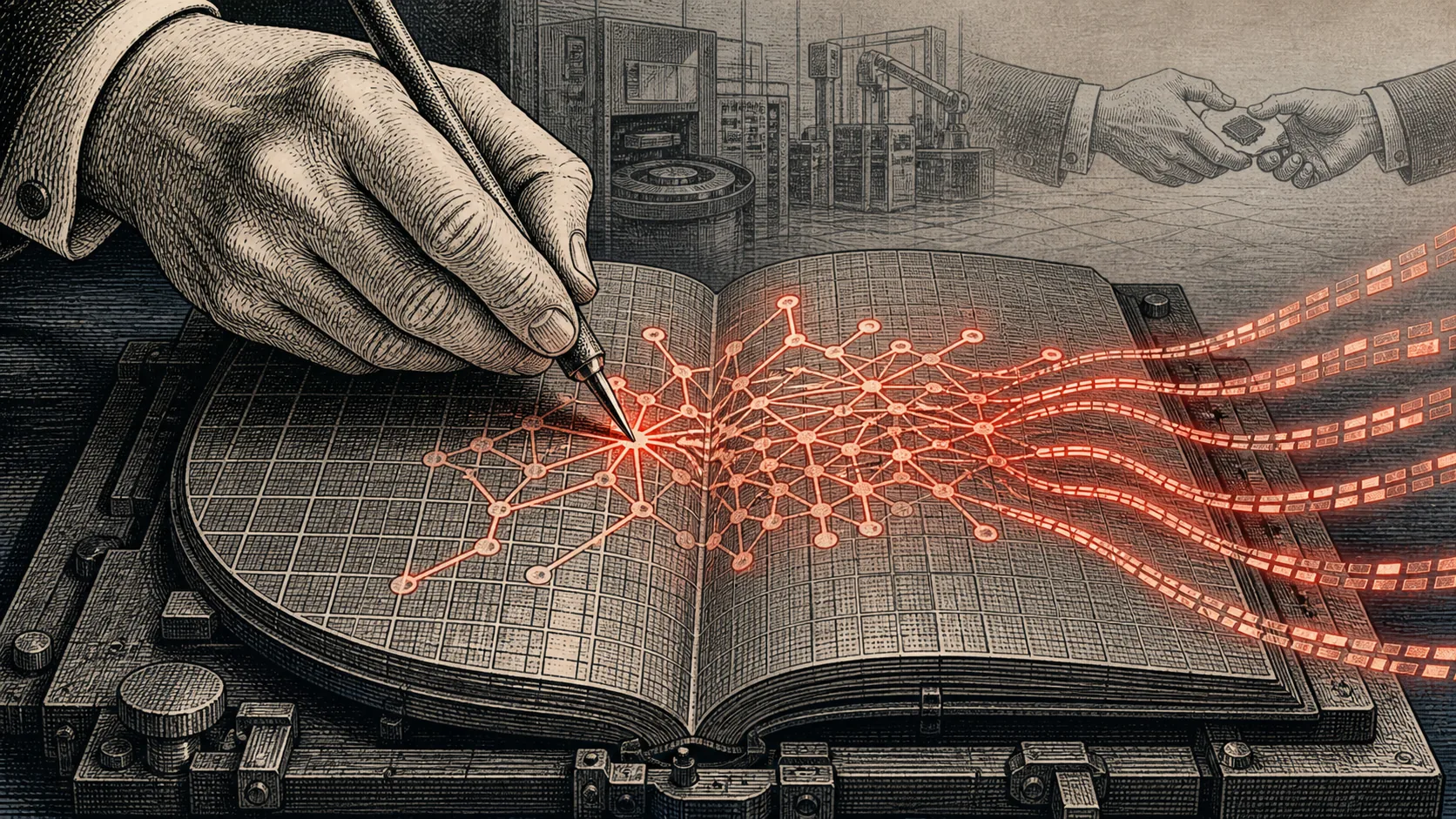
Taalas’ approach differs from conventional GPUs, Groq LPUs and Cerebras waferscale accelerators because its chips do not use HBM to store model weights. The weights are etched into silicon, making the chips model-specific integrated circuits, or MSICs (chips built for one model). In February, Taalas revealed its first HC1 test chip, made on TSMC’s 6nm process, and reported that it served Meta’s Llama 3.1 8B at 16,960 tokens a second. At that announcement, the result was 48x faster than Nvidia's GPUs and 8.5x faster than Cerebras' accelerators.
Taalas has said little publicly about how the processors work, but the article says they contain two main regions: a mask-ROM recall fabric where model weights are etched and an SRAM recall fabric where KV caches and fine-tuning adapters are stored. Its second-generation HC2 chip, due out this summer, is meant to raise capacity to 20 billion parameters. At 20 billion parameters per chip, a trillion-parameter model would need 50 accelerators, and AMD has rack-scale compute platforms that could hold that kind of system.
AMD is expected, according to the article, to pair Instinct-based Helios racks with chips based on Taalas technology. That setup would use GPUs for compute-heavy prompt processing and Taalas-based accelerators for token generation. AMD SVP of AI Vamsi Boppana said AMD is building “a full-stack AI platform” so customers can use the right compute for each AI workload.
The main limitation is that a deployed Taalas chip is tied to the model etched into it. Any change larger than something like a LoRA adapter would require a chip re-spin, which is expensive and time-consuming. The startup says the process is not a full restart because only two layers of metal must change. The article says model developers, infrastructure providers and some inference providers are the likely users, and Taalas told The Next Platform in February that etching model weights into silicon is 100x less expensive than training a frontier model.
The article says the acquisition could affect model development because lower cost per token and higher output speeds may support more test-time scaling, a method that lets a model spend longer before answering. Test-time scaling uses more tokens, making it costlier and slower for chatbots, code assistants and agents. If Taalas-based systems reduce cost per token and improve output speeds by 10x or 20x, model developers may extend reasoning time further. The acquisition is expected to close in the fourth quarter, subject to regulatory approval.