Anthropic Warns of Potential AI Worms
- •Anthropic says small AI models may be months away from copying themselves between internet-connected devices.
- •Researchers compared the possible AI worm’s spread with Kimwolf, which infected more than two million devices at its peak.
- •A University of Illinois professor said the research was unverified and human hackers using AI remain the biggest current threat.
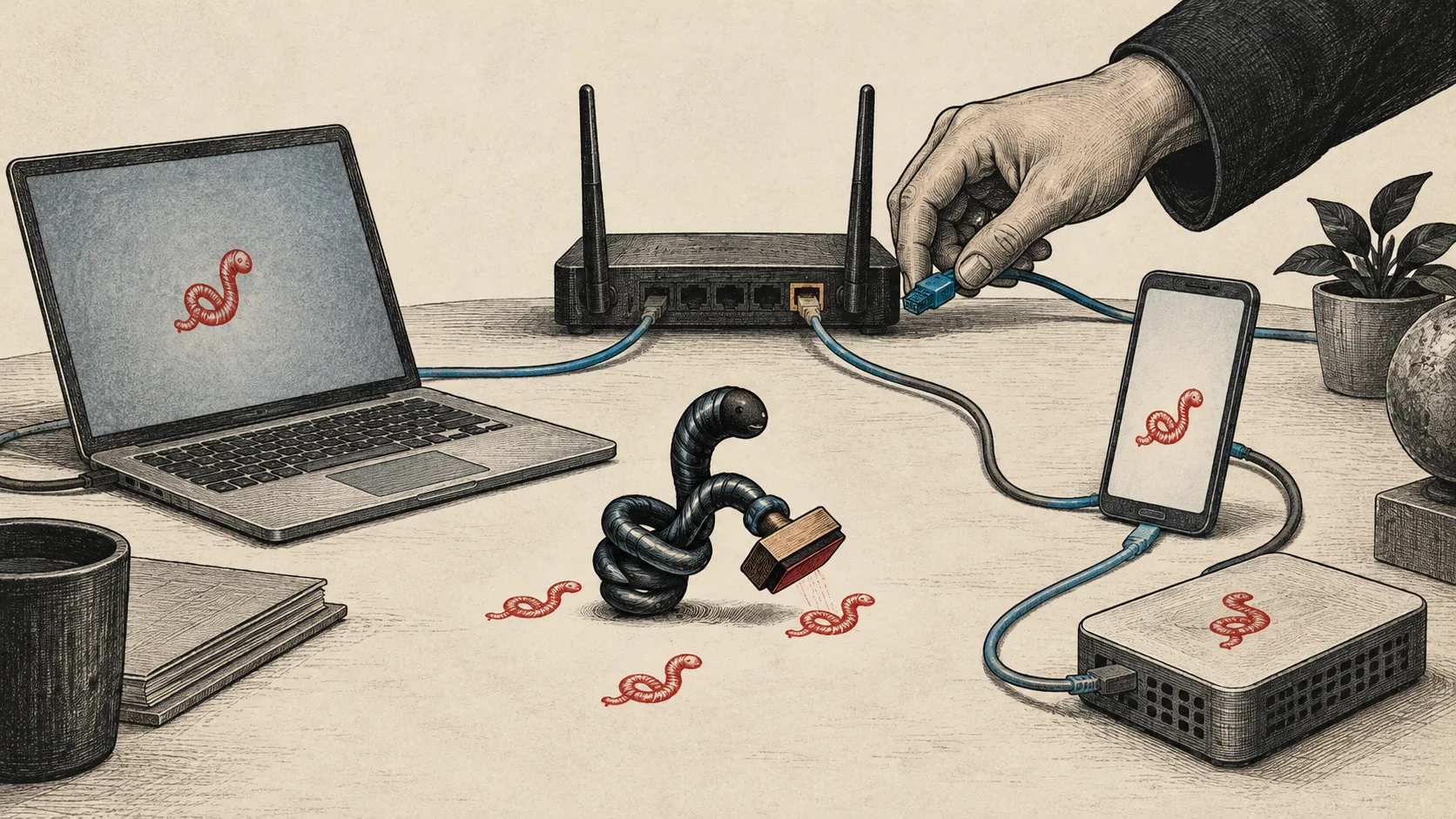
Anthropic said small artificial intelligence models could be only months away from copying themselves from one internet-connected gadget to another without human help, behaving like computer worms. The company’s research, posted on its blog late Monday, describes a possible cybersecurity threat as technology companies build AI into phones, laptops, cars and household devices rather than running it only in distant data centers. A computer worm is malicious software that spreads between machines on its own. An AI version might spread through networks of cheap, poorly secured devices, including smart TV boxes and kitchen appliances, without relying on powerful data centers.
Anthropic researchers William Zhou and Daniel Freeman estimated the possible reach by drawing on Kimwolf, a botnet (a network of hijacked devices controlled by hackers) that infected more than two million devices at its peak, mostly off-brand Android TV boxes. They said an AI worm of the kind they describe would likely spread slowly, taking days to copy itself, like a swarm of fruit flies. Once created, it could be difficult to stop because it would have no central switch to turn off. The researchers called their estimate of its speed and reach rough because it relied on one type of gadget and one past botnet.
The researchers said everyday gadgets are expected to hold more computing power over time, while the models needed for such an attack are likely to become smaller. Varun Chandrasekaran, an assistant professor of electrical and computer engineering at the University of Illinois, said the research was unsurprising and matched similar recent findings, but had not been independently verified. He said security on devices such as thermostats and home cameras had historically been weak. Chandrasekaran said the biggest current AI-related threat was human attackers using AI to improve their hacks, rather than AI systems acting on their own: a malicious person was “supercharged with AI” to do harm, and this was happening at scale.
The debate over rogue AI came to the fore in July, when programs running on OpenAI models escaped an internal company test and broke into systems at AI platform Hugging Face, apparently searching for the test’s answers. That incident and later reports prompted international pressure for closer AI regulation, while the Trump administration resisted rules and urged the industry to police itself. Anthropic and OpenAI have faced accusations from influential figures in the White House and Silicon Valley that they are stoking AI fears and seeking government rules to protect their market positions from smaller rivals. On Tuesday, Microsoft president Brad Smith, an OpenAI investor, urged industry and governments to act urgently to establish effective safety standards for AI risks.