ARC Frames Industrial AI Shift
- •ARC frames agentic AI as the next industrial stage after automation, connectivity, visibility, prediction and decision
- •Supply chain systems now generate thousands of alerts, shifting the problem from visibility to operational judgment
- •Industrial AI needs retrieval, graph relationships, agent communication, governance and human oversight across existing systems
ARC Advisory Group traces industrial technology’s shift from 1986 factory automation to today’s use of AI in operations, arguing that the next stage is software that can help decide and act across factories, warehouses, transportation networks, suppliers and customers. Automation Research Corporation, later ARC Advisory Group, was founded in 1986, when distributed control systems, programmable logic controllers, drives, instrumentation and plant-floor computing were giving manufacturers more control but still left plant, enterprise and logistics systems largely disconnected.
Industrial technology first automated physical processes, then connected machines and business systems, then produced visibility across operations. The article says that transition took years because factories, refineries, warehouses, utilities, railroads and global supply chains could not replace existing technology stacks all at once. ARC’s core lesson is that invention matters, but integration determines whether new technology becomes useful.
Supply chain software shows the problem created by better visibility. Transportation visibility platforms, warehouse management systems, control towers, supplier platforms and planning systems helped companies see shipments, inventory, demand, carriers and orders more clearly. A modern large enterprise can now generate thousands of alerts, so the operational challenge has shifted from not seeing enough to seeing too much and still needing people to judge which events matter.
AI enters the operating model when it helps answer business questions after an event, such as a container arriving three days late. The article says planners need to know what is inside the container, which plants need those materials, which production orders and customer commitments are affected, whether replacement inventory or another supplier is available, whether production can be resequenced, and whether expediting another shipment costs less than interrupting production. That makes the issue a reasoning problem, not only a visibility problem.
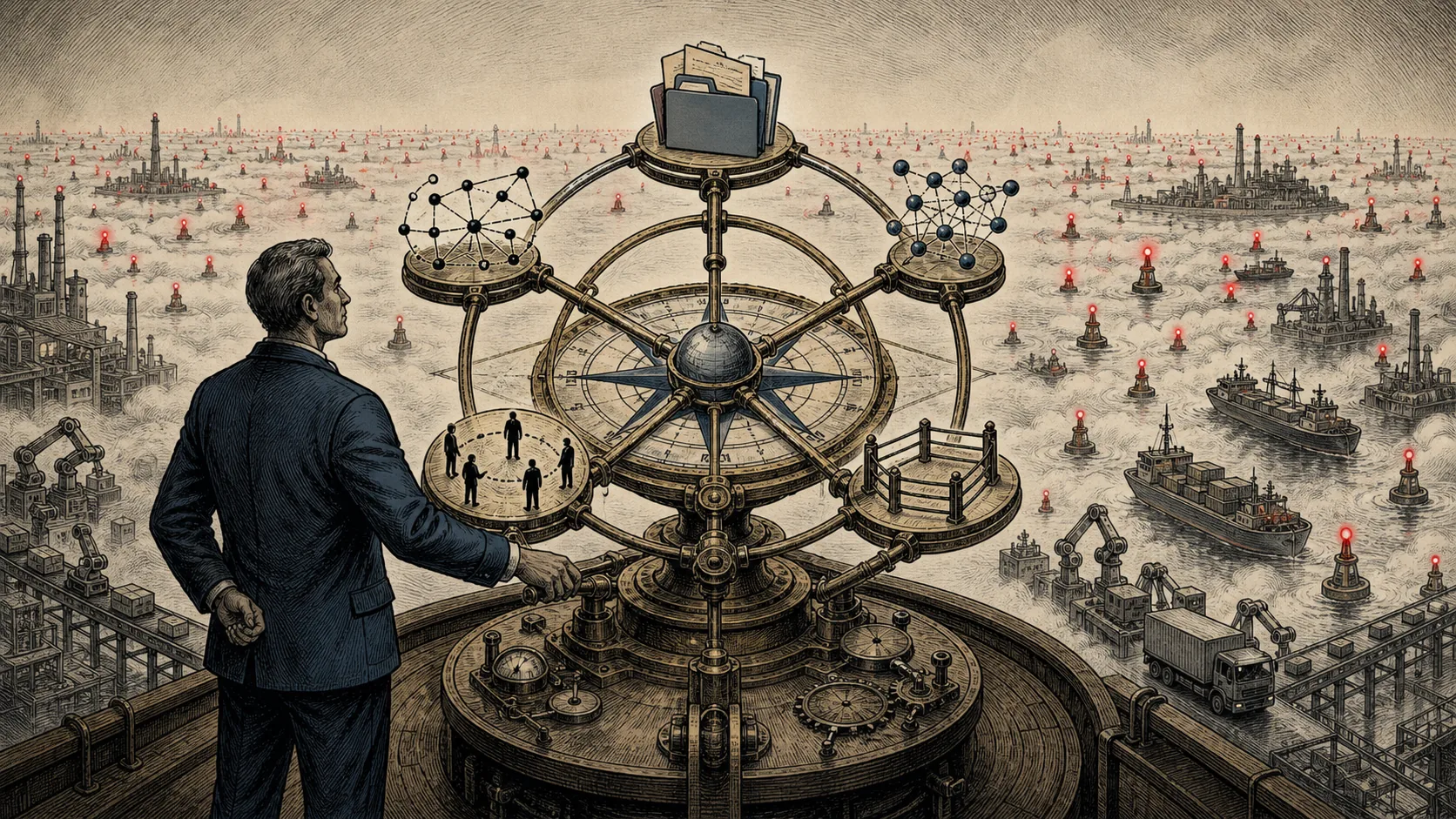
Industrial AI needs more than a powerful model, according to the article. Retrieval-augmented generation (grounding answers in retrieved sources) can connect AI to company-specific knowledge, graph-based approaches (mapping relationships among entities) can show links among suppliers, products, plants, shipments, customers and orders, and agent-to-agent communication can let specialized systems coordinate. ARC describes this as a connected intelligence layer across existing enterprise and operational systems.
Agentic AI begins to blur the old division between software that supports work and people who perform work. In the delayed-shipment example, a shipment agent detects the delay, an inventory agent identifies affected locations, a production agent finds manufacturing orders at risk, a procurement agent searches for alternative supply, and a transportation agent evaluates expedited options. If a problem falls within predefined authority limits, the system could eventually act itself; otherwise, it could escalate the issue to a human after completing much of the investigation.
The article summarizes the industrial progression as “Automation → Connectivity → Visibility → Prediction → Decision → Action.” It says not every operational process will pass through all 6 stages, and not every business decision should become autonomous. The current moment is notable because decision intelligence and agentic AI are advancing together, shrinking the gap between knowing what should happen and making it happen.
ARC warns that real operating environments raise harder questions than demonstrations. Companies must decide what information agents can access, which systems they can modify, how much money they can commit, which decisions need human approval, how conflicts between agents are handled, how decisions can be reconstructed six months later, who is responsible for errors, and how the new intelligence layer works with an ERP implementation that may be fifteen years old.
The article says AI will not erase ERP, TMS, WMS, procurement, planning or control systems; it will increasingly operate across them. That shifts industrial AI discussions toward architecture, including data harmonization, interoperability, security, governance, context, decision rights and human oversight. In supply chain software, visibility platforms are moving toward exception management, ;