Bain Urges End-to-End AI Workflow Redesign
- •Bain advocates end-to-end workflow redesign alongside workforce modernization to move organizations beyond scattered AI pilots.
- •A UK bank reduced customer-engagement workflow teams from up to 40 specialists to groups of three to four.
- •The bank built an agentic AI workflow within four months after processes had taken 60 to 100 days and over 10 handoffs.
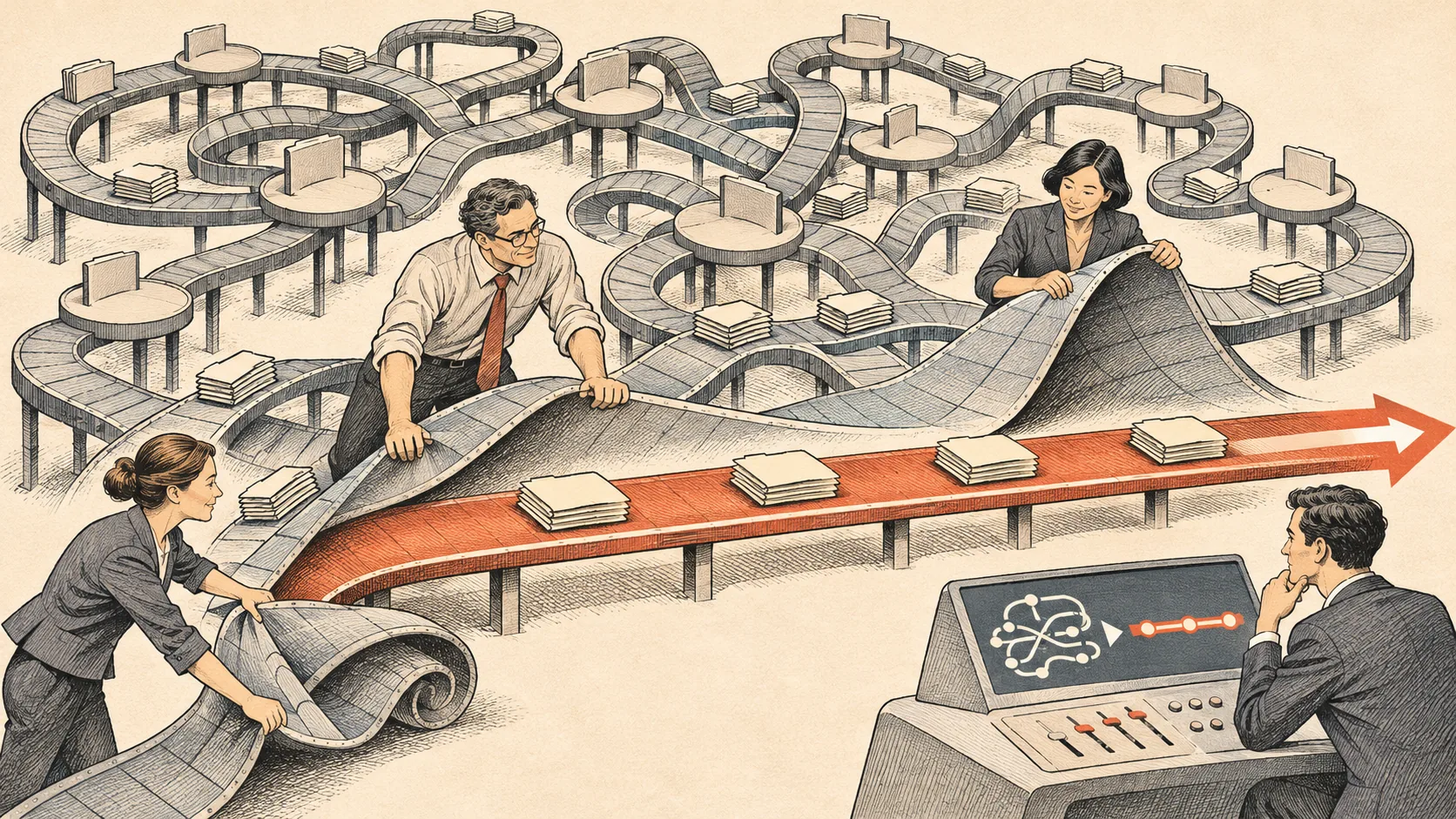
Organizations often modernize work in disconnected efforts: finance and procurement rethink sourcing, technology teams automate, operations pursue efficiency, and HR handles reskilling, staffing levels, and engagement. This fragmentation can create duplicated work, missed dependencies, resistance, uneven adoption, and repeated disruption for employees. Bain argues that companies should redesign workflows and workforce plans together, moving beyond scattered AI pilots to end-to-end changes that combine off-the-shelf and custom technology.
Executives should begin with the work: what to stop or simplify, what better serves customers, and where AI could deliver an order-of-magnitude improvement. The article recommends focusing on a few critical workflows with clear outcomes and one accountable owner, using fit-for-purpose data products and buying or partnering before building custom tools where they offer a real distinction. It also warns against automating problematic processes. “Workflow debt”—unnecessary meetings, approvals, handoffs, exceptions, and one-off policies—can make tasks harder; AI may amplify that complexity. AI agents need clear rules, stable handoffs, and aligned decision rights.
Bain says companies should set integrated goals for customer experience, service quality, cost, and speed, then decide which tasks humans do, which they do with AI assistance, and which AI agents can run autonomously. The approach also calls for cross-functional teams, workforce planning and training, trust-building through clear communication and redeployment, and embedding new workflows and performance standards in enterprise systems.
A leading UK banking group cut the time to test or deploy a customer-engagement idea from 60 to 100 days and more than 10 handoffs to a target of one day. Within four months, its data-products and digital-channels teams built a workflow combining the bank’s technology foundation with agentic AI for complex reasoning and problem-solving. The bank replaced specialized teams of up to 40 people with groups of three to four full-stack problem solvers. Reskilling and hiring filled the roles; employees embraced the project partly because the bank emphasized training and empowerment rather than head-count cuts. The changes are helping marketing become a continuous learning system, with AI finding customer-behavior insights and people identifying what resonates. Bain’s stated lesson is to redesign high-value workflows end-to-end while modernizing the workforce in parallel.