Biohub Expands Virtual Cell Initiative to $1.8 Billion
- •Biohub expands its virtual-cell AI initiative with U.S. agencies, Google DeepMind, and other research organizations participating.
- •The collaboration totals $1.8 billion; Google DeepMind, Isomorphic Labs, and Meta are contributing $300 million combined.
- •DOE plans to invest more than $500 million over five years, while NIH will provide data supported by more than $500 million in prior federal investment.
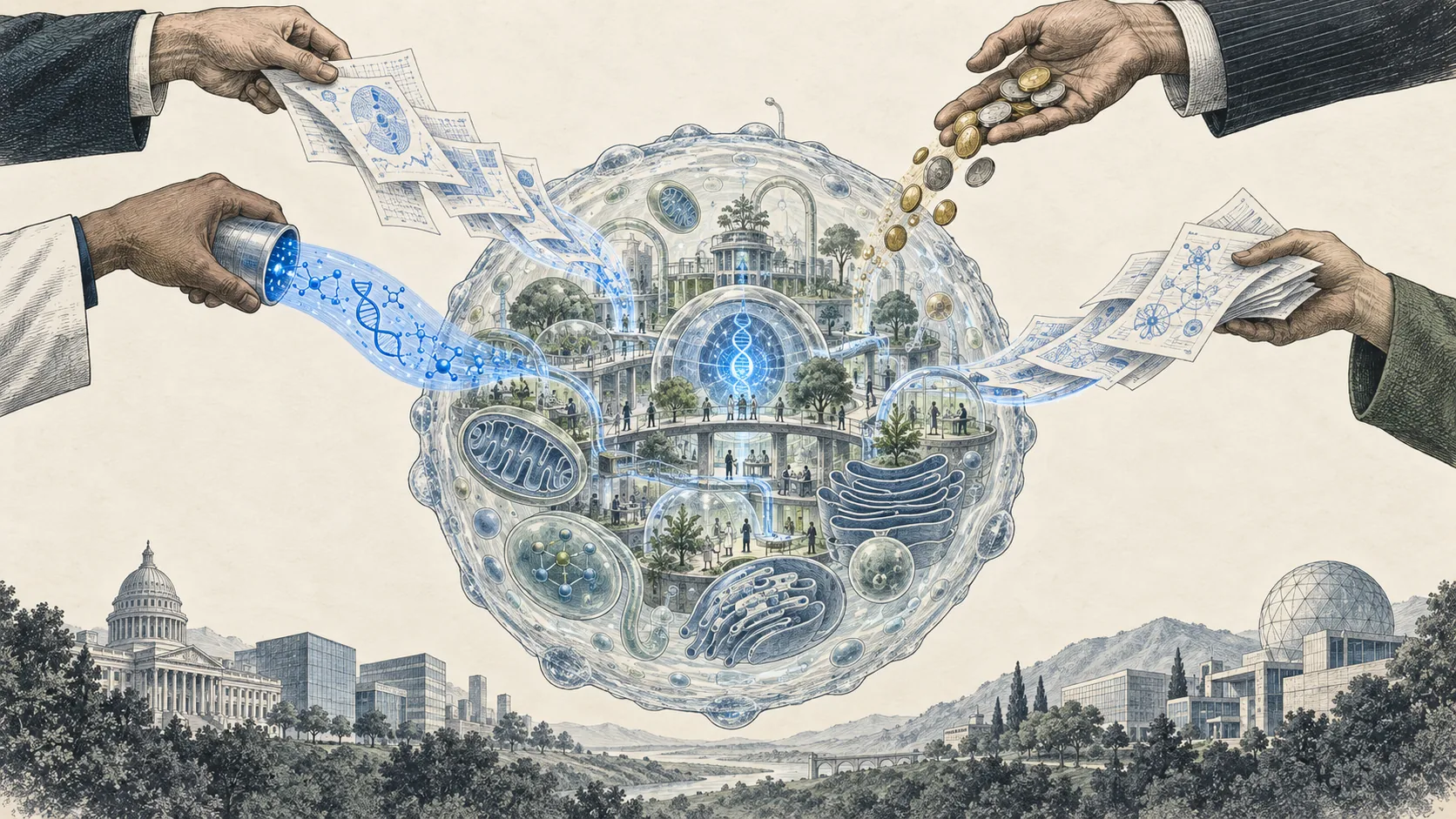
Nonprofit research organization Biohub announced on October 7, 2026, an expansion of its five-year Virtual Biology Initiative, which supports AI models that predict how cells work. The U.S. Department of Energy (DOE), National Institutes of Health (NIH), Google DeepMind, Isomorphic Labs, Meta, and others are participating. Their combined funding, data, computing resources, and measurement technology amount to a $1.8 billion collaboration.
Biohub was co-founded by Meta’s Mark Zuckerberg and physician Priscilla Chan. The initiative will build a large body of experimental data showing how cells respond to interventions, such as drug treatments, and changes in conditions, then create an open data platform for researchers worldwide. Its goal is a “virtual cell” that predicts cell functions and responses to change on computers. If achieved, it could help researchers examine biological questions computationally and narrow down candidates to test in the lab. Training such models requires measurements of cell responses across far more cell types and conditions than are available today.
Biohub first announced the initiative on April 29, 2026, and pledged $500 million over five years. It allocated $400 million for internal technology development and large-scale data generation, and $100 million to support external research. Biohub plans to develop cryo-electron tomography, a method for capturing frozen samples in three dimensions, to observe fine structures inside cells, as well as microscopy techniques for imaging many cells in living tissue. It intends to make the resulting data freely available.
Google DeepMind, AI drug discovery company Isomorphic Labs, and Meta are now contributing a combined $300 million to help build the technologies and datasets needed for predictive models of life. DOE’s Office of Science, NIH, and Biohub signed a memorandum of cooperation. DOE plans to invest more than $500 million over five years in cell research data collection, AI analysis, laboratory measurement and imaging, modeling, and computing.
DOE’s effort is part of the Genesis Mission, which aims to accelerate scientific research with AI. It will use national laboratory exascale supercomputers, X-ray and neutron scattering, cryo-electron microscopy, and autonomous laboratories. NIH will coordinate the provision of related datasets, storage infrastructure, and knowledge bases developed through more than $500 million in past federal investment, and work with Biohub to standardize data for AI training.
The announced $1.8 billion is not all new funding; the collaboration’s total also includes existing data and computing resources. Participants include the Allen Institute, Broad Institute, Gladstone Institutes, Human Cell Atlas, Human Protein Atlas, and Wellcome Sanger Institute. NVIDIA is contributing computing infrastructure, specialized software, and technical expertise. Biohub will standardize formats and identifiers across institutions and establish a single access point so their data can be combined.