Brazil Courts Data Centers With Renewable Power
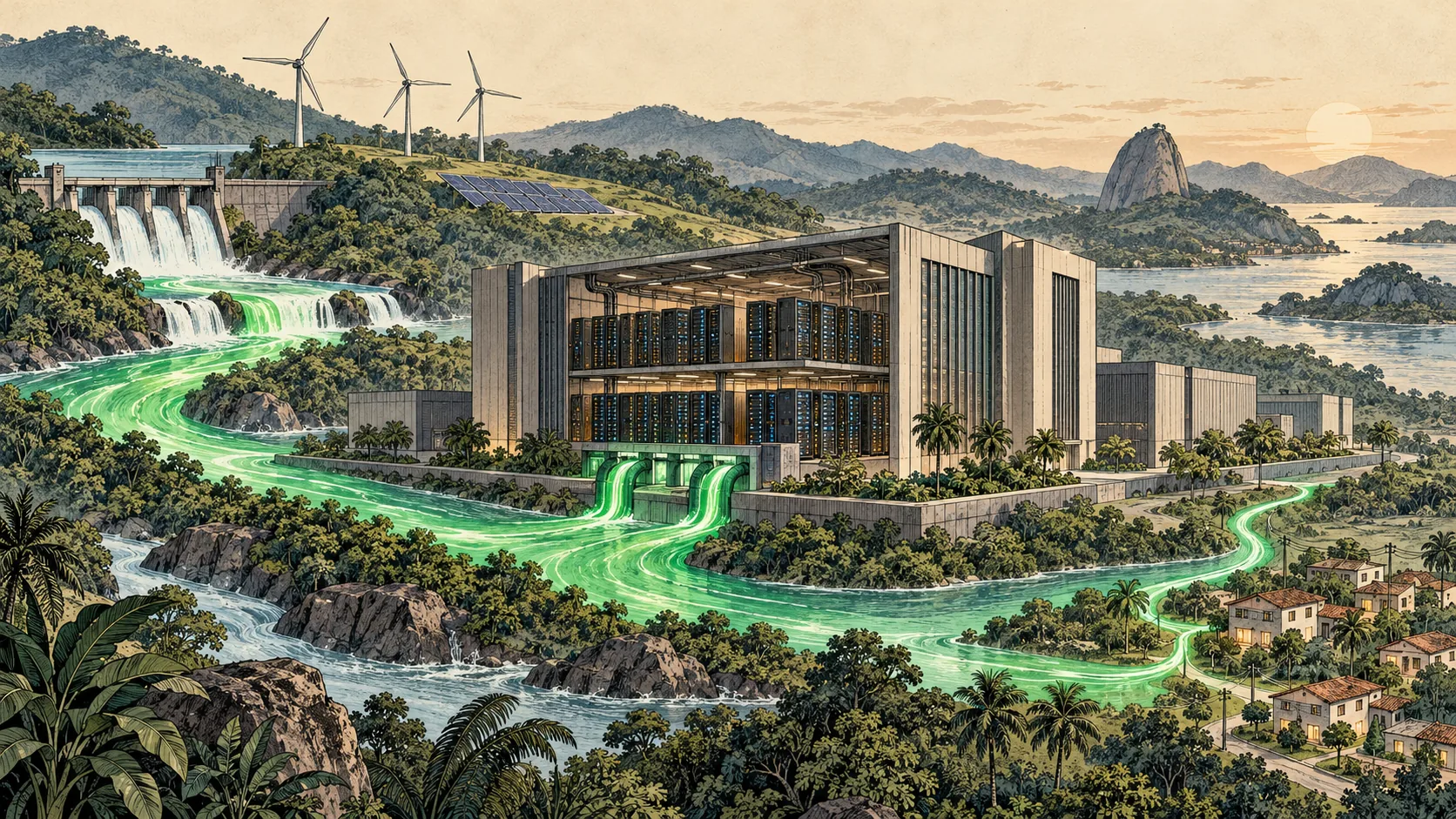
- •After securing reelection, Lula said Brazil would use renewable energy to attract data centers and build its own AI.
- •Redata offers tax relief if facilities use renewable or low-emission power and reserve at least 10% of service capacity for Brazil’s domestic market.
- •Brazil’s energy plan projects data centers will use 30 TWh annually by 2036; renewables supplied more than 86% of electricity in 2025.
Brazilian President Luiz Inácio Lula da Silva said on the 25th, in his first speech after securing reelection, that the country would use its renewable energy resources to attract data center investment and keep Brazilian data stored and processed at home. He said Brazil should reduce its dependence on AI technology from China and the United States and develop its own AI, with some data center capacity reserved for processing and storing Brazilian information. He named training in mathematics and engineering, along with investment in the digital and green economies, as priorities for his new term.
The government enacted Law No. 15.504 on September 15, establishing Redata, a special tax incentive program for data centers. It covers companies building new centers in Brazil or modernizing or expanding existing facilities, including sites for cloud computing, high-performance computing, and AI model training and inference. When buying or importing equipment, companies can defer PIS/Pasep, Cofins, the Industrialized Products Tax (IPI), and import duties under certain conditions. Deferred taxes may receive a zero rate if companies meet their legal obligations.
To qualify, data centers must source all their electricity from renewable or low-emission generation. They may sign supply contracts or use their own generation facilities, with solar, wind, and hydropower among eligible sources. Participating companies must generally ensure that at least 10% of their data processing and storage service capacity can serve Brazil’s domestic market. They may substitute an additional investment equal to 10% of equipment purchases in research, development, and innovation for that obligation. Separately, they must invest 2% of equipment purchases in Brazilian research, development, and innovation projects, and cooling systems must meet water-efficiency standards.
The Brazilian Energy Research Office (EPE) said in its National Energy Balance report, published in June, that renewable sources accounted for more than 86% of electricity supply in 2025. Solar generation reached 88.1 TWh last year, up 24.7% from the previous year, while installed capacity rose 33.7% to 64.79 GW. Wind generation increased 8.2% to 116.5 TWh, and solar and wind together made up 26.4% of total generation.
A 10-year energy expansion plan through 2036, released on the 26th by the Ministry of Mines and Energy and EPE, projects data centers will consume 30 TWh of electricity annually in 2036. New large sources of demand—including data centers, electric vehicles, and water-electrolysis hydrogen facilities—are projected to use about 47 TWh combined, more than 10 times this year’s expected level. Brazil’s total electricity consumption is forecast to reach 979 TWh in 2036, while consumption supplied by the power grid is projected to rise from about 620 TWh this year to 878 TWh.
Data center investment could create opportunities for solar and wind developers through long-term power purchase agreements (PPAs) and new generation projects. But the need for reliable electricity means site selection and investment scale depend on grid connection capacity, transmission and distribution infrastructure, and supply reliability. Lula did not announce investment amounts, construction scale, or targets for expanding dedicated solar plants in his speech.