Companies Pull Back After Rapid AI Rollouts
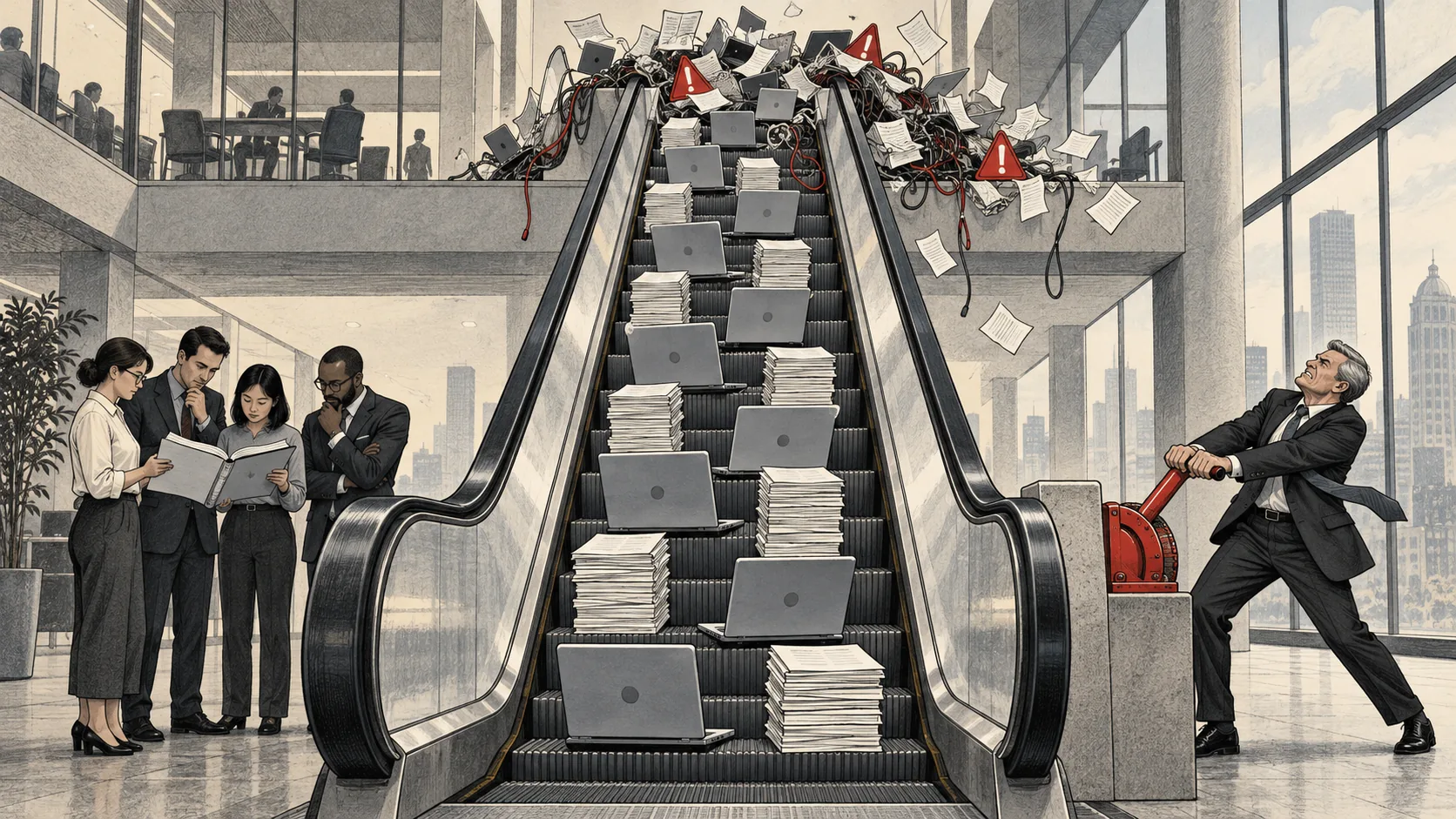
- •Rapid AI adoption brought errors, low-quality work, costs, and security risks, leading some employers to restrict tools and expand training.
- •90% of executives reported no productivity gains yet; 36% of senior AI executives reported an AI incident.
- •More than 112,000 US job cut announcements in 2026 mentioned AI, while Meta dropped AI usage from performance reviews.
Companies that adopted AI rapidly are facing errors, low-quality work, rising costs, and privacy and security risks, prompting some to restrict employee use, restore experienced roles, and expand training. In the United States, 90% of executives said AI efforts had not yet produced productivity gains at their companies, according to an Atlanta Federal Reserve working paper. An Ernst & Young survey published last month found that 36% of senior AI executives at companies with at least $1bn in annual revenue reported an AI incident involving data loss, financial or brand damage, or operational disruption.
Meta scaled back plans to cut staff and use more AI agents after employees spent increasing time fixing technical and security errors, Reuters reported. After reducing its workforce, especially middle managers, in a 2023 efficiency push, Meta is expanding managerial ranks again, according to employees’ LinkedIn posts. Microsoft executive vice-president Ryan Roslansky described receiving an AI-generated document from a colleague, then using AI to summarize it without gaining new ideas. He warned of a “doom loop” in which AI handles reading and writing and produces an “ocean of sameness.” Walmart store and warehouse workers have reported unreasonable targets, inaccurate task assignments and schedules, and false alerts from AI tools, Business Insider reported.
Microsoft and McKinsey are limiting employee use as growing consumption of AI tools weighs on costs. Reuters reported that Palantir, Booz Allen Hamilton, and Nvidia are restricting use over concerns about exposing organizational data to AI companies. Microsoft’s Kathleen Hogan said the company learned that access and usage alone do not equal transformation. Employers are shifting from one-off webinars to sustained, role-specific training, according to Society for Human Resource Management chief Johnny C Taylor Jr. An Indeed survey published in July found that more than half of employees said they lacked needed AI training; just 45% of managers felt equipped to lead employees with AI skills. Microsoft said pairing early-career engineers with experienced colleagues boosted productivity.
University of Pennsylvania management professor Jessica Reif said AI can produce plausible-looking work with hidden weaknesses, allowing errors to spread through workflows. A court case involving 3M showed the risks of AI-assisted professional work: attorney Will Moye said an expert report appeared to have been assembled from 14,500 pages in hours and suspected its author had relied on ChatGPT. The jury found 3M had failed to inspect a gas detection system properly and ordered it to pay $61.5m to 24 homeowners. 3M said the expert independently reviewed the facts and used AI in preparing his report; his lawyer said ChatGPT helped with formatting, structuring, and drafting, not his opinions or professional judgment.
A University of Pittsburgh study published in May concluded that productivity did not rise after companies invested in AI and cut staff. More than 112,000 US job cut announcements so far in 2026 mentioned AI, according to Challenger, Gray & Christmas. Meta paused tracking employee computer activity to train AI earlier this year, Reuters reported, and later told employees that AI adoption and usage would no longer count in performance reviews, The Information reported. Pittsburgh researcher Mark Ma said some managers had learned from rushing to invest in AI and lay off workers; he also said company share prices tend to fall after AI-related layoff announcements.