FilmFlow Plans Camera Moves for 3D Scenes
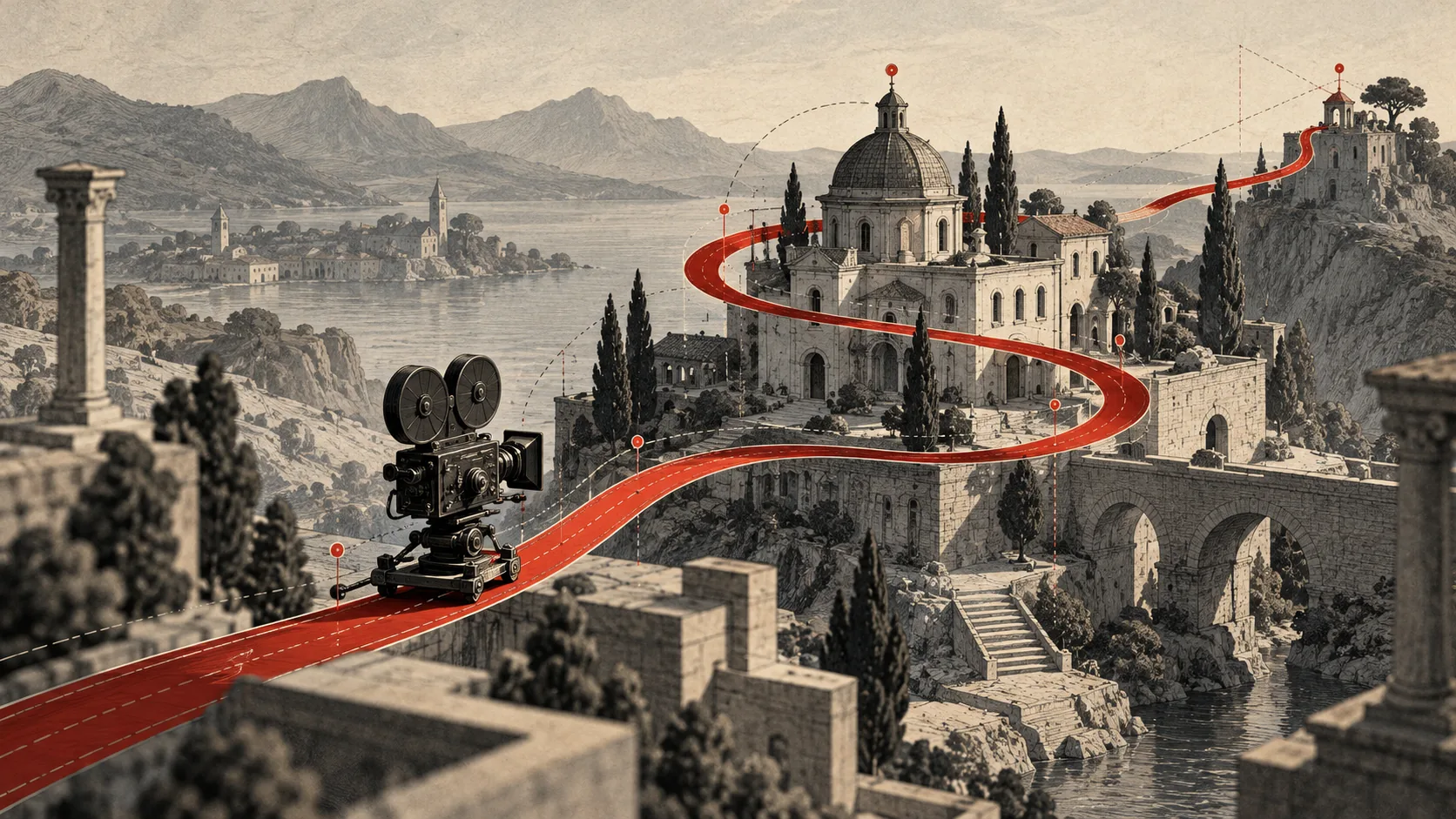
- •Researchers present FilmFlow, an agentic framework that turns text instructions or reference videos into 3D camera trajectories
- •Its Director, Interpreter, Scout and Critic agents plan camera motion, select viewpoints and refine rendered results
- •CinemaBench includes 150 Blender scenes, 750 text-directed tasks and 60 reference videos; FilmFlow leads evaluated baselines
Researchers introduced FilmFlow, an agentic framework that turns natural-language instructions or reference videos into executable camera trajectories for dynamic 3D scenes. The system targets camera movements that can be controlled and carried out in a virtual scene, translating cinematographic intent into camera plans.
FilmFlow’s Director agent builds camera plans by combining high-level motions from concurrent atomic operations, which jointly control translation, rotation and framing. Three other specialized agents support it: an Interpreter extracts cinematographic intent grounded in the scene, a Scout chooses initial viewpoints, and a Critic evaluates rendered results and supplies visual feedback for iterative plan refinement.
The researchers also introduced CinemaBench, a dataset of 150 Blender scenes drawn from self-created and licensed sources. Each scene has five camera instructions, making 750 text-directed tasks; 60 reference videos are associated with a subset of the scenes. The benchmark tests both camera generation from text and camera generation guided by a reference video.
Across a diverse set of evaluated baselines, FilmFlow achieved the strongest benchmark performance and the highest user preference, according to the researchers. They say the results demonstrate spatial reasoning, temporal coordination and visual composition for executable 3D cinematography. The source provides no numerical scores for the benchmark comparison.