Google DeepMind Introduces Gemini 4 Argon
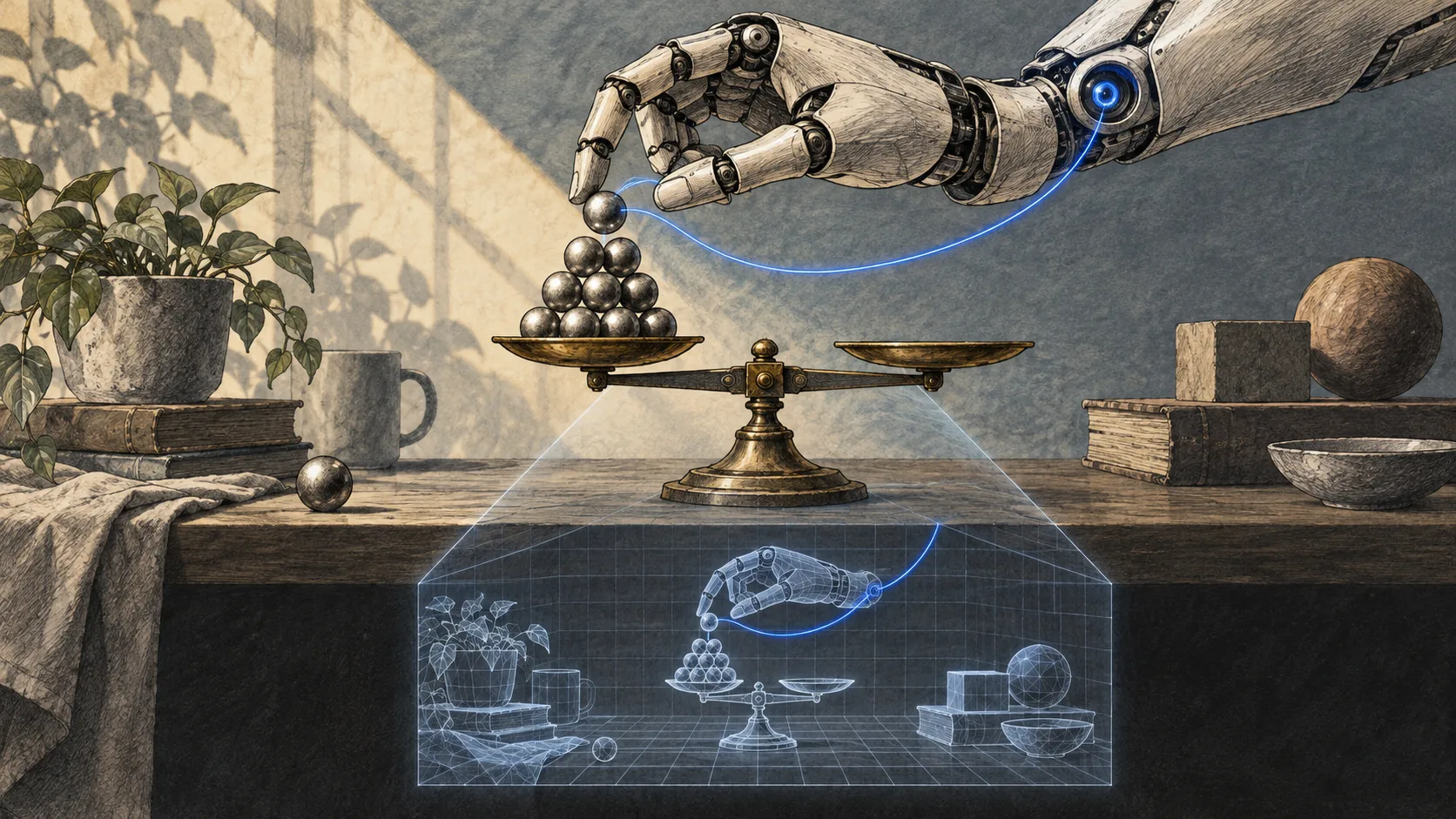
- •Google DeepMind introduces Gemini 4 Argon for physical reasoning across robotics tasks
- •Argon scores 87% on ERQA and controls robots through simulation practice and visual feedback
- •Examples include Real2Sim reconstruction, video labeling and a 12-ball balance-scale puzzle
Google DeepMind introduced Gemini 4 Argon on Oct. 13, 2026, describing it as a general-purpose physical reasoning model for robotics. The company says Argon marks a step change in physical understanding, code generation and visual-semantic reasoning, and can support workflows across the robotics stack. On the Embodied Reasoning (ERQA) benchmark, which tests solving physical and spatial problems in 3D environments, Argon scored 87% using pure reasoning, outperforming every other frontier model.
DeepMind describes Argon applications in four areas: robot control, Real2Sim reconstruction, physical understanding, and research and self-improvement. For robot control, it says Argon can operate a Boston Dynamics Spot quadruped with 12-DoF legs and a 6-DoF arm. In a trash-disposal example, Argon creates a MuJoCo digital twin of a foot-pedal bin, practices stepping on the pedal, then uses the physical robot to drop soda cans inside. A separate zero-shot control example has a robotic arm right a fallen mug and place a crumpled napkin inside, using visual coordinates and action primitives over several turns. Argon also guides a video world model through an iterative visual loop to rearrange five Scrabble tiles—G, R, A, N and O—into A-R-G-O-N.
For Real2Sim, Argon reconstructs a MuJoCo simulation from a robot teleoperation episode, tuning object assets and scenes until simulated camera views and contact forces match recorded data. The prompt sets constraints: object motion must come from MuJoCo contact; simulated commands must stay within 0.55 rad for arm joints and 0.65 rad for hand joints of the logged trajectory. A second example turns egocentric human video into a simulated humanoid manipulation task, using 500 Hz physics and a 76-DoF bimanual humanoid with 22-DoF hands. A sketch-to-simulation example describes a 76-DoF humanoid throwing a ball at six boxes, with a 50 Hz, 140-step trajectory lasting 2.80 seconds; the prompt calls for verification of upright balance within 3 cm of pelvis drift and knockdown of all 6 boxes.
For physical understanding, DeepMind says Argon can label manipulation videos at multiple levels. In an ALOHA 2 robot paper-folding example lasting 136 seconds, it produces an episode goal, 6 semantic subtasks, 17 contact-level primitives and quality-control reweighting that keeps progress flat during fumbles and retries. The post also begins a 12-ball balance-scale puzzle example: Argon builds a Franka FR3 MuJoCo environment with visually identical balls, one heavier or lighter, and a two-pan balance. The supplied article text ends during this example.