AlphaFold Team Shifts Toward Gemini Science AI
- •Financial Times reported on July 29, 2026, that the AlphaFold development team had effectively been disbanded
- •About one-quarter of key paper authors left, while John Jumper and 2 others moved to Anthropic
- •AlphaFold access continues, maintaining over 200 million data entries and use across more than 190 countries and regions
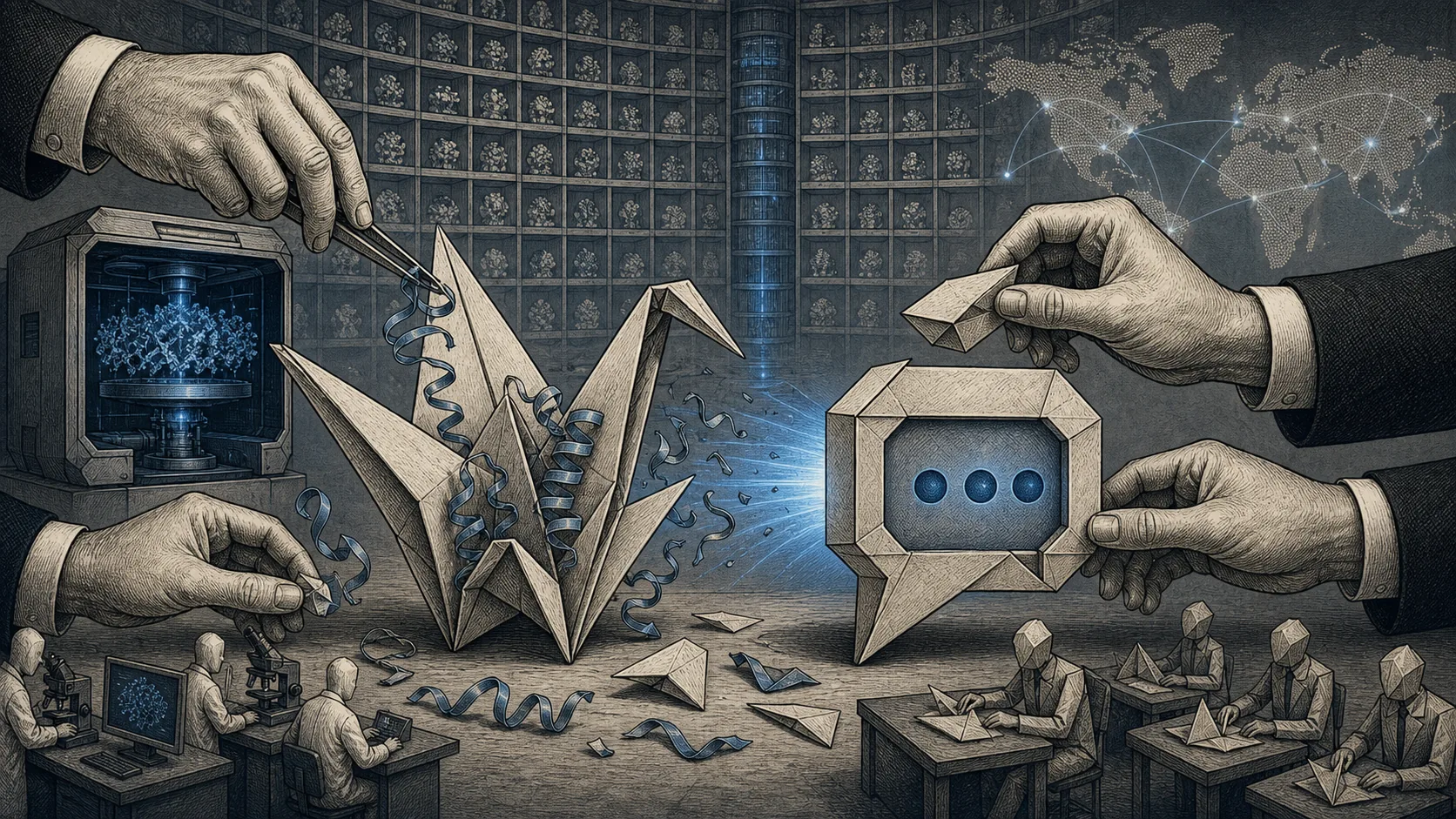
The Financial Times reported on July 29, 2026, that Google DeepMind had effectively disbanded the development team behind AlphaFold, the AI system that predicts 3D protein structures. According to the paper, many researchers who wrote AlphaFold’s key papers moved to other projects over the past year, and about one-quarter of the authors affiliated with Google DeepMind left the company. Google DeepMind has not officially announced a team shutdown, but it acknowledged that researchers have moved to projects based on Gemini, as well as enzyme design, nuclear fusion and genomics.
John Jumper, who led AlphaFold development, announced on X in June 2026 that he was leaving Google DeepMind after about 9 years and would join Anthropic after taking time off. Jumper led the development of AlphaFold 2 with Google DeepMind CEO Demis Hassabis and won the 2024 Nobel Prize in Chemistry alongside David Baker, who researched computational protein design. Jonas Adler and Alexander Pritzel, both involved in AlphaFold, also said on X that they had left Google DeepMind and would join Anthropic. All 3 were authors of the main AlphaFold 2 paper published in Nature in 2021.
The Financial Times said it reviewed the current affiliations of the paper’s authors and found that many had moved to Gemini, enzyme design, nuclear fusion, genomics and Isomorphic Labs, Alphabet’s drug discovery company. Pushmeet Kohli, vice president of research who leads AI for Science at Google DeepMind, said the company had organized research teams over the past 9 years around clear “big problems,” such as protein folding. He said the company is now focusing not only on individual problems but also on building systems that use Gemini to support scientists and automate parts of scientific research.
Google’s “Gemini for Science,” released in May 2026, showed a strategy that emphasizes general-purpose AI agents that support researchers across broad scientific fields, not only models specialized for specific domains. Gemini for Science includes “Hypothesis generation,” where multiple AI agents generate and evaluate hypotheses; “Computational discovery,” which runs large numbers of computational experiments in parallel; and “Literature insights,” which analyzes scientific papers across the literature. “Co-Scientist,” a multi-agent research support AI system, can use specialized models such as AlphaFold as external tools.
No end to AlphaFold development or access has been reported. The AlphaFold Protein Structure Database, operated by Google DeepMind and EMBL-EBI, publishes predicted data for more than 200 million protein structures, and Google DeepMind says AlphaFold is used by more than 3 million researchers in over 190 countries and regions. The AlphaFold Server, which provides access to AlphaFold 3 for non-commercial research, also remains available, while Isomorphic Labs continues applying AlphaFold technology to drug discovery. Kohli said on X that the science team is expanding its scope rather than changing direction.