Google Satellite Receives First AI Response
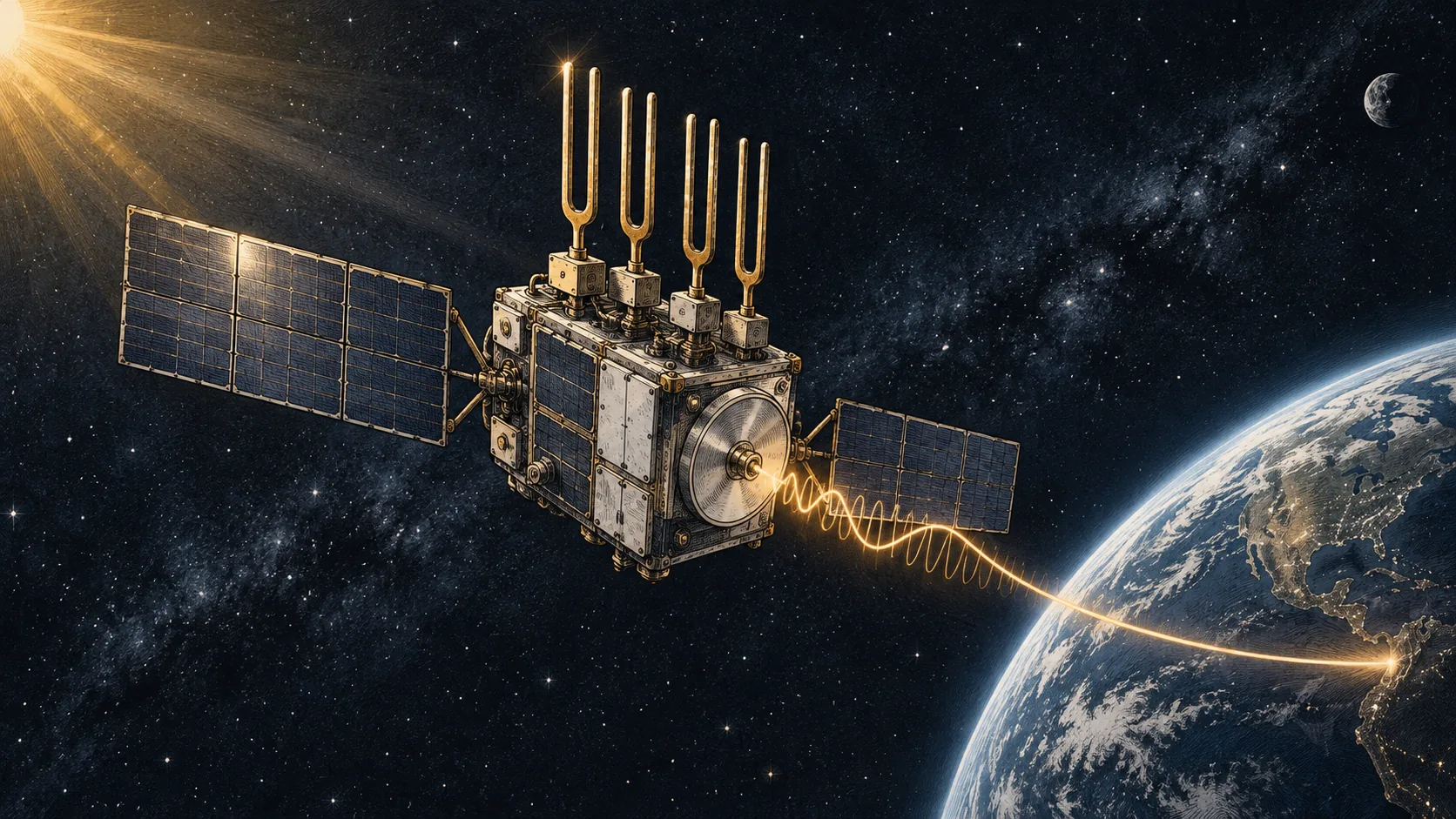
- •Google’s Project Suncatcher prototype satellite received its first AI response in orbit.
- •Four onboard TPUs generated the response using up to 1 kW of power.
- •Google plans to launch twin satellites with higher-performance TPUs next year.
Google said on October 30 local time that it received the first AI response from a prototype satellite for Project Suncatcher, its planned space data center. Ground researchers asked the satellite to write a short poem about what it feels like to be in space using Gemma 4, Google’s open-source AI model. The satellite replied: “Below, a blue marble / Data flowing in quiet grace / Starlight fills my core.”
Google said this was the first AI response generated by a data center-grade Tensor Processing Unit (a chip designed to accelerate machine-learning tasks) operating on a satellite in Earth orbit. The company called it “an important milestone on a long journey toward a cosmic goal.” The prototype carries four TPUs and generates up to 1 kW of power, including through solar power.
Google launched the satellite on October 1 aboard a SpaceX Falcon 9 rocket. After it reached orbit, the team completed three weeks of commissioning and subsystem checks, then began full-scale machine-learning computing tests.
Google plans to continue testing whether the TPUs can compute reliably without data errors amid sharp temperature swings and radiation exposure. After completing technical validation, the company plans to launch twin satellites next year equipped with higher-performance TPUs and optical laser communications.
Other participants in the space data center effort include Starcloud, a startup backed by Nvidia, and SpaceX. Experts cite space radiation, maintenance difficulties, data center cooling and space debris as challenges, and say commercial deployment will take more time. The article does not give a specific timeline for commercialization.