HDC Labs Unveils Companion AI Housing Vision
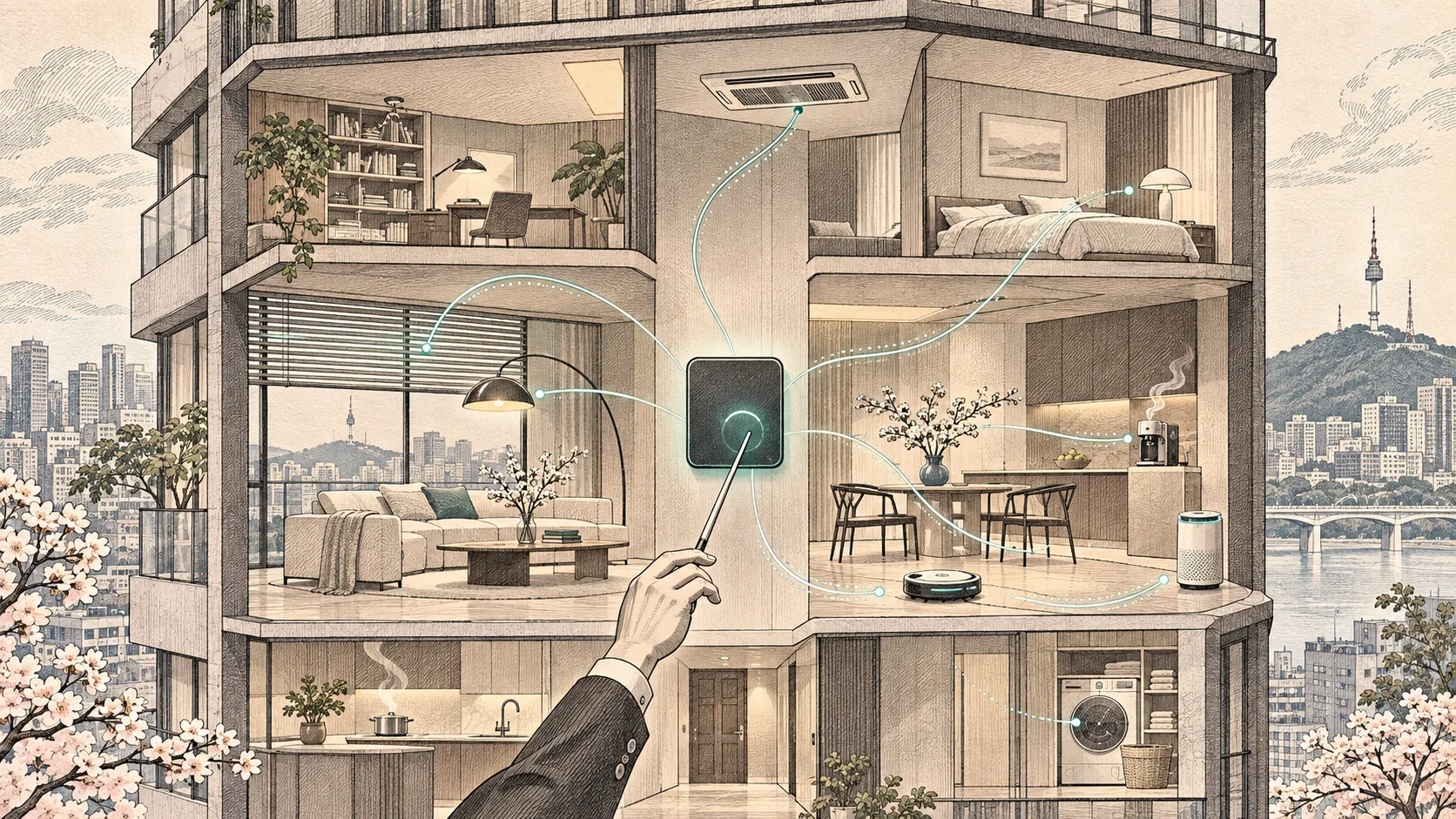
- •HDC Labs unveiled its Companion AI housing vision at a Seoul conference on November 3, describing services that anticipate residents’ needs.
- •The company plans AI services for LeL Upper House, Park Roche Seoul One, and Cheonan IPark City complexes 3 and 4.
- •A government-supported project is testing home AI services that connect wall pads with IoT devices in a residential testbed.
At the Intelligent Home Technology and Service Trends Conference in Seoul’s COEX on November 3, HDC Labs unveiled a housing service vision built around Companion AI, which reads residents’ routines and conversational context to provide services they may need. Presenter Lee Geon-hee, a member of HDC Labs’ AI LAB, discussed applying digital healthcare technology for intelligent homes to residential spaces. He said smart homes should move from responding to commands to understanding residents’ circumstances and proactively offering services.
Companion AI combines smart home automation, health and lifestyle care, and AI assistant functions. It is designed to adjust lighting, heating and cooling, and security; offer lifestyle guidance based on sleep and activity patterns; enable natural-language control of spaces; and manage schedules. In scenarios presented, the system prepares indoor conditions for a resident’s usual wake-up time and alerts a family member designated by the resident when it detects an unusual activity pattern. Other examples included controlling home devices by voice and managing medical appointments.
HDC Labs is implementing and validating intelligent home AI services in residential testbeds. The company is preparing to install a conversational AI wall pad at LeL Upper House, scheduled for completion in June 2027. It plans to bring digital healthcare services and an AI home assistant to Park Roche Seoul One, and announced plans for LLM-based AI wall pads in Cheonan IPark City complexes 3 and 4.
The development and validation work is linked to a project supported by the Ministry of Science and ICT and the Institute of Information & Communications Technology Planning & Evaluation (IITP), titled “Development of Lightweight AI Models Specialized for Intelligent Homes and Service Demonstration.” Led by the Korea Advanced Institute of Science and Technology (KAIST), the project assigns HDC Labs, a joint research and development institution, responsibility for building testbeds based on lived-in homes and developing demonstration scenarios. The company is testing home AI agent services that connect wall pads and IoT devices.
HDC Labs plans to strengthen its spatial solutions business through four AX portfolios: Companion AI; AI video analysis-based smart safety monitoring; intelligent space operations that manage building equipment and energy efficiency; and integrated automation centered on AI agents and robot control. Lee said Companion AI aims to be an everyday companion that learns residents’ routines and provides services when needed, beyond controlling hardware. He said the company would expand its life-care solutions using its spatial infrastructure capabilities and data from on-site demonstrations.