Hitachi Develops GPU Cooling Cold Plate
- •Hitachi develops a cold plate to cool GPUs in data centers.
- •About 40°C water circulates through U-shaped channels; cooling equipment power use is expected to fall by about 30%.
- •The plate is made by stacking dozens of etched copper foils; Hitachi aims to commercialize it after testing on actual equipment.
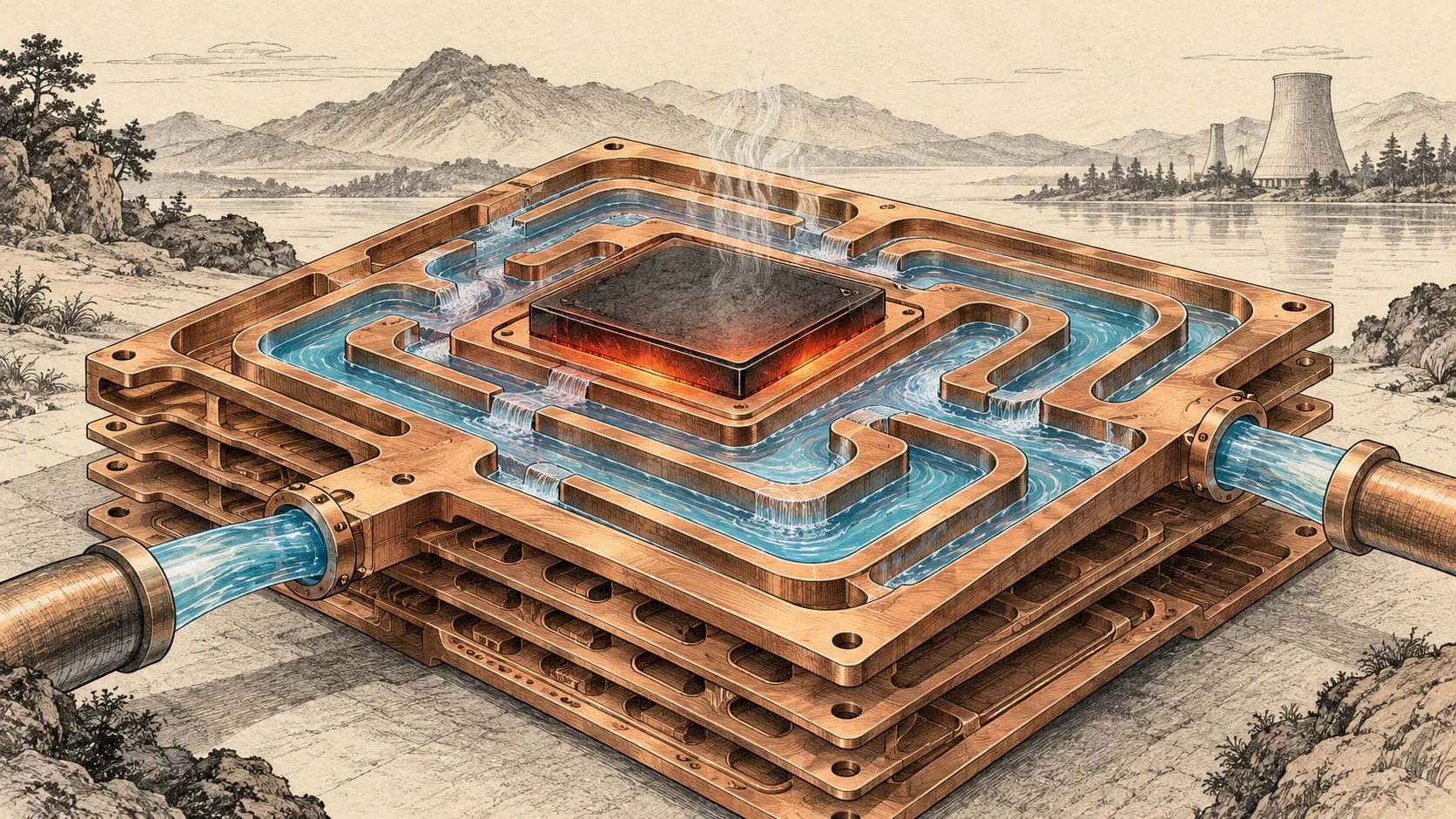
Hitachi Ltd. announced on October 21, 2026, at a press conference in Chiyoda, Tokyo, that it had developed a cold plate (a component that transfers heat from a device to circulating liquid) for cooling GPUs in data centers, where power consumption is rising with the spread of generative AI. Its proprietary “U-shaped tunnel channel” sends cooling water directly to the GPU’s heat-generating areas, where the water absorbs heat, turns around, and flows out.
Conventional designs such as skived fins send water parallel to the GPU surface through long channels, so the water gets warmer toward the outlet. This makes it difficult to cool the GPU evenly and lowers cooling efficiency. Hitachi’s design sends about 40°C water from an inlet chamber vertically through thousands of tiny holes to the heat-generating areas. The warmed water then exits through an outlet chamber. Hitachi says cold and warmed water do not mix inside the plate, helping maintain cooling performance across the GPU.
The structure can cool GPUs efficiently using water at a higher temperature than conventional systems. Higher-temperature water makes it easier to use outdoor air for cooling and reduce reliance on chillers, which consume large amounts of electricity. Hitachi expects the design to cut power consumption across cooling equipment by about 30%.
Kinya Nakatsu of Hitachi explained that manufacturing uses no machining such as cutting metal from a solid block. Instead, dozens of thin copper foils are perforated using an etching process (using chemicals to shape a material’s surface), similar to printed circuit board production, then stacked and bonded with heat and pressure. Changing the number of foils and the hole pattern allows the channel depth and diameter to be adjusted, making cooling performance easier to design. Nakatsu said mass production could also lower costs.
Hitachi describes the announcement as a research and development achievement and aims to commercialize the cold plate as soon as possible, including after testing on actual equipment. The company said it would share detailed structural information and verification results in a later follow-up report. The report says Hitachi is aiming for early deployment as data centers face an urgent need to reduce power consumption.