India Weighs Pragmatic AI Sovereignty
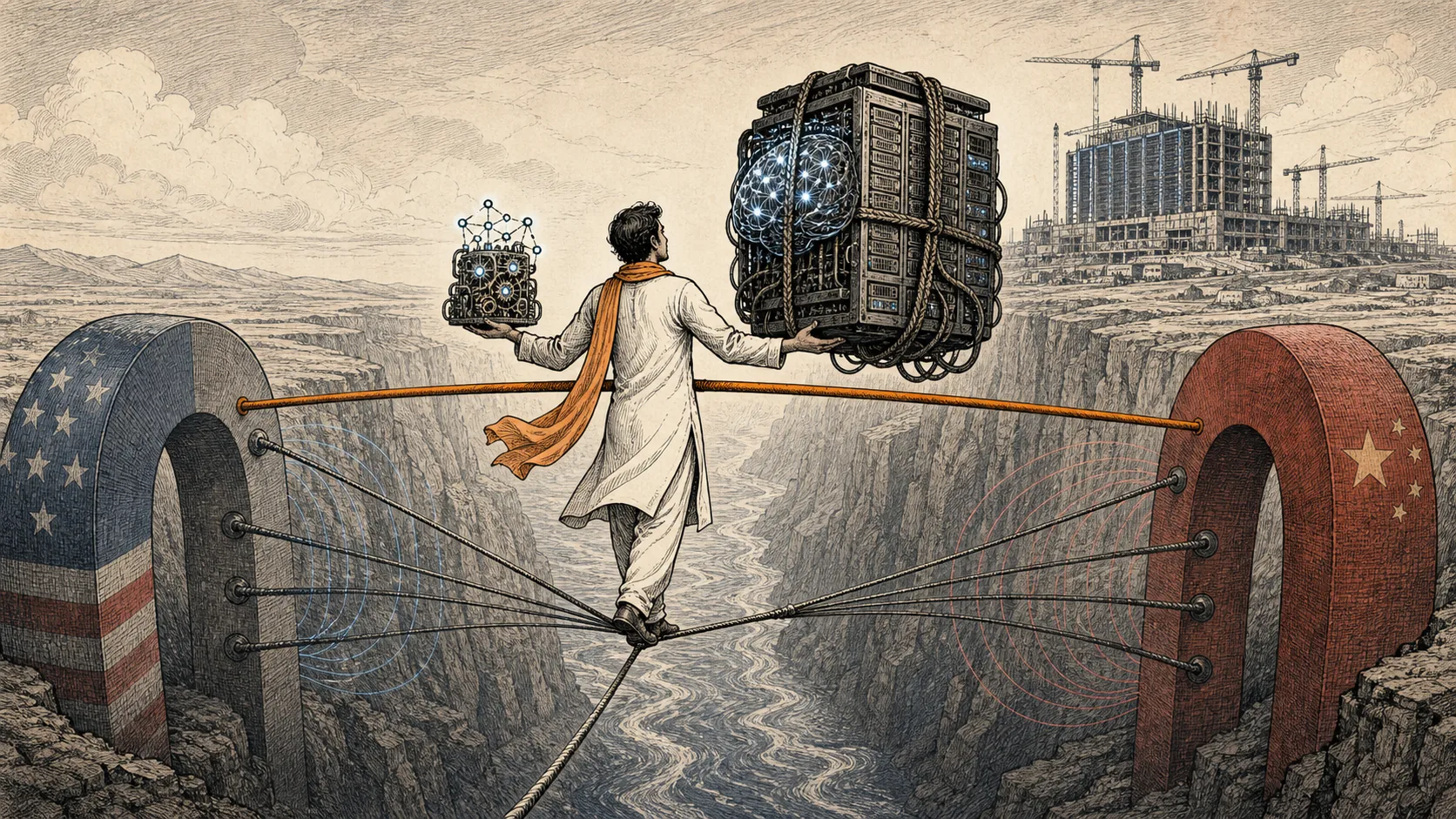
- •India urged to accept temporary foreign AI reliance while pursuing long-term sovereignty
- •Sarvam has a few hundred billion parameters, while Kimi K3 has 2.9 trillion
- •US export controls and China’s WAICO could push countries toward competing AI blocs
India should pursue pragmatic AI policy by accepting some foreign technology reliance while building domestic capacity, Amit Kapoor and Mohammad Saad wrote in The Economic Times on Aug. 26, 2026. The column says AI sovereignty remains a core goal in Indian policy debate, but achieving it has become harder after the US banned foreign access to Claude Mythos and as the US and China dominate frontier AI systems.
The authors say the US leads with frontier models such as Claude, ChatGPT and Gemini, while China is catching up through DeepSeek, GLM and Kimi K3. India has not yet developed a comparable model: Sarvam, described as its most prominent model, has only a few hundred billion parameters, while frontier models have several trillion and China’s open-source Kimi K3 has 2.9 trillion parameters.
India’s gap is attributed to limited research spending, compute access, semiconductor capacity, risk-averse capital markets, environmental constraints and foreign competition. The column cites Semiconductor Mission 2.0, the Anusandhan National Research Foundation, expanded compute capacity and skilling as government efforts, but says matching US and Chinese investment will take time. It says this year’s Economic Survey advised India against the costly path of frontier AI and urged smaller models suited to local needs.
External pressure is rising from the US because frontier firms have expanded users slightly faster than compute capacity, pushing up AI token prices. The authors say Indian firms using foreign foundation models for AI wrappers and applications face possible supply-chain shocks, and the US decision to deny foreign access to its most advanced model makes reliance on foreign models less certain.
China is applying pressure from another direction by offering cheap models with near-benchmark performance at a fraction of American model prices, often as open source. The column says open-source Chinese models can be fine-tuned (adapted for specific local needs), while Alibaba uses Qwen AI to pull users toward its cloud computing platform. For Indian firms already competing with American firms, Chinese models add another competitive challenge.
The authors say US-China rivalry could create competing AI blocs. The US has imposed harsh semiconductor export restrictions on China and pressed allies to adopt similar measures, while NVIDIA has prepared a whitelist of Asian customers to prevent chip diversion to China through intermediary countries. China has created the World Artificial Intelligence Cooperation Organization, or WAICO, which the column describes as a possible foundation for a China-centered AI ecosystem.
India should pursue “strategic reliance” rather than “meaningless dependence,” the column argues. Smaller firms may need expensive American models when they cannot develop or fine-tune models themselves, while larger firms could use open-source Chinese models for local adaptation. The authors say geopolitical tensions with China may have to be set aside when India’s broader technology interests require it.
The column also urges India to extract more value from application-based AI when using closed-source models and to use open-source models as a route toward stronger domestic fine-tuning. It says India is not currently part of WAICO, but policymakers should seek access to emerging AI arrangements, while sovereign models such as Sarvam could benefit from partnerships with Anthropic and OpenAI through shared compute resources, technical expertise and knowledge transfer. Domestic compute and research still need strengthening because foreign technology use cannot replace self-reliance.