Intern Lumina U2 Unifies Visual AI Tasks
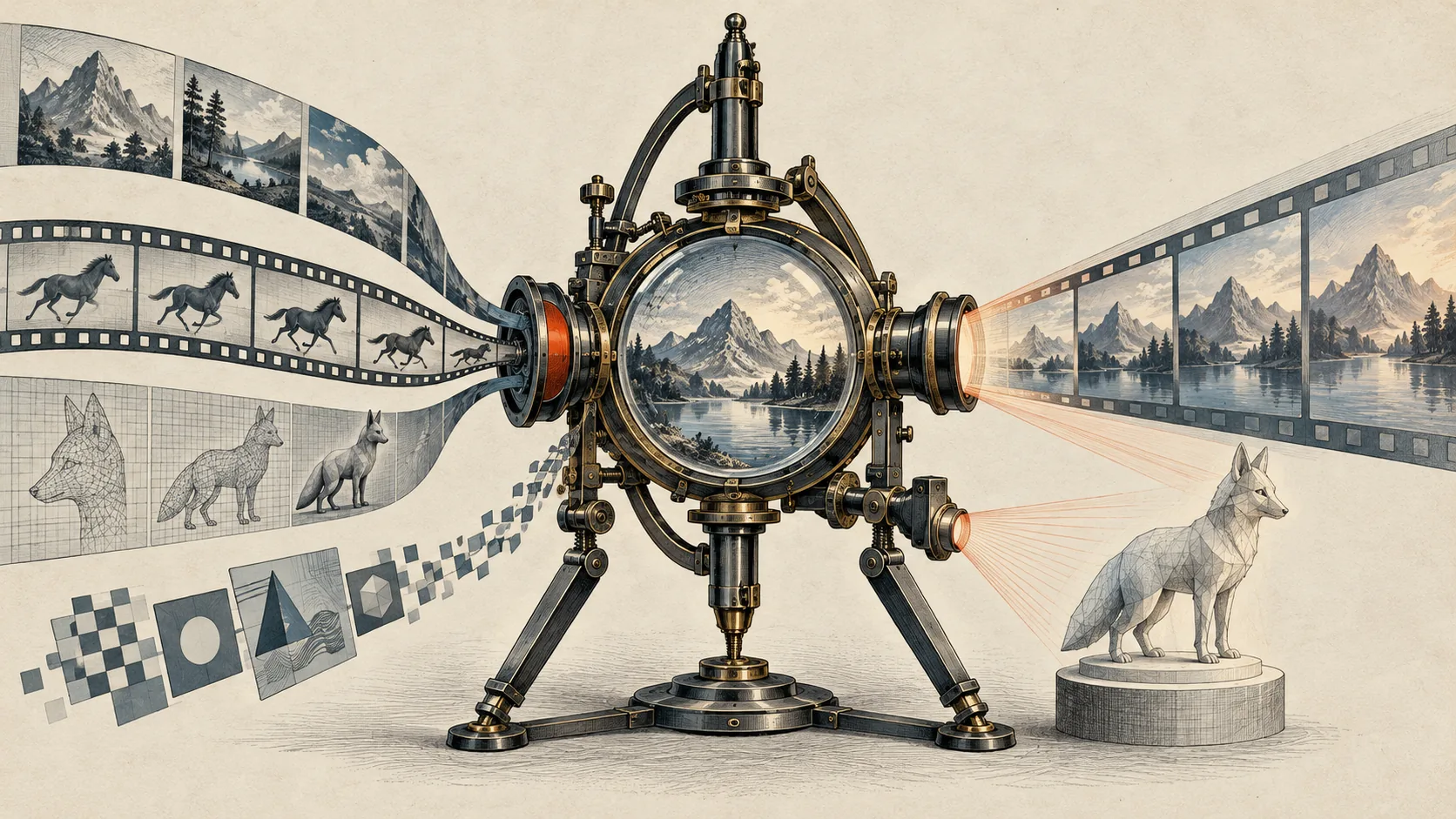
- •Shanghai AI Laboratory researchers present Intern Lumina U2, a unified diffusion model for visual understanding and generation.
- •The 16.9B-parameter model activates 1.4B parameters and uses 8 discrete visual codes at each position.
- •The authors report a 4.45× image-generation speedup and leading scores across image, video and 3D benchmarks.
Shanghai AI Laboratory researchers presented Intern Lumina U2, a diffusion language model for visual understanding and generation, in a paper published on October 14 and submitted to Hugging Face on October 16. The model uses multiple groups of discrete visual codes to process text, images, video and 3D content through one backbone. The authors say it is the first diffusion language model to represent multi-codebook visual tokens in a fully discrete space.
Each visual position contains 8 AToken codes. Their embeddings are combined at the input, and a lightweight autoregressive head predicts codes within each position sequentially while the diffusion backbone processes positions in parallel. The 16.9B-parameter mixture-of-experts model activates 1.4B parameters. It supports visual understanding, text-to-image generation and image editing, and was trained, run and evaluated on Ascend and NVIDIA platforms, including a run on 1,024 Ascend 910B NPUs.
The paper reports top or tied results on 6 of 10 image-understanding benchmarks and better results than the same-backbone LLaDA2.0-Uni on 8 of 10. Scores included 85.9 on CharXiv-DQ, 64.6 on HallusionBench, 36.5 on MathVision and 63.6 on DynaMath. It led all three reported video benchmarks: Video-MME 56.7, MLVU 62.1 and MVBench 61.8; its 3D MM-Vet score was 50.5, ahead of ShapeLLM and PointLLM.
For text-to-image generation, the authors report leading results among unified models on DPG-Bench (87.79), UniGenBench (86.11) and TIIF-Bench (88.57 for short prompts and 87.08 for long prompts), plus a tie for best on GenEval (89). They say it outperformed FLUX.1-dev and exceeded Qwen-Image on GenEval, UniGenBench and TIIF-Bench with about 14× fewer activated parameters. A confidence-guided sampling strategy with cache refreshing accelerated image generation by 4.45×. On VeriphyT2IBench it scored 76.58 on the Local metric, above GPT-Image-1 and Gemini 2.5 Flash Image; its GenExam-Physics relaxed score was 44.8, the highest among general-purpose unified models.