IOWN Alliance Targets Edge Twin for Connected Cars
- •IOWN Global Forum presented mobility use cases at its Amsterdam meeting and public FUTURES event.
- •5GAA, AECC and IOWN Global Forum agreed to use IOWN to realize the Edge Twin concept.
- •Connected cars are expected to exceed 600 million by 2030; 5GAA plans an Edge Twin proof of concept at MWC in March 2027.
IOWN Global Forum held an interim meeting in Amsterdam, the Netherlands, in early October and presented mobility use cases at the public FUTURES event. IOWN, a next-generation optical communications technology proposed by NTT, is being considered as a way to support European data centers facing power constraints amid rising demand for generative AI. It is also expected to serve as core infrastructure for “physical AI,” which operates AI in the physical world beyond servers.
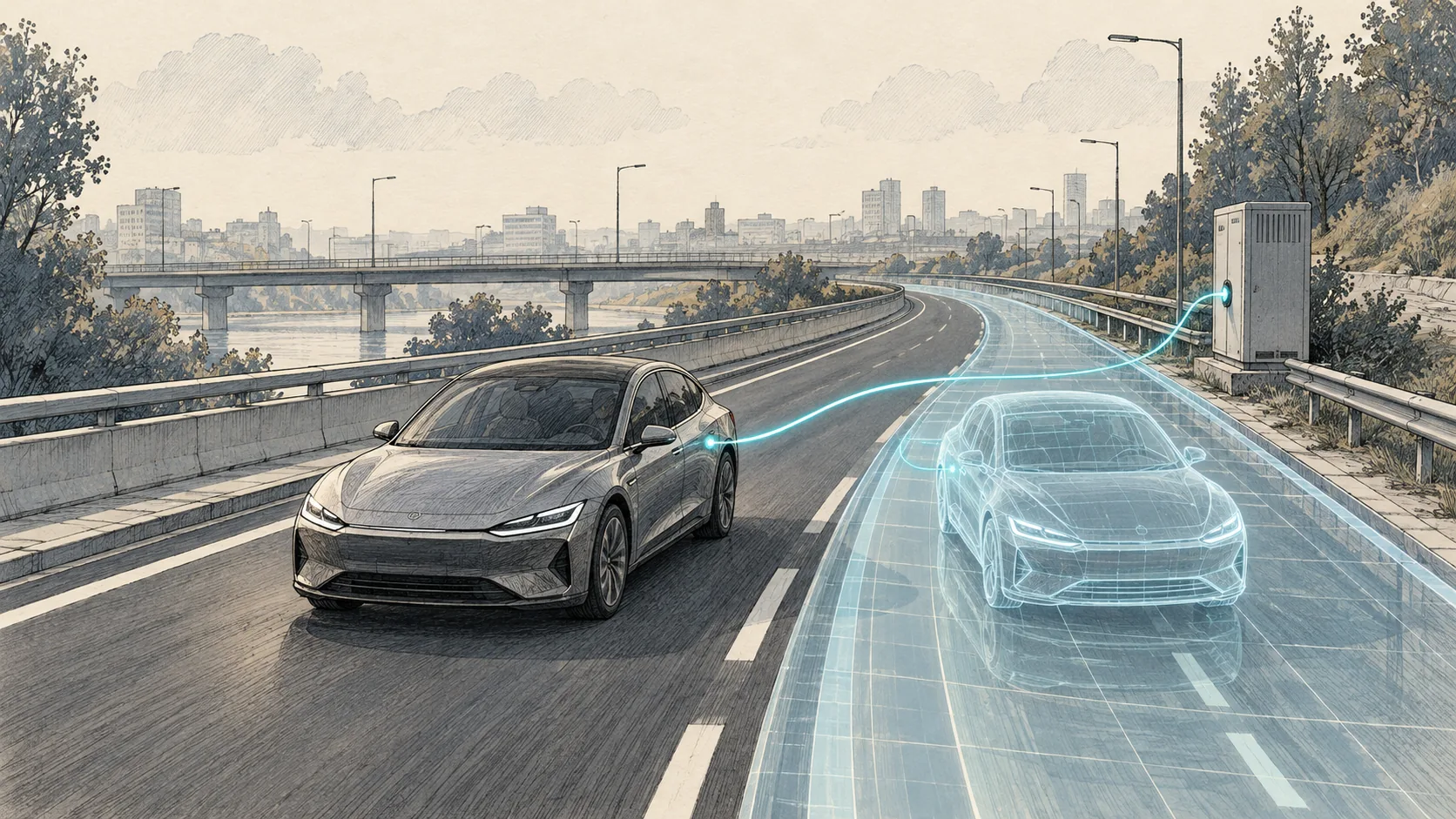
Edge Twin is a digital twin concept (a virtual replica of real-world places and objects) jointly proposed in 2024 by 5GAA, which promotes 5G in the automotive sector, and AECC, an international connected-car organization. It recreates streets and moving vehicles in a digital environment to support automated driving and prevent traffic accidents. 5GAA, AECC and IOWN Global Forum agreed to use IOWN to realize the concept. The number of connected cars worldwide is expected to exceed 600 million by 2030.
5GAA was founded in 2016 by eight automotive, telecommunications and semiconductor companies; more than 110 companies worldwide, including Toyota Motor, now participate. AECC was founded in 2018 and is represented by Ryokichi Onishi of Toyota Motor. At FUTURES, Onishi said distributed computing using IOWN is essential to process in real time the vast amount of data generated by 600 million cars.
5GAA CTO Maxime Flament said building Edge Twin would move beyond conventional driver assistance toward an era in which AI autonomously controls vehicle operations. 5GAA plans to present an Edge Twin proof of concept at MWC in Barcelona, Spain, in March 2027. Instantly synchronizing information from vehicle sensors and road infrastructure through IOWN is necessary to track and make decisions about traffic lights, vehicles and pedestrians.
The article also reports that a remote operation trial has begun at a copper mine in Chile, linking sites up to 1,500 kilometers apart over an ultra-low-latency network to remotely control heavy equipment. It does not give a specific meeting conclusion on whether IOWN can resolve European data centers’ power constraints. The mobility agreement and the need to synchronize information instantly for distributed processing are the meeting’s reported outcomes.