South Korea Sets AI Leadership Priorities
- •South Korea’s science ministry outlines infrastructure, domestic models and narrower access gaps as priorities for joining the AI top three.
- •The government plans about $1.5 quadrillion in public-private investment across three major AI projects.
- •Its “AI for Everyone” initiative aims for one AI agent per person and a global AI hub with international partners.
South Korea’s Ministry of Science and ICT has named expanded computing infrastructure, stronger homegrown AI models and reduced gaps in AI use as priorities for becoming one of the world’s top three AI powers after the United States and China. Lee Jin-soo, the ministry’s director general for AI policy planning, said global competition is continuing at a special lecture on the “2026 K-Open Source AX” event, held on the 28th at the Korea Science and Technology Center in Seoul’s Gangnam District. He said China, which has pursued open-weight models, has also recently shown moves toward export controls on top-tier models.
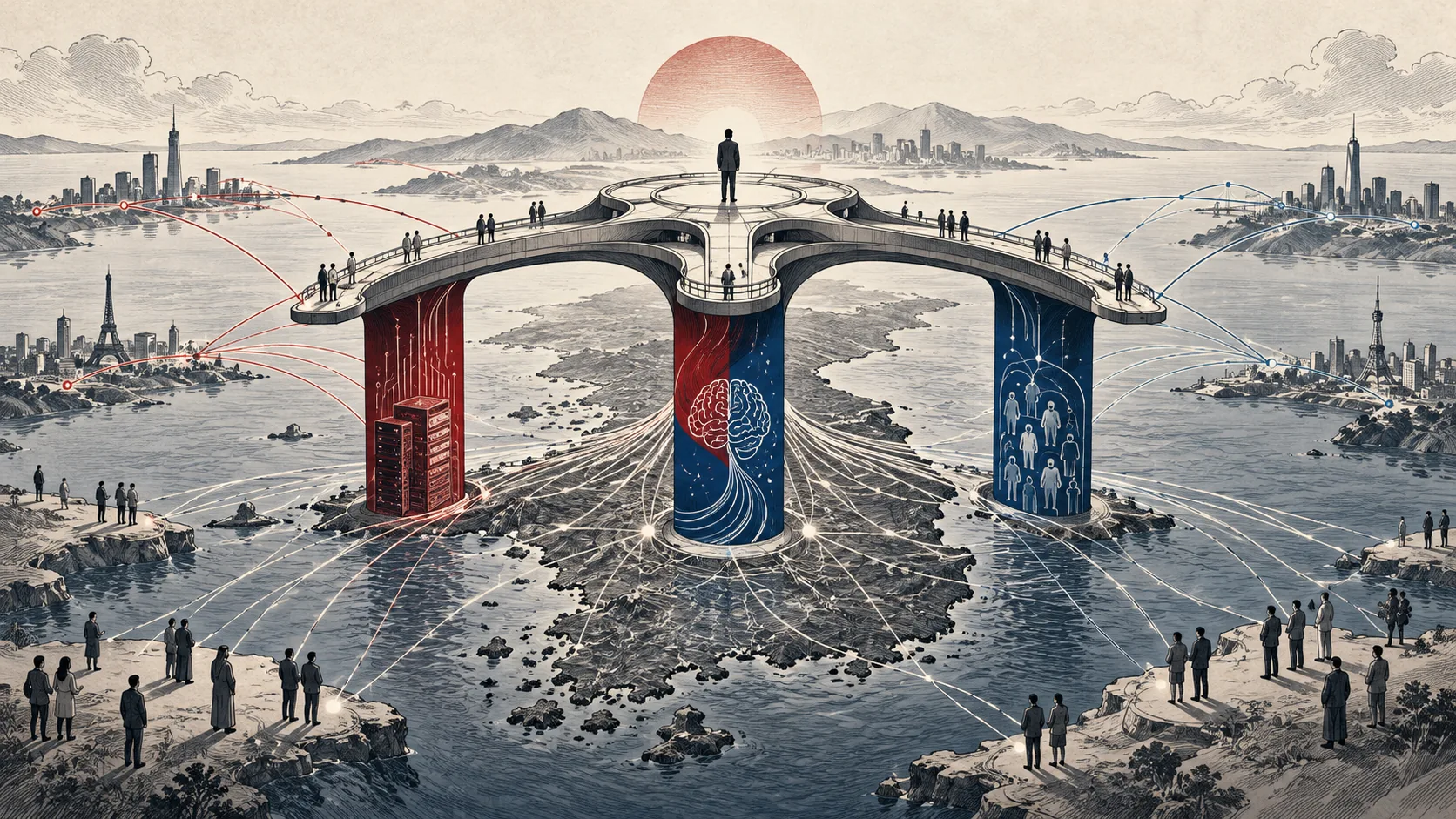
The government plans four policy initiatives: three major projects based on South Korea’s full-stack AI technology, development and wider use of independent foundation models, an “AI for Everyone” initiative, and stronger global AI leadership. The three projects link semiconductors, AI data centers (facilities built to run AI workloads) and physical AI (AI systems that interact with the physical world) in a production system. Lee compared semiconductors to the brain, data centers to the heart and physical AI to the body, saying the government is investing in all three areas.
The government is pursuing about $1.5 quadrillion in public-private investment across the three projects. A plan announced in July included more than $800 trillion for semiconductors and about $550 trillion for domestic and overseas AI data centers. It also plans to invest $20 trillion in physical AI and strengthen research and development. The government intends to combine general-purpose independent AI models with industry data, then develop and expand specialized services for law, chemistry, manufacturing and the public sector.
The ministry said many people do not yet benefit from AI and that South Korea’s domestic AI service ecosystem remains underdeveloped, leaving users highly dependent on foreign services. Through “AI for Everyone,” it plans to enable an era of one AI agent per person and support AI use in asset management, learning and retirement planning. It also proposed rewarding economic and social activity with tokens that could be spent or reinvested.
International cooperation is also planned. At the “San Francisco AI Summit” attended by President Lee Jae-myung in July this year, six AI infrastructure agreements worth a total of $950 billion were signed. The government plans to establish a “Global AI Hub” involving nine international organizations and five multilateral development banks. Lee described South Korea as a full-stack country with domestic companies and technology across five AI layers: energy, semiconductors, infrastructure, models and applications. He said the top layer, the AI application market, remains at an early stage. Competition is currently focused on infrastructure, he said, while industrial growth and business opportunities are expected in applications. Lee urged participants to help build a healthy AI ecosystem, as open source contributed to the development of software ecosystems in the past.