South Korea Opens Humanoid Data Factory
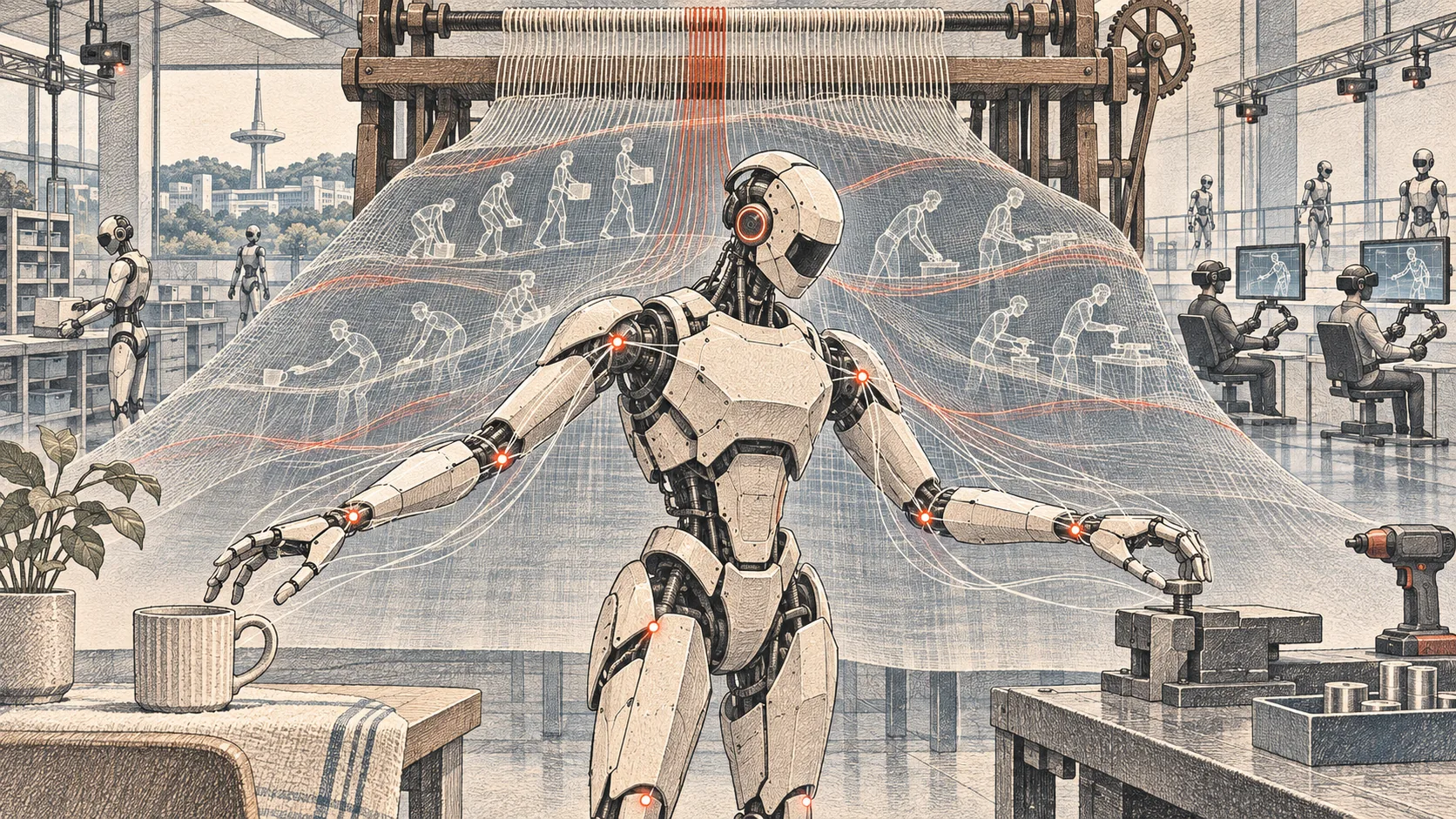
- •South Korea’s science ministry, KIMM and ETRI opened the country’s first humanoid data factory in Daejeon.
- •The research group has 12 humanoids collecting household and industrial task data through teleoperation.
- •The completed Kairos humanoid is due to be unveiled next April; the facility will open gradually from the end of next year.
South Korea’s Ministry of Science and ICT opened the country’s first data production facility dedicated to bipedal humanoids on the 3rd at the Korea Institute of Machinery and Materials (KIMM) in Yuseong District, Daejeon, together with KIMM and the Electronics and Telecommunications Research Institute (ETRI). The facility produces data humanoids need to perform tasks. The government expects it to reduce reliance on overseas data and contribute to domestic self-reliance in humanoid technology.
At the factory, people remotely operate robots to carry out tasks while the robots’ movements and work data are recorded. To perform a range of tasks independently in homes and industrial settings, humanoids need to understand their surroundings and learn real-world actions for handling objects. That requires large datasets covering varied movements and work processes.
The facility was built to collect a broad range of data, from arm and leg movements to tasks using the whole body. AI is trained on the collected data and applied to real robots; their performance is then tested, and the results are fed back into training to steadily improve task performance. The Autonomous Growth AI Humanoid Global Top Strategy Research Group, which built the facility, currently has 12 humanoids and plans to expand the robots and the tasks covered by data collection in stages. KIMM plans to gradually open the facility from the end of next year to support humanoid research and development by domestic industry, academia and research institutions.
At the opening ceremony, demonstrations showed data collection through teleoperation and imitation of human movements. Several humanoids performed household tasks such as taking items from a refrigerator, handling laundry and tidying a sofa, as well as industrial tasks such as operating buttons and levers inside a car. KIMM also unveiled precision object manipulation and whole-body motion imitation technology for Kairos, a domestically developed humanoid. Kairos has reached a stage where it can perform dynamic full-body movements, including motions inspired by traditional mask dance; its completed form is scheduled to be unveiled next April.
KIMM President Ryu Seok-hyun said that securing large quantities of high-quality robot task data is central to national technological competitiveness. He said collaboration among industry, academia and research institutions would accelerate Kairos’s development, and that gradually opening the factory from the end of next year would help strengthen South Korea’s physical AI industry. Kim Seong-su, director general for research and development policy at the Ministry of Science and ICT, also said public data infrastructure supporting joint research and development is important. He said the ministry would gradually expand the shared foundation for producing and using data, while working to secure independent AI humanoid technology and accomplish the K-Moonshot AI Humanoid Mission.