Korean Stocks Slide on AI Data Center Regulation Fears
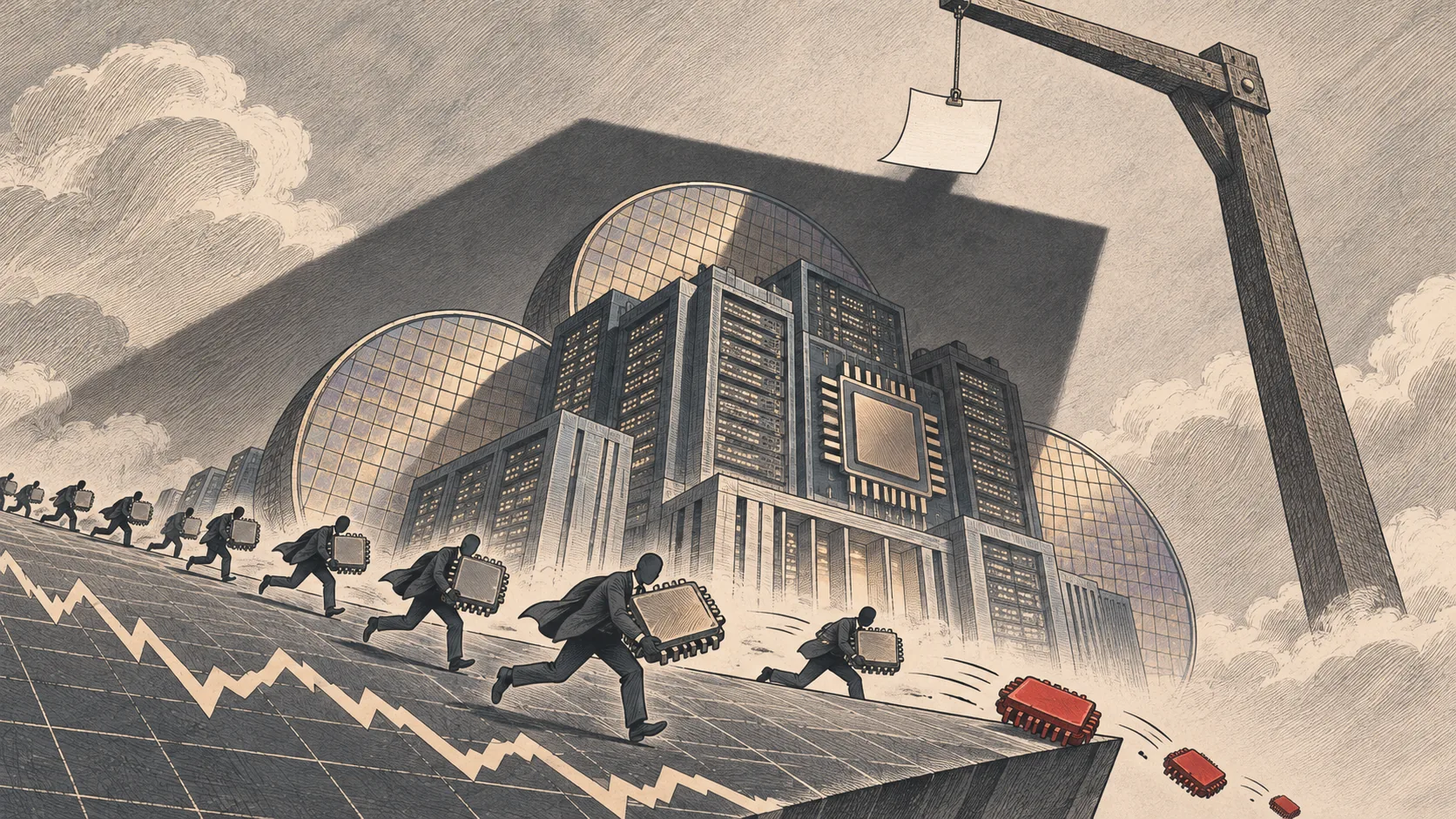
- •Kospi fell 5.28% and Kosdaq 5.11%; sell-sidecars were triggered in both markets during trading.
- •Foreign investors net sold 3.3928 trillion won in Kospi shares; Samsung Electronics fell 7.57% and SK Hynix 9.46%.
- •Analysts linked the decline to fears of tighter data center rules after the U.S. midterm elections and selling in AI-related stocks.
On November 5, South Korea’s Kospi and Kosdaq each fell more than 5% amid concerns that AI data center regulations could tighten after the U.S. midterm elections and amid foreign investor selling. The Kospi closed down 300 points, or 5.28%, at 5,383.80, while the Kosdaq fell 36.54 points, or 5.11%, to 678.41. Sell-sidecars were triggered in both markets during the session.
On the Kospi, individual and institutional investors were net buyers of 2.2722 trillion won and 845.7 billion won, respectively, while foreign investors were net sellers of 3.3928 trillion won. On the Kosdaq, foreign and institutional investors sold a net 73.4 billion won and 102.6 billion won, while individual investors bought a net 172 billion won. In the main board market, Kospi 200 futures fell 46.48 points, or 5.21%, to 843.96 at 10:16:19 a.m., suspending the effect of program sell orders for five minutes. The Kosdaq sell-sidecar was triggered at 2:27:31 p.m. under rules requiring Kosdaq 150 futures to fall more than 6% and the Kosdaq 150 index more than 3% for one minute.
Large semiconductor stocks led the declines. Samsung Electronics fell 7.57% to 201,500 won, and SK Hynix dropped 9.46% to 1,264,000 won. Samsung Electronics preferred shares fell 6.58%, SK Square 10.01%, LG Energy Solution 2.54%, and Samsung Electro-Mechanics 15.34%. Samsung Biologics rose 1.67%, Hyundai Motor 3.53%, KB Financial 3.63%, and Celltrion 7.50%. Semiconductor equipment, substrate, and power equipment shares also fell: Hanmi Semiconductor dropped 9.13%, LS Electric 13.87%, Hyosung Heavy Industries 12.59%, and HD Hyundai Electric 3.44%.
On the Kosdaq, EcoPro BM fell 7.72%, EcoPro 7.54%, Jusung Engineering 12.21%, Rainbow Robotics 3.60%, HLB 3.28%, Simmtech 17.97%, Leeno Industrial 9.53%, and EO Technics 16.21%. Alteogen rose 3.68% and Sam Chun Dang Pharm 0.46%. In Seoul foreign exchange trading, the won-dollar rate closed at 1,342.10 won, up 0.6 won from the previous session.
Brokerages said worries that a Democratic Party victory in both chambers of the U.S. Congress could bring tighter permits for new data centers and regulation of electricity costs contributed to the Korean market’s fall. Major U.S. indexes rose overnight as the end of the election eased political uncertainty, but semiconductor shares weakened. The Philadelphia Semiconductor Index fell 3.13%; Micron dropped 7.00%, Nvidia 3.17%, and Broadcom 2.00%. Lee Kyung-min, a researcher at Daishin Securities, said concerns over AI data center regulation weighed more heavily on Korean shares than the easing of political uncertainty. He said foreign investors’ net selling of both cash equities and futures, alongside declines in AI-related sectors, deepened the losses. Kang Jin-hyeok, a senior researcher at Shinhan Securities, said concerns over data center delays hurt AI-related shares in semiconductors, materials and components, and robotics.
Yang Il-woo, a researcher at Samsung Securities, said he did not expect data center construction to be significantly delayed. He said regulation was more likely to reduce tax benefits for developers or raise their costs than to delay construction for a long period. The report presented brokerage views that regulatory concerns could weigh on AI-related stocks in the short term, while the likelihood of an actual pullback in investment was limited.
Saxo Bank, also cited in the report, forecast that a Democratic-led Congress could increase investigations of AI companies over competition, consumer and privacy protection, and model safety. Tighter rules on power consumption, water use, and permitting, together with local opposition, could raise construction costs and delay data center completion; AI safety standards, independent model assessments, and developer accountability systems were also discussed as possibilities. Saxo Bank said investor attention was shifting from AI capital spending to profitability, with investors beginning to scrutinize who bears costs, debt levels, the time needed for facilities to generate revenue, and how supply chain profits are distributed. These forecasts were presented as brokerage analysis explaining the day’s fall in Korean stocks.