KT Expands Global AI Data Links
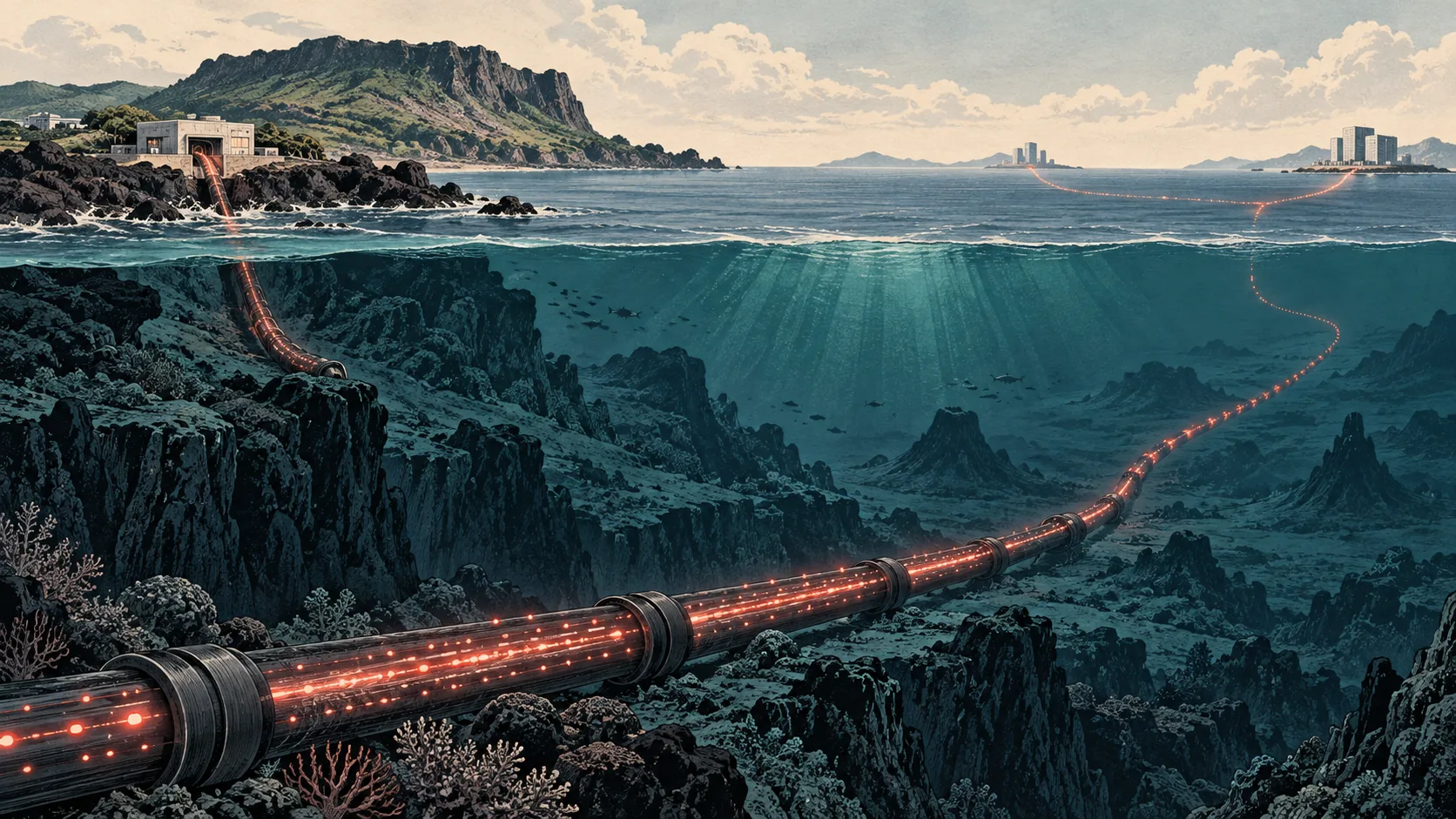
- •KT plans international subsea links connecting overseas AI hubs with infrastructure in South Korea.
- •Subsea cables carry about 99% of global data traffic; KT projects 1,500T+ in additional capacity will be needed by 2035.
- •KT is building a Jeju cable landing station linked to I-AM and plans an “AI Highway” connecting AI data centers.
KT is expanding international subsea cable infrastructure to meet global data connectivity demand in the AI era. It plans to combine more than 40 years of cable operating experience with new international routes, cable landing stations, South Korea’s domestic network and AI data centers (AIDCs) to link overseas AI and cloud hubs with domestic AI infrastructure. KT says it has an end-to-end network connecting subsea cables through landing stations and the national backbone network to AIDCs and AI edge facilities.
Subsea cables carry about 99% of data traffic between countries and continents and remain in service for more than 25 years after construction. The design capacity per cable built last year was about 290 Tbps. KT expects demand for high-capacity international data transfer to grow as AI training and inference and overseas cloud use increase. The company has participated in APCN2, APG, KJCN, NCP and TPE projects, and plans to add I-AM, linking Malaysia, Singapore, Japan, South Korea, the Philippines and Taiwan, and E2A, connecting Asia and North America. It is also considering more capacity to Asian data hubs such as Singapore and Japan and to North America, along with multiple routes including South Korea-Japan-US connections and a direct South Korea-US link.
Based on the government’s 2035 target of 18.4 GW in AIDC construction, KT estimates global traffic will reach about 1,700T. Subsea cable capacity currently in operation or scheduled for construction by 2030 is about 200T. KT says more than 1,500T of additional connection capacity will be needed by 2035 and is working to secure subsea routes. Current international cables are concentrated in the southeast, with one in Taean, six in Busan and one in Geoje. KT is building a Jeju cable landing station linked to I-AM and plans to expand hubs into the southwest and southeast, diversify international entry routes and improve connections to AIDCs in each region.
KT envisions an “AI Highway” linking cable landing stations with regional AIDCs over ultra-high-bandwidth, ultra-low-latency networks of at least 400 Gbps. It aims to reduce data-transfer bottlenecks between GPUs and AIDCs distributed across multiple regions using capacity of 400 Gbps to 1.6 Tbps per circuit and the shortest optical-fiber routes. KT said it would connect subsea cables, landing stations, the domestic backbone network, AIDCs and AI edge facilities in one network. A KT official said AI competitiveness can be secured when computing resources and connectivity infrastructure are integrated.