LangChain Tests OpenWiki Agent Memory
- •OpenWiki made an agent roughly 5x more accurate on questions connecting information across documents than keyword search alone
- •An evidence graph raised accuracy 27%, doubled citation consistency, and cut median answer time 40%
- •Testing covered 111 insurance documents, 972 facts, 80 simple lookups, and 50 connected questions asked three times each
LangChain said on October 28, 2026, that an agent using its OpenWiki memory layer was roughly 5x more accurate than an agent relying on keyword search alone for questions that required connections across documents. Adding an evidence graph to the wiki improved accuracy by 27%, doubled citation consistency, cut median answer time by 40%, and reduced cost per correct answer by 58%. For simple lookups, search and the wiki produced similar accuracy, while the wiki took longer.
OpenWiki is an open-source wiki compiler that turns source documents into linked pages with citations. LangChain tested it using a synthetic insurance library of 111 long-form documents and a ledger of 972 facts. The library included outdated versions, contradictions, indirect reference chains, varied wording, and very long documents. The same retrieval agent, model, instructions, documents, and questions were used in both conditions; only access to the compiled wiki changed. Researchers asked 80 simple lookup questions and 50 connected questions three times each.
For simple lookups, keyword search scored 0.84 accuracy and 0.72 citation overlap, while the wiki scored 0.83 accuracy and 0.74 overlap. Cost per correct answer was $0.020 with search and $0.021 with the wiki; median latency increased from 9 to 12 seconds. For connected questions, accuracy rose from 0.10 with search alone to 0.52 with the wiki, and cost per correct answer fell from about $0.55 to $0.19. However, citation overlap on connected questions was 0.25, compared with 0.74 on simple lookups, indicating that the agent did not consistently cite the same evidence across runs.
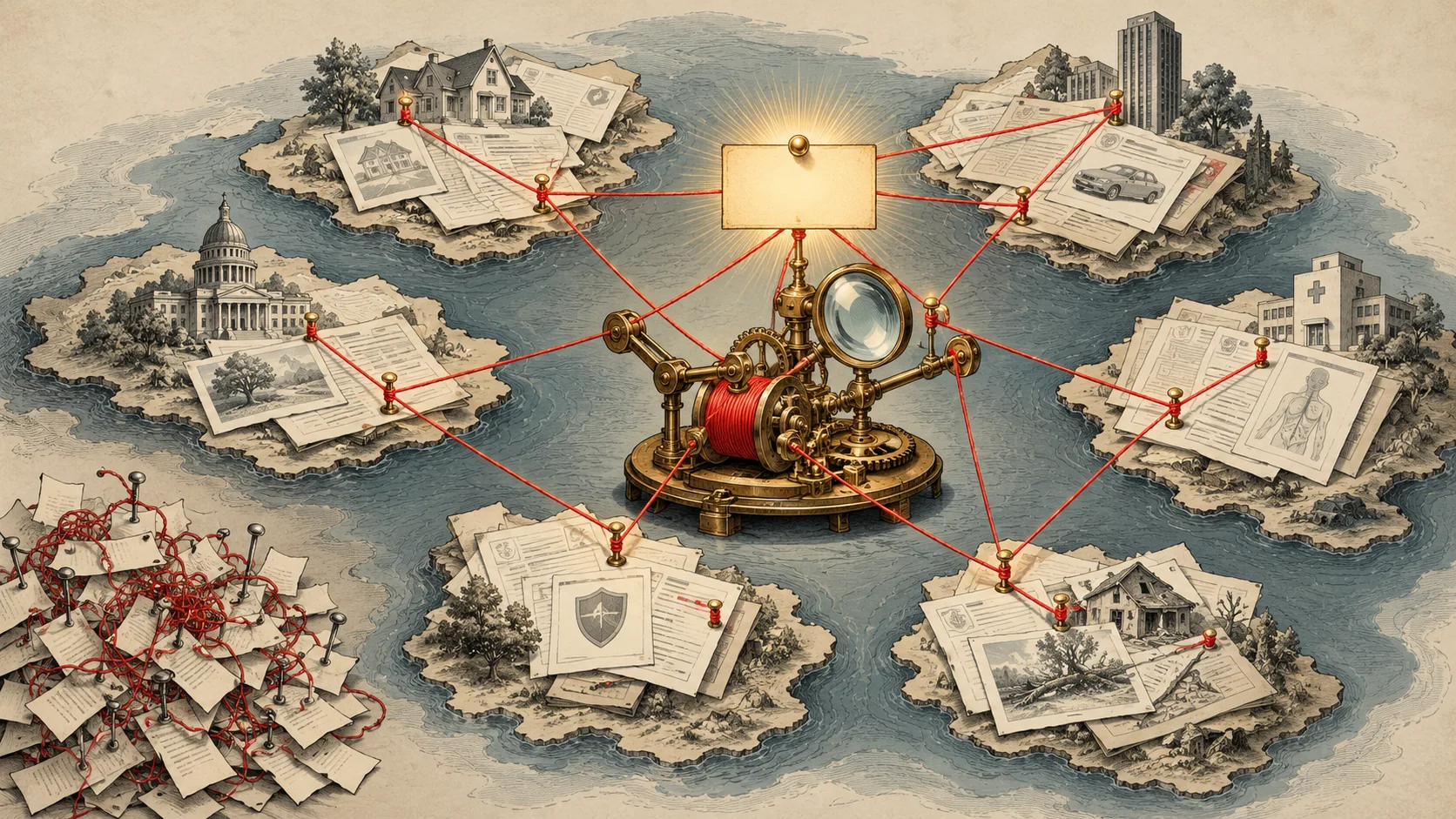
LangChain then added an evidence graph, a map of typed links among claims, wiki pages, paragraphs, and topics. The graph splits documents into uniquely identified paragraphs and links claims to exact passages; its edges also record relationships such as one document superseding an older one or a section referring to another document. It took under a second to build and resolved every explicit cross-reference in the test library. The graph reuses citations and references, requiring no additional model calls to construct, although wiki-derived edges still depend on the accuracy of model-generated citations.
With the graph, the agent could use locate to find a starting point and expand to follow links to evidence and related documents. Compared with the wiki alone, the graph improved accuracy by 27%, doubled citation consistency, cut median answer time by 40%, and lowered cost per correct answer by 58%. LangChain says the reported answer costs exclude wiki compilation and updates: compiling the 111-document library cost $4.15, and adding 17 documents later cost about $0.09 each. The company says the approach is most useful when multiple agents repeatedly answer questions spanning the same sources; for simple lookups, search alone was as accurate and faster. It plans to build wikis dynamically and explore claims and typed edges for semantic, episodic, and procedural agent memory.