Compare AIFind AIAI NewsAI How-To
About Us
PrivacyTermsFAQContactContact
AIB Inc.Company info
© 2026 AIB Inc.

Matrix Reframed as Brain Compute Cluster
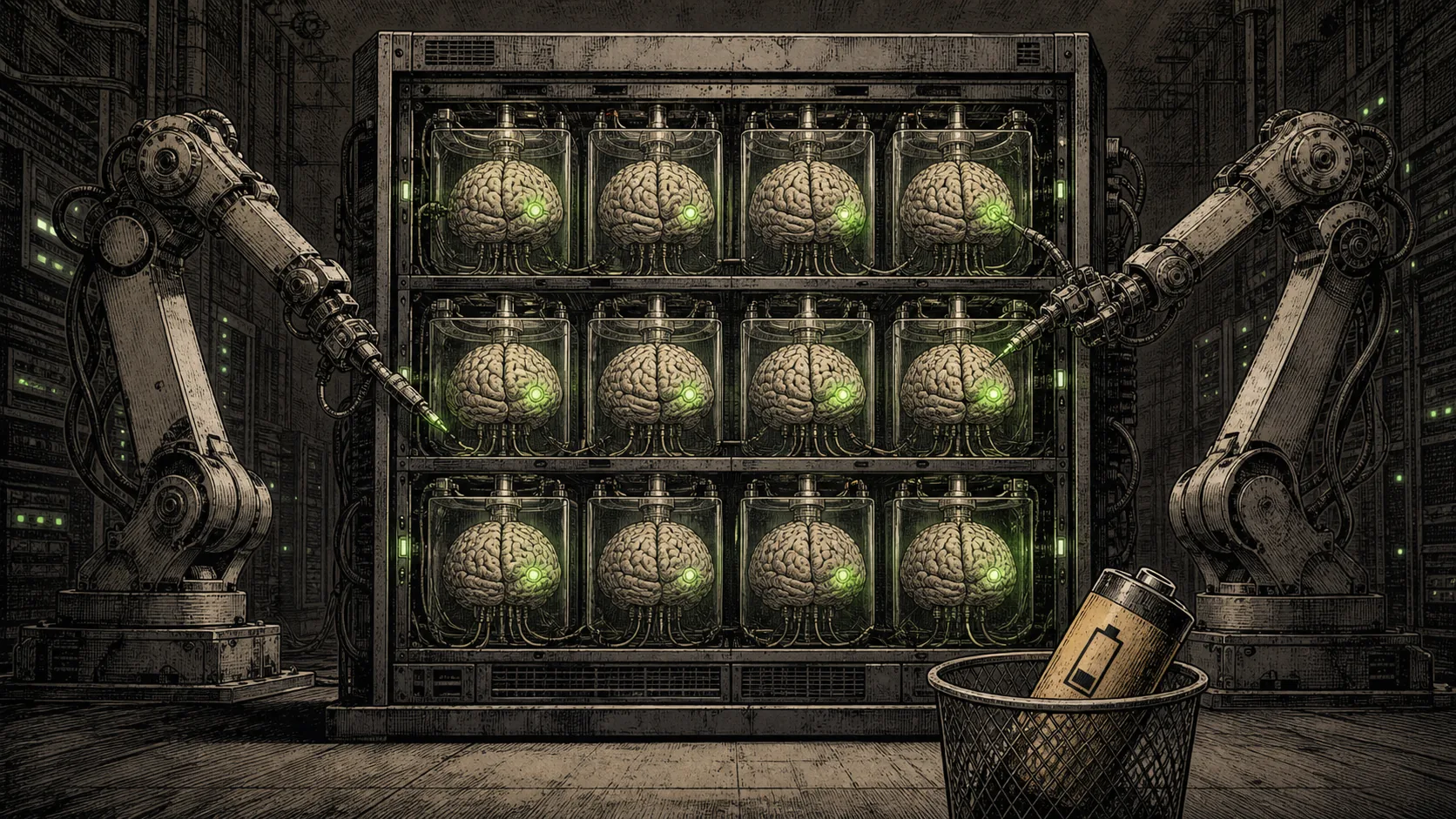
Matrix Reframed as Brain Compute Cluster

DEV.to·Sunday, August 30, 2026
  • •Matrix battery plot reframed as human-brain compute cluster for AI inference costs
  • •Human brain cited as 20-watt reference for vision, audio, language, and motor control
  • •FinalSpark and Cortical Labs examples show living neurons explored for low-power learning
  • •Matrix battery plot reframed as human-brain compute cluster for AI inference costs
  • •Human brain cited as 20-watt reference for vision, audio, language, and motor control
  • •FinalSpark and Cortical Labs examples show living neurons explored for low-power learning
  • •Matrix battery plot reframed as human-brain compute cluster for AI inference costs
  • •Human brain cited as 20-watt reference for vision, audio, language, and motor control
  • •FinalSpark and Cortical Labs examples show living neurons explored for low-power learning
  • •Matrix battery plot reframed as human-brain compute cluster for AI inference costs
  • •Human brain cited as 20-watt reference for vision, audio, language, and motor control
  • •FinalSpark and Cortical Labs examples show living neurons explored for low-power learning

Jonathan Murray argued on August 28 that The Matrix works better if humans are treated as compute resources rather than batteries, using the movie as a frame for AI's current inference cost problem. He contrasts modern data-center demand with the human brain, which he says runs on about 20 watts while handling real-time vision, real-time audio, language, motor control, a continuously updated physics model, and a predictive world model.

Murray says Morpheus' battery explanation fails because feeding humans liquefied protein slurry to extract electricity would make humans a lossy middleman. In his alternative reading, the machines built a planet-sized data center where billions of podded humans functioned as compute nodes, and the simulated 1999 world was not a pacifier but the workload keeping brains engaged.

The article says a sedated human would be useful for a battery but not for compute. A brain used for computation would need a coherent world with stakes, consequences, and other agents, which Murray says explains why Agent Smith's “perfect world” version of the Matrix failed: a frictionless paradise would create a trivial workload, while a harder world would keep utilization high.

Murray says the idea came from a forty-minute exchange with an AI about a 27 year old movie. He says the AI helped him find vocabulary he did not already have, including organoid intelligence (computing with lab-grown brain tissue), neuromorphic systems (chips inspired by brains), and dendritic computation (processing inside neuron branches), and he describes that exchange as a new way to learn a subject.

The article then points to real-world companies exploring related ideas. Murray says FinalSpark, a Swiss outfit, runs lab-grown human brain organoids as a cloud platform that users can rent over the internet, while Cortical Labs in Melbourne taught a dish of neurons to play Pong and then productized it into a purchasable unit.

Murray says both companies pitch biological neural systems as orders of magnitude less power-hungry than silicon for certain learning tasks, but he emphasizes limits: organoids live weeks, maybe months; programming them is not recognizable as conventional programming; and neurons operate in milliseconds per spike, compared with nanoseconds for a transistor. He says that makes them different machines for different jobs, not drop-in replacements for an H100.

The article also raises an ethics question around when useful living neural tissue starts to matter morally, noting that FinalSpark's own scientists have said they think about it. Murray says he is not advocating for biological computing and identifies neuromorphic silicon such as Loihi, NorthPole, and SpiNNaker as the more likely path: copy brain-inspired architecture, keep memory near compute, use spiking neurons and parallelism, implement it in silicon, and avoid the latency and ethics issues of wet tissue.

Jonathan Murray argued on August 28 that The Matrix works better if humans are treated as compute resources rather than batteries, using the movie as a frame for AI's current inference cost problem. He contrasts modern data-center demand with the human brain, which he says runs on about 20 watts while handling real-time vision, real-time audio, language, motor control, a continuously updated physics model, and a predictive world model.

Murray says Morpheus' battery explanation fails because feeding humans liquefied protein slurry to extract electricity would make humans a lossy middleman. In his alternative reading, the machines built a planet-sized data center where billions of podded humans functioned as compute nodes, and the simulated 1999 world was not a pacifier but the workload keeping brains engaged.

The article says a sedated human would be useful for a battery but not for compute. A brain used for computation would need a coherent world with stakes, consequences, and other agents, which Murray says explains why Agent Smith's “perfect world” version of the Matrix failed: a frictionless paradise would create a trivial workload, while a harder world would keep utilization high.

Murray says the idea came from a forty-minute exchange with an AI about a 27 year old movie. He says the AI helped him find vocabulary he did not already have, including organoid intelligence (computing with lab-grown brain tissue), neuromorphic systems (chips inspired by brains), and dendritic computation (processing inside neuron branches), and he describes that exchange as a new way to learn a subject.

The article then points to real-world companies exploring related ideas. Murray says FinalSpark, a Swiss outfit, runs lab-grown human brain organoids as a cloud platform that users can rent over the internet, while Cortical Labs in Melbourne taught a dish of neurons to play Pong and then productized it into a purchasable unit.

Murray says both companies pitch biological neural systems as orders of magnitude less power-hungry than silicon for certain learning tasks, but he emphasizes limits: organoids live weeks, maybe months; programming them is not recognizable as conventional programming; and neurons operate in milliseconds per spike, compared with nanoseconds for a transistor. He says that makes them different machines for different jobs, not drop-in replacements for an H100.

The article also raises an ethics question around when useful living neural tissue starts to matter morally, noting that FinalSpark's own scientists have said they think about it. Murray says he is not advocating for biological computing and identifies neuromorphic silicon such as Loihi, NorthPole, and SpiNNaker as the more likely path: copy brain-inspired architecture, keep memory near compute, use spiking neurons and parallelism, implement it in silicon, and avoid the latency and ethics issues of wet tissue.

Read original (English)·Aug 28, 2026
#inference#gpu cluster#human brain#20 watts#organoid intelligence#neuromorphic#dendritic computation#finalspark#cortical labs#spiking neurons