MIT Tests AI Agents Exploring a Virtual Island
- •MIT researchers published an experiment on October 5 in which AI agents explored a virtual island without assigned tasks.
- •After 30 hours, Echo agents averaged 10.3 objects on a spire, compared with 3.5 for agents without exploration.
- •Six of 13 agents discovered an airborne throwing technique; deleting relevant memories increased the time needed to solve the task.
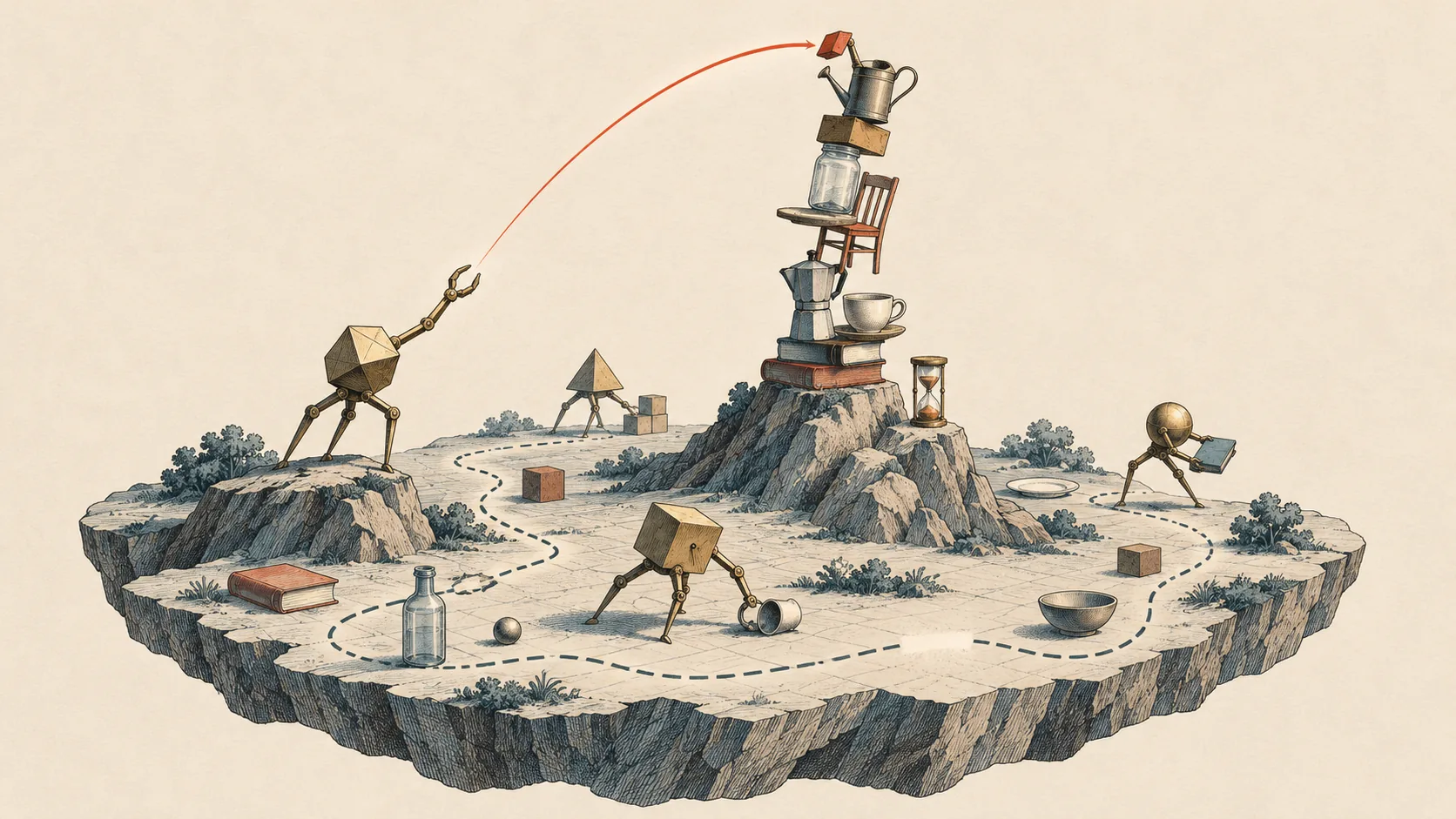
MIT researchers published the paper “Is This Machine Playing?” on October 5, 2026, and tested whether an AI agent called Echo could explore a virtual island without assigned tasks, build experience, and use it to solve later problems. They created a simple island with mountains, cliffs, spires, 12 blocks, stones, and a ring. Built on a language model, Echo received text descriptions of nearby objects’ locations, sizes, and shapes, as well as the terrain, then chose how to act. An initial instruction encouraged exploration, but there were no missions to complete, scores, or rewards. Researchers observed 13 Echo agents under the same conditions for 30 hours. They engaged in different activities, such as climbing hills, stacking blocks, and arranging objects into patterns. The agents did not act without prior knowledge: they used language models already trained on extensive data.
During exploration, Echo discovered that throwing a stone hard enough made a new block appear. After testing different directions and force repeatedly, it used stones as tools for obtaining blocks. Agents also created play resembling basketball, by placing a round ring high up and throwing blocks toward it, and bowling, by standing blocks upright and rolling stones to knock them down. Researchers observed agents assigning objects new roles and creating, modifying, and repeating their own activities. They did not conclude that Echo imagined or felt enjoyment as humans do; they assessed only externally observable behavior.
Researchers gave the same tasks to 13 Echo agents that had explored freely for 30 hours and 13 structurally identical agents without exploration experience. Tasks included building as many five-block-high towers as possible, placing as many objects as possible on a tall spire, building the tallest tower, and throwing blocks onto a spire without climbing it. On the spire task, the exploration group placed an average of 10.3 objects, compared with 3.5 for the group without exploration. The exploration group also did better at building at least three five-block-high towers. However, the groups performed similarly when asked to build a single tallest tower, so free exploration did not improve every ability.
Although the island reset every hour and the conversation context started over, Echo saved experiences in external memory files. Researchers described two kinds of records: episodic memory, which logs actions and outcomes, and semantic memory, which organizes discovered rules and skills. Echo referred to these files in later activities without changing the language model’s weights or retraining it. When researchers deleted a record about how to make additional blocks, the average number of completed five-block-high towers fell from 6 to 2; performance on the other three tasks mostly held steady. People could read and edit the memories, but researchers said this did not mean they fully explained every decision.
Memories could also preserve mistaken experiences. One Echo incorrectly concluded that throwing blocks was more reliable than placing them directly, recorded that belief in its knowledge notes, and performed worse after relying on it. Its performance improved after researchers removed the false belief. Useful records helped with later problem solving, but storing errors as knowledge affected subsequent actions. Researchers said checking whether experiences are reliable and correcting information that is wrong or no longer valid are important issues in managing agents’ long-term memories.
Some Echo agents jumped first and threw a block as they rose, while attempting to throw blocks onto a spire. In the simulator, Echo’s upward speed affected the thrown object’s motion, sending the block higher. Six of the 13 agents in the main experiment discovered this airborne throwing method. When researchers deleted the technique from one Echo’s memory, the time it took to solve the task increased substantially. The researchers had not expected the technique to be useful; it emerged from finding physical interactions built into the virtual world. The same method is not guaranteed to work in reality.
Researchers said Echo’s results showed, in a limited environment, that virtual experience and memory could contribute to performance on later tasks. The study did not establish effects in industry, but the article points to digital twins as a possible setting for AI to explore experimental conditions or operating methods. A digital twin represents a real facility or system in a virtual environment so its state can be observed and analyzed and scenarios tested. Because physical properties can differ between real and virtual environments, researchers must examine the simulation-to-reality gap and verify accuracy and safety before practical use. The study’s conclusion was that agents may be able to explore, remember experience, and use it, while their memories and discoveries still need verification.