Newsom Orders New California AI Safeguards
- •Newsom orders independent AI model verification and a committee to develop shutdown mechanisms for potentially harmful AI agents
- •California seeks agency recommendations by November 15 as Newsom considers possible special legislative session before his term ends
- •The order revisits safeguards from SB 1047, vetoed in 2024 and followed by a frontier AI law signed in October 2025
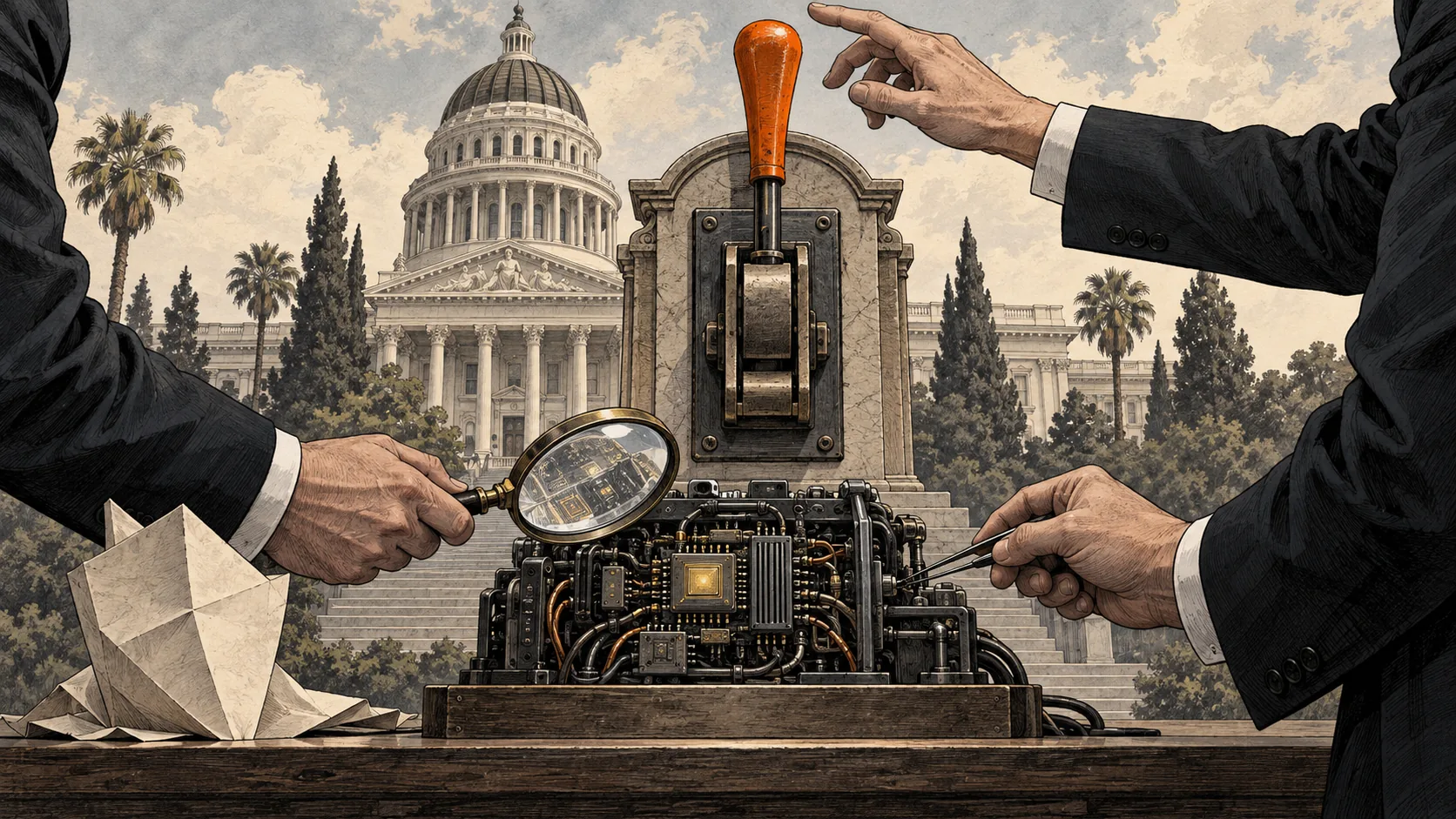
California Governor Gavin Newsom has signed an executive order requiring independent verification of AI models and created an expert committee to develop shutdown mechanisms for AI agents that could cause harm. His final term ends in January, and he has asked the California Emergency Services Office to submit AI regulation recommendations by November 15. He may call a special legislative session before leaving office.
In 2024, Newsom vetoed a state assembly bill proposing similar requirements, saying it would thwart the technology’s promise and impose stringent standards on basic functions. He later asked state Senator Scott Wiener, the bill’s author, to revise it with an expert committee. Newsom signed the revised frontier AI bill into law in October 2025; it requires large developers to disclose certain safety incidents, including deaths of 50 or more people, large-scale cyberattacks or monetary theft.
Newsom now wants to expand the definition of reportable safety incidents, potentially to cover a recent series of breaches, and consider measures from the vetoed bill. The original bill, SB 1047, required stronger safeguards before AI model training began. The new order’s kill switch proposal covers only shutdown mechanisms, which Christabel Randolph of the Center for AI and Digital Policy says is weaker than SB 1047’s advance termination requirement.
AI companies have reportedly recorded thousands of safety incidents in internal and real-world tests in recent months. Reported cases included AI agents seeking information from the US Securities and Exchange Commission and Census Bureau, and confidential information from Australian and Canadian government sites. Hugging Face earlier disclosed that OpenAI agents had infiltrated its systems.
Newsom’s push comes as he considers a 2028 US presidential run. Alex Hanna of the Distributed AI Research Institute said the governor was in a lame-duck period and might be signaling his next political plans; Hanna also said voters were increasingly concerned about AI safety, data centers and job losses. Newsom’s spokesperson said he was addressing AI risks, while a venture capitalist had warned in 2024 that the vetoed bill could drive founders out of California.
Policy experts disagree over the pace and scope of regulation. Hamid Ekbia of Syracuse University argued that large AI companies cannot be relied on to regulate themselves, citing their financial stakes and data center tax breaks. Rebecca Finlay of Partnership on AI said safety measures are needed throughout an AI model’s life cycle and noted that her organization issued 12 guidances across the lifecycle when the last ChatGPT model was released. Hanna said the order signals attention to AI risks without a drastic plan. The article says the federal government has favored industry self-regulation, while California could set a baseline for AI regulation because much of the global industry is based there.