NVIDIA Researchers Introduce ThinkWorld for Robotics
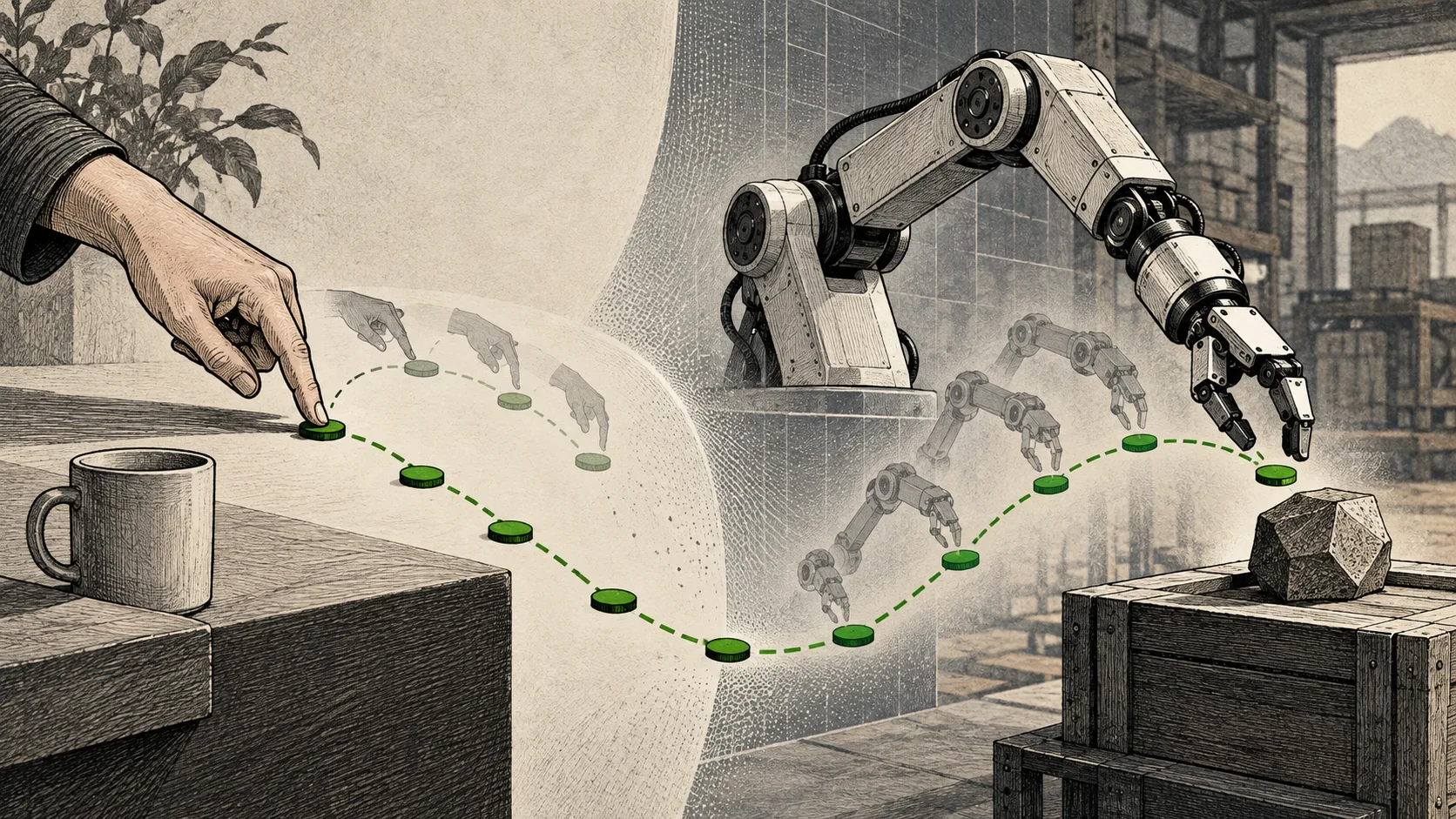
- •NVIDIA researchers introduced ThinkWorld, a framework that learns robot actions from human videos and robot demonstrations.
- •ThinkWorld encodes actions as Chain-of-Dynamics sequences of discrete motion tokens linking current and future states.
- •Experiments in simulation and on real robots showed human-to-robot transfer and generalization to unseen tasks and environments.
NVIDIA researchers introduced ThinkWorld, a vision-language-action (VLA) learning framework for improving how robots transfer learned skills to new tasks and environments. The paper, published on October 27 and submitted to Hugging Face on October 28, says the approach learns from human videos without action labels as well as from robot demonstrations.
ThinkWorld represents each action as a Chain-of-Dynamics (CoD): a sequence of discrete motion tokens describing the intermediate changes between the current world and a future state. The authors say this representation gives different robot embodiments a shared way to express actions. They initialize CoD using demonstrations that include action labels, then predict the future state each CoD would produce.
The framework reinforces CoD predictions that better match observed outcomes. That lets videos without action annotations supervise learning through visible changes between states, while human and robot experience refine the same action reasoning space. The researchers report experiments in simulation and on real robots, with human-to-robot transfer and generalization to unseen tasks and environments; the abstract provides no numerical results or specific task counts. The paper identifies limited diversity and coverage in action-labeled robot demonstrations as a constraint on VLA models’ generalization, while human videos offer broader behavioral and environmental experience.