OnePredict Pushes AI Autonomy Beyond Factory Automation
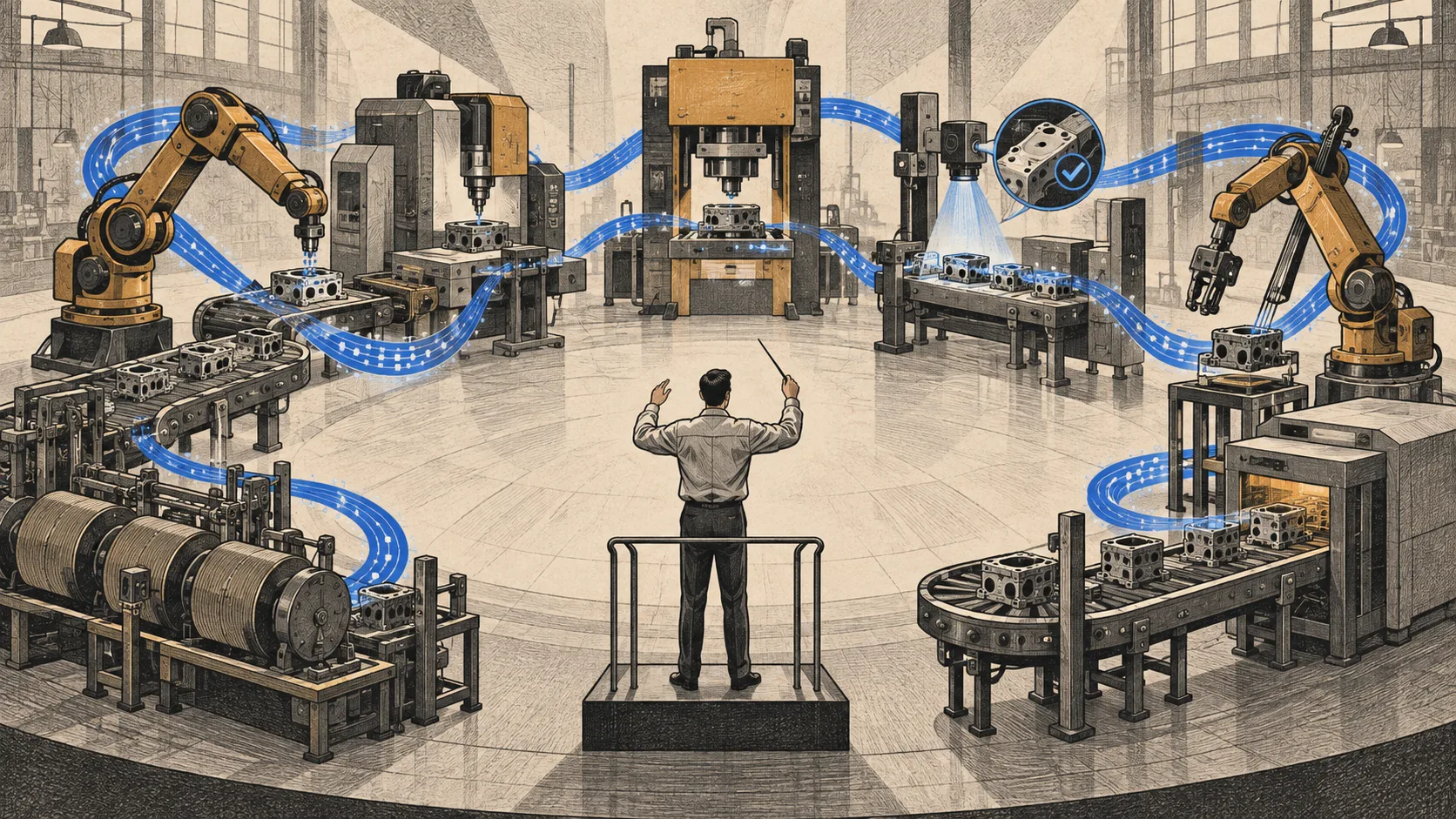
- •CEO Byung-dong Yoon outlined AI autonomy linking processes across the factory floor.
- •The company has 96 employees and more than 250 cumulative AI Factory deployments, with a focus on manufacturing AI and quality control.
- •Cyclone supports plant data and AI model operations through DataOps and MLOps.
OnePredict CEO Byung-dong Yoon explained the difference between factory automation and autonomy at the company’s office in Seocho-gu, Seoul, on September 1. He said automation alone—such as machines following set procedures to inspect products—does not connect factory work from beginning to end. With autonomy, AI assesses risk after inspection, decides whether to stop a production line, carries out necessary actions, restarts it, and prepares a report. Yoon classified as automation a washing machine maker’s use of AI to distinguish good products from defective ones by listening to their sounds.
Yoon said OnePredict, which began at Seoul National University, incorporated in October 2016 and now has about 96 employees. The company initially focused on energy and power generation but now emphasizes manufacturing AI. It reports that its AI Factory has been applied at more than 250 plants cumulatively. OnePredict aims to expand AI agent use across quality control, equipment maintenance, energy and process optimization, and safety. The company, known for predictive maintenance, plans to focus next on quality control, then expand into energy optimization and safety.
In an autonomous process, vision cameras photograph products and AI analyzes the images to identify good and defective items. Yoon said AI can make decisions and take necessary actions based on data after workers’ tacit knowledge (experience that is difficult to express in words) is formalized and used for training. A quality agent would take over the role of the person conducting inspections. Existing automated control systems lack reasoning capabilities, so people decide risk levels, when to stop a line, and how many workers to assign. Yoon added that decisions and inspection results can vary with each person’s skill and the circumstances.
OnePredict’s Cyclone solution supports DataOps (the management of data operations) by continuously collecting plant data and preparing it for AI use. Its data pipeline is designed to produce usable data without requiring people to preprocess it every time. Cyclone also includes MLOps features for managing AI models. Equipment maintenance can change operating characteristics and affect model performance, so the system manages the model lifecycle, including assessing changes and retraining models. The company said it originally included Cyclone in PDX but now offers the data pipeline as a separate product to meet demand from universities and research institutes seeking to build their own models.
Because installing sensors on every piece of manufacturing equipment is costly, OnePredict said it is important to determine which measurements to take and where to place sensors to gather more information with fewer devices. Its approach uses legacy data from existing factories and adds sensors as needed to more precisely identify information for predictive maintenance, quality prediction, and energy optimization. Sensor placement also takes into account the condition of nearby equipment and physical knowledge.
Yoon identified the shortage of AI-ready data as a bottleneck in manufacturing. A measurement such as “87.5” does not show whether it refers to temperature, pressure, or vibration; it needs metadata describing the measurement time, factory, line number, and data item, along with labels marking products as good or defective, to be usable for AI training. The company is targeting manufacturing, mobility, and defense, as well as its established energy and power generation fields. About 90% of its business revenue comes from products: PDX accounts for about 80% of total revenue, separately sold Cyclone about 10%, and services such as consulting the remaining 10%.
Yoon plans to focus on the domestic market for the time being rather than overseas expansion. He cited digitalization at Korean large and mid-sized companies, skilled workers’ tacit knowledge, and government support as market advantages. He said local deployments could build a foundation for global standards and help the company gain ground in the world market. South Korea and China are digitalizing quickly; despite past debate over the effectiveness of smart factory programs, systems and equipment such as ERP, MES, and PLC have been introduced, creating a basis for accumulating digital data. Yoon said China is growing quickly because it has many factories and large volumes of data, while the United States has strong AI technology but faces limits in obtaining manufacturing data. He said South Korea has limited resources and must focus on the country’s 12 key industries to compete with China, while working to secure competitiveness within U.S. supply chains. OnePredict’s roadmap is to develop an AI-native factory operating system and broaden the areas where agents are used.