OpenAI Math Results Leave Major Fields Sparse
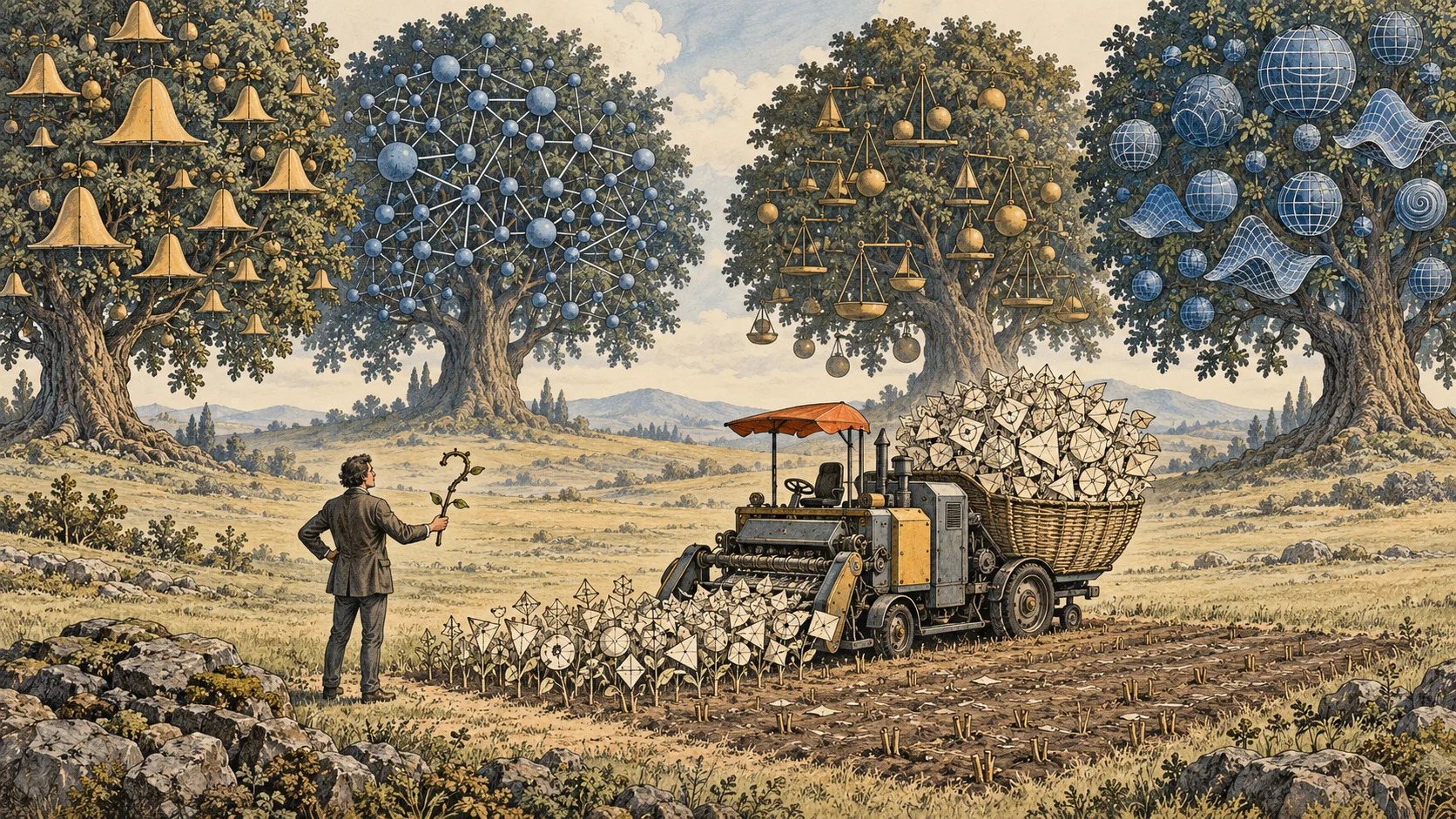
- •OpenAI’s release contains more than 700 model-proved mathematical results, with fewer than 1% in four major fields
- •Statistics, ML theory, optimization and numerical analysis account for 20% of arXiv theorems
- •Author argues math research could feed into LLM training and urges researchers to prepare larger questions
OpenAI has released more than 700 mathematical results proved by its model, but fewer than 1% concern statistics, machine learning theory, optimization or numerical analysis. Those fields make up 20% of the theorems on arXiv, and the gap remains statistically significant even when the comparison counts only arXiv papers that solve open problems. The post asks whether cryptography and other fields are underrepresented in the release, and notes that the results do not touch modern cryptography.
The author suggests one possible explanation: AI labs may hold back work in fields they want to use internally, preserving a competitive advantage. The post also recalls that in 2025 Sebastien Bubeck said GPT-5 Pro solved an open problem in a convex optimization paper by proving a better bound, which he checked. Among the released results, the author says only one would have interested their 2020–2021 self professionally: a proof that Max-Cut cannot be approximated better than 0.878, assuming P != NP. The result follows from the Unique Games Conjecture Theorem included in the same batch.
The author argues that mathematical capabilities could eventually feed back into large language model training, despite weaknesses in pre-2026 deep learning theory. They say mathematics has improved faster than other areas of human expertise and argue that common AI bottlenecks—limited data, costly feedback, and out-of-distribution generalization—do not apply in the same way: mathematics can use synthetic data, cheap verification and straightforward curriculum learning. In the author’s view, adding compute could therefore produce more mathematical capability.
The post cautions against concluding that labs have focused heavily on mathematics for short-term economic gain, noting that human mathematics is not economically fruitful. Instead, it argues that AI improves faster at mathematics than at other tasks, and that labs can direct compute toward it. The author says gains in biology and robotics from $1B of compute would be much smaller than gains in mathematics, and calls on researchers to ask larger questions spanning deep learning, generalization and adversarial examples. Citing Christian Szegedy’s Jevons paradox conjecture, the post imagines cheaper, deeper mathematics becoming fundamental infrastructure. The author anticipates AI systems using mathematical objects that people might need months to describe while remaining only barely superhuman at most other tasks; they say preparatory research questions could help people understand that phase, which they warn could last only a few months if coordination fails.