Pinal Designs Protein Candidates From Text
- •Westlake University researchers developed Pinal to design candidate proteins from natural-language descriptions of their functions.
- •Pinal training used 135 million protein sequences to build 1.7 billion protein-text pairs.
- •One of 29 tested fluorescent candidates worked; five of 20 H-protein candidates worked, with one reaching 1.7 times output.
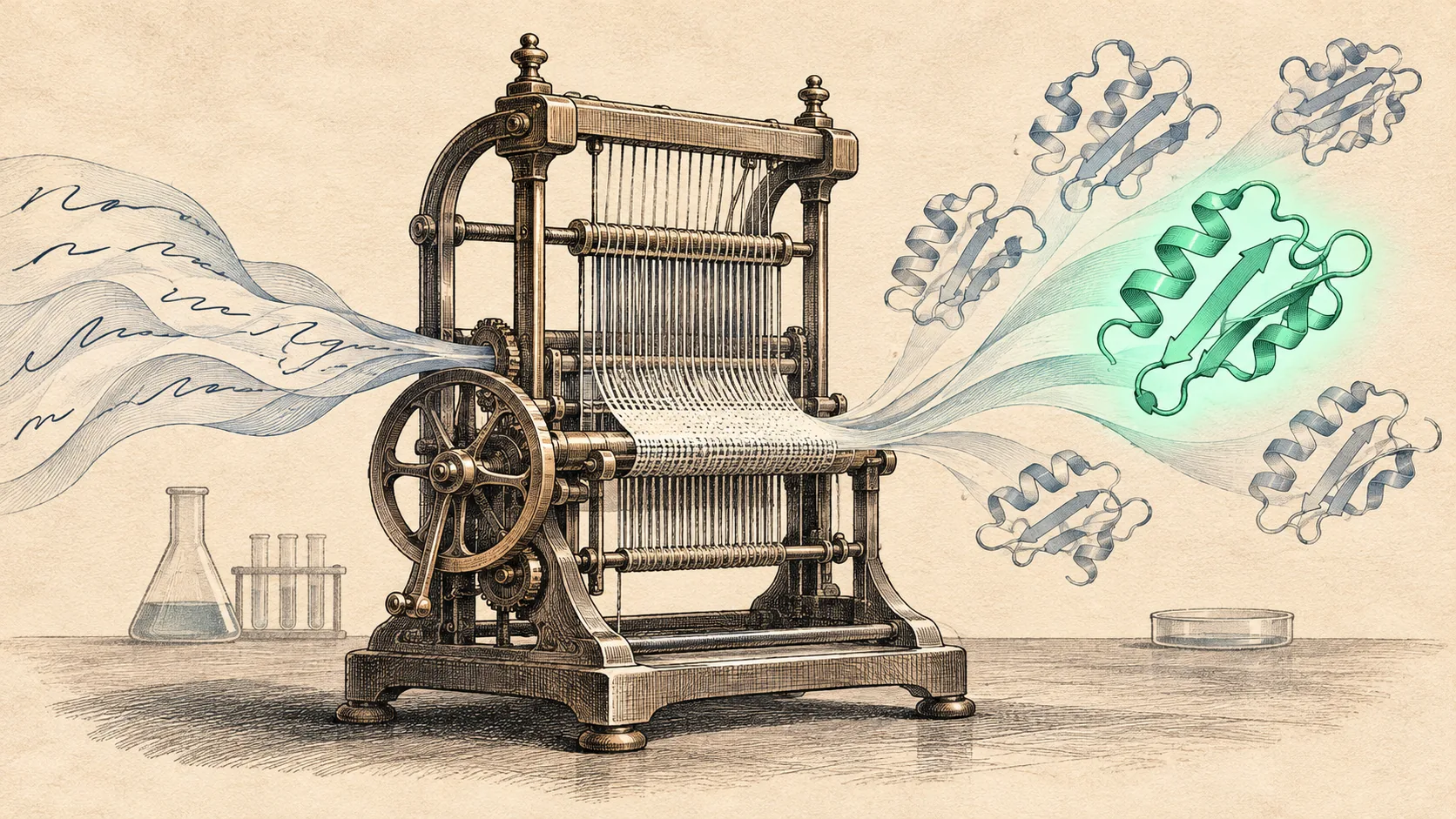
Researchers led by Westlake University in China developed Pinal, an AI model that generates candidate proteins from natural-language descriptions of their desired function. The team reported the system in a paper published in Nature. Protein-design tools have often required users to understand molecular structures and geometric constraints to guide models; Pinal is designed to reduce that need. A user can, for example, ask for a fluorescent protein that emits green light under illumination.
Pinal uses two modules to turn a prompt into a protein sequence. T2struct first creates a one-dimensional structural blueprint, and SaProt-T then uses that blueprint and the original prompt to generate a matching amino acid sequence. The system produces several blueprints, designs a sequence for each, and scores the pairs to select a final candidate. To train it, the researchers began with 135 million protein sequences and used AI models and existing annotations to create plain-language descriptions of their functions. That process yielded 1.7 billion protein-text pairs; the team also obtained predicted three-dimensional structures from an existing AlphaFold database.
Researchers tested Pinal on four targets: a fluorescent protein, a plastic-breaking enzyme, an alcohol dehydrogenase, and a metabolic H-protein. For the fluorescent protein, it generated 50,000 sequences, which were filtered to 29 for testing; only one fluoresced. The researchers said precise control remains difficult, including requests for a specific emission wavelength. Results were stronger for the metabolic H-protein shuttle: five of 20 candidates worked, and the best increased output of a key carbon-capturing process to 1.7 times the output achieved with the natural E. coli protein. The researchers said further work is needed before Pinal becomes a routine laboratory tool.