Rakus CAIO Says SaaS Will Retain Value in AI Era
- •Rakus CAIO Shinichiro Honmatsu says many Japanese companies will continue choosing existing SaaS after AI adoption grows.
- •RakuRaku Seisan has hundreds of features, nearing 1,000 in some estimates; recreating them with AI still requires testing combinations.
- •Rakus is advancing collaborative AI and ASURACORE, aiming to automate expense claims and build systems tailored to individual companies.
Rakus director and CAIO Shinichiro Honmatsu says many Japanese companies will continue choosing existing SaaS even as AI makes it possible to build applications. The interview took place on October 22, 2026. He says Japanese companies tend to seek systems that fit their existing workflows, while companies in the United States and elsewhere are more likely to adapt their work to a system.
Replacing SaaS while keeping current workflows requires reproducing detailed features and processing tasks accurately. Accounting procedures include checks such as matching amounts and verifying entries to prevent mistakes, and systems refined over many years are not easily changed by new technology. Generative AI also carries a hallucination risk (producing output that conflicts with facts). Honmatsu says the difficulty of replacement depends both on technology and on how much a company can change its operations.
Rakus is conducting internal thought experiments and limited PoCs (tests of practical feasibility) on whether its expense-management service, RakuRaku Seisan, could be replaced by an AI-based system. Honmatsu says it comprises hundreds of features, in some cases nearing 1,000. Even if AI reproduced 100 features, people would need to check whether they work correctly in combination. AI implementation and testing also require specifications that define correct behavior; writing those specifications and judging whether the system works for the business require knowledge of both operations and systems. Even for Rakus, a company specializing in system development, organizing and checking specifications for every feature would be a major burden.
Honmatsu says SaaS value includes not only features but also the knowledge and know-how needed to combine them into workable business processes and verify that they function correctly. AI replacement may advance for simple tasks, but building a system in-house also entails staffing costs for maintenance and repairs. Considering quality, efficiency and operating costs, an existing package that is both affordable and high quality may be the better option.
Rakus is developing “collaborative AI,” which uses rule-based systems as its foundation and automates tasks previously handled by people. An AI agent supporting voucher creation in RakuRaku Seisan helps transfer receipt details and assess amounts and account categories. Rakus aims to automate judgments formerly made by people by having AI learn from or refer to past claims and instructions from accounting staff. The company also plans to use AI for tasks such as checking claims against internal rules, which require interpreting text and making varied judgments that are difficult to express as fixed conditions. Rakus says RakuRaku Seisan’s strength is that past claims and approval results are available within the system; it continues to review which information should be used for learning.
Rakus aims for “complete automation” of expense reimbursement, but Honmatsu says people will not be removed entirely. AI’s review can reduce their workload, while final approvals and other checks remain because people are responsible for errors. By “complete automation,” the company means that systems and AI handle much of the work while people remain involved in decisions and checks that carry responsibility.
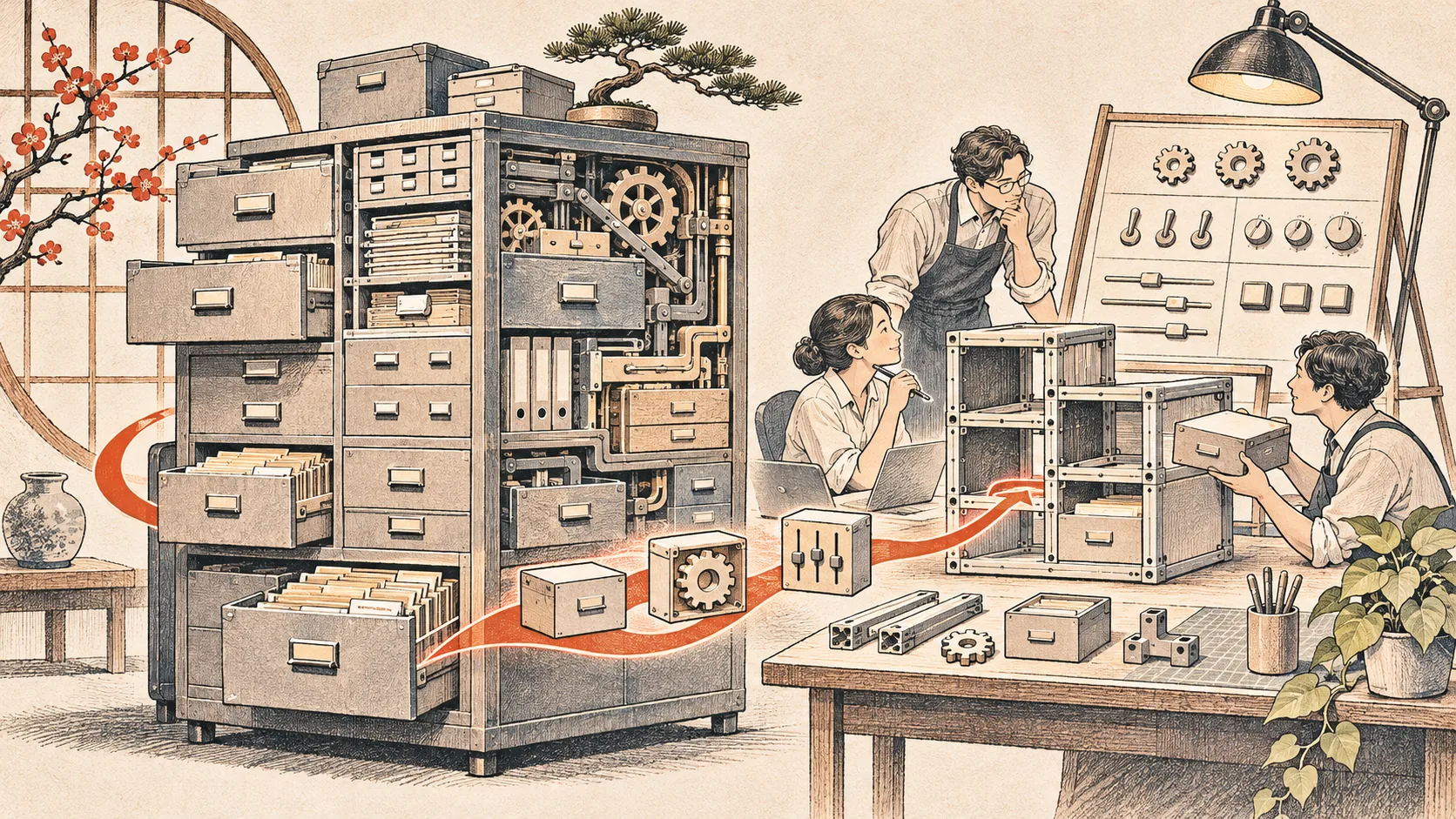
Rakus is also working on ASURACORE, a service that uses AI to build systems tailored to each customer’s operations. An ASURACORE director interviews the customer, translates requests expressed in everyday language into features, and says the system can be ready for use in as little as 1 month. The service draws on Rakus’s accumulated business knowledge, organized as an ontology (a formal representation of concepts and their relationships). Customer-specific conditions are identified during requirements definition; the service does not assume that every company’s implicit knowledge can be fully mapped in advance.
Honmatsu says concept tests have succeeded in building systems by combining prepared business knowledge with information gathered by directors. The knowledge shared across projects records which features were built for which business requirements; customer-identifying details and specific operational information are not used for learning. Internal rules and decision criteria that AI consults during operation are treated as knowledge belonging to each company. Rakus plans to apply lessons from system-building experience to features, screens and processing methods in later systems.
Honmatsu says Rakus prioritizes understanding customers’ operations and problems to improve efficiency, rather than the SaaS delivery model itself. The company plans to refine features for tasks existing SaaS can handle, combine AI with tasks where it is effective, and build systems for individual requirements. He says that when companies review their operations with AI in mind, their system requirements will also change.