Researchers Present SLA Robot Model
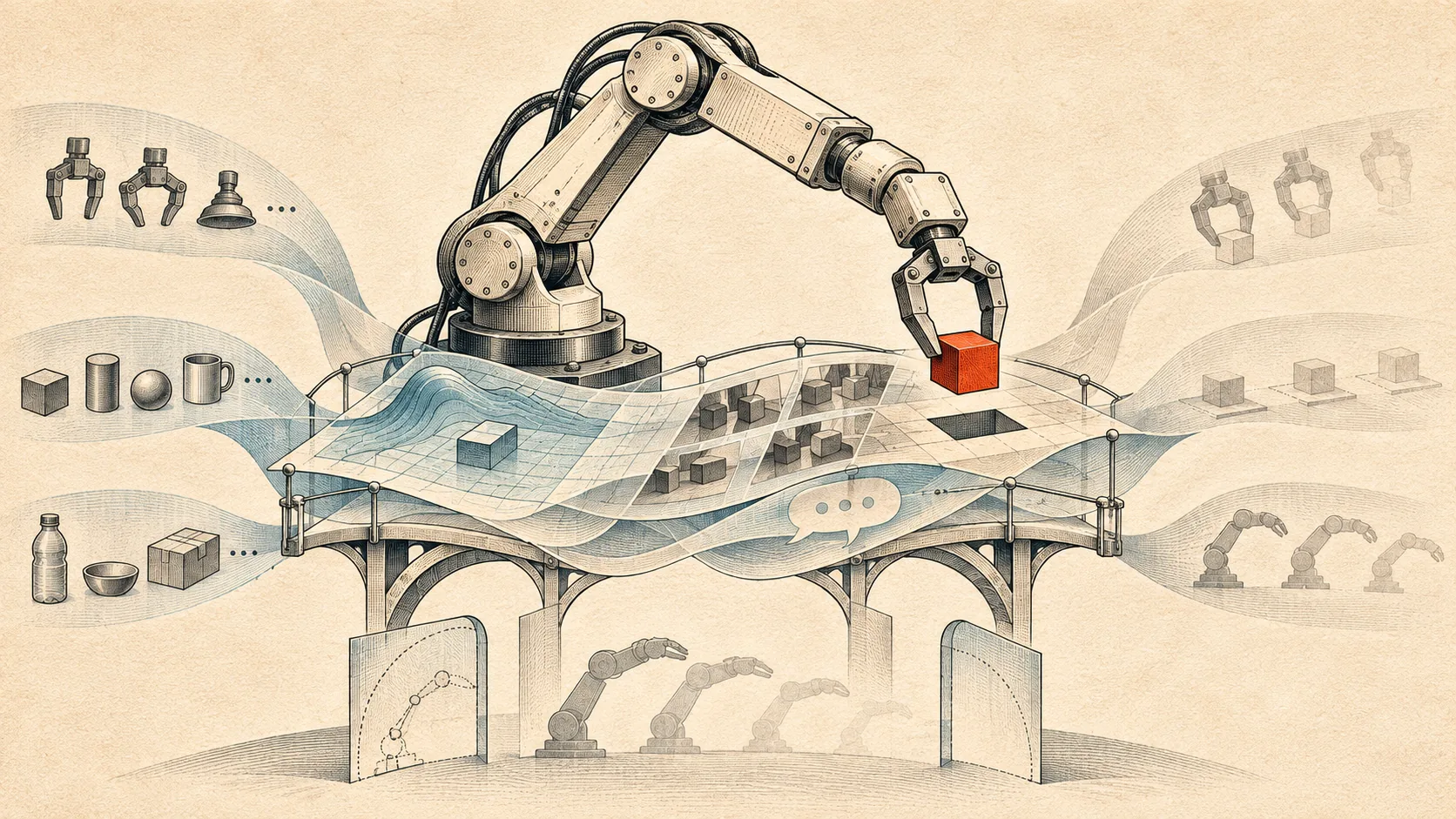
- •Researchers present SLA, a spatial-language-action model for robotic manipulation, in a paper published November 5.
- •SLA aligns visual embeddings with spatial representations while training on varied robot datasets and tasks.
- •Training-only gates and probabilistic state dropout preserve the original inference architecture, the authors say.
Researchers introduced SLA, a Spatial-Language-Action model for robotic manipulation, in a paper published on November 5 and submitted on November 6. It aims to combine semantic understanding with precise control in three-dimensional space. The authors say vision-language-action (VLA) models often inherit representations from 2D vision-language pre-training, while spatial supervision is added mainly during adaptation for specific tasks.
Initialized from a pretrained pi05 policy, SLA continually pre-trains and post-trains the policy while aligning intermediate visual embeddings with spatial representations from a frozen 3D perception model. The researchers unified varied robot datasets covering different embodiments, tasks and scenes. Feature-dependent gates (learned controls that combine features) select visual embeddings from multiple VLA layers for spatial supervision.
The 3D perception model uses available depth and camera calibration data alongside RGB observations, allowing the method to use varied geometric annotations. Probabilistic state dropout (randomly omitting state inputs during training) encourages the model to rely on visual cues and reduces overfitting to demonstration trajectories. The auxiliary components are used only during training, so the authors say SLA can reuse pretrained VLA weights while preserving the original inference architecture.