Tesla and SpaceX Advance Merger Talks
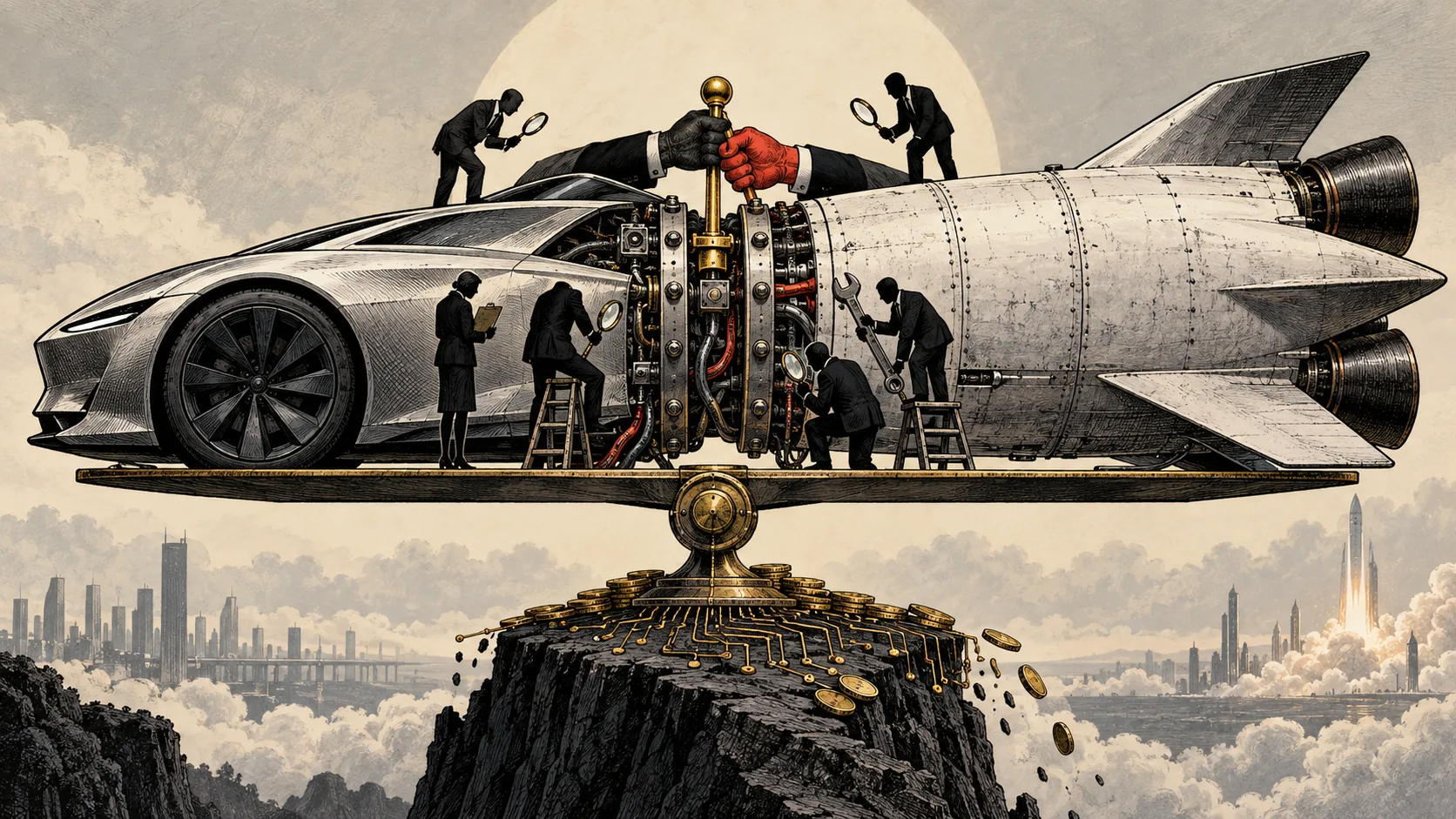
- •Tesla and SpaceX formed independent director committees to discuss a merger, with combined valuations of $3.5 trillion.
- •Shareholder compensation for Tesla investors and Elon Musk’s control are key issues in the talks.
- •The proposed combination would unite real-world data and AI infrastructure, while governance and investment costs remain unresolved.
Tesla and SpaceX are discussing a merger in earnest, with each company forming a special committee of independent directors. CEO Elon Musk said a merger would have significant advantages. Their combined valuation is $3.5 trillion. Wall Street is treating a merger as a near certainty, but key questions include what Tesla shareholders would receive and how much control Musk would gain.
A merger could create an AI company spanning cars, robots, semiconductors, data centers and communications networks. OpenAI and Anthropic have focused on chatbots, coding agents and business automation, while major AI services from Google, Amazon and Meta are based in digital environments. A Tesla-SpaceX combination would put physical products such as cars and robots at the center of its AI business.
The companies’ businesses have changed over the past 1–2 years. Tesla is presenting autonomous driving and robots as growth businesses alongside electric vehicle manufacturing. After unveiling its Cybercab autonomous vehicle in 2024, it recently began early production of its Optimus humanoid robot. SpaceX expanded its AI models and computing businesses after absorbing xAI. In the third quarter, revenue from businesses including AI models and computing reached $7.6 billion, more than half of SpaceX’s total revenue of $14.6 billion.
Real-world data and the conditions needed to collect it are cited as potential advantages in developing Physical AI. Language models can learn from online text and code, while robots need data from moving through physical spaces and handling objects. Tesla already operates cars and factories, using driving data to improve its autonomous driving system. If Optimus is deployed widely in factories, Tesla could also collect data on robot tasks. Mass deployment could increase the volume of data, but driving and task data differ, and Optimus is still in early production, so the amount actually collected remains to be seen.
Grok Voice 3.0, unveiled on the 14th, is an example of applying an AI model to services across affiliated companies. It ranked first with a score of 86.9 in Artificial Analysis’s voice AI evaluation. The model handles millions of conversations per day in Tesla vehicles and is used for 20,000 daily calls at Starlink customer support. The company says it handles about 70% of support calls without human intervention. Problems and customer requests from live services can inform model improvements, but the companies have not disclosed how much real-world data has contributed to performance gains.
AI inference infrastructure is another part of the merger discussions. At the end of the third quarter, SpaceX had AI computing infrastructure with capacity of 1.7 gigawatts (GW), as well as the Starlink satellite network. Tesla could add batteries, energy storage systems and in-house AI chip design capabilities. The companies are jointly pursuing Terafab, a large-scale semiconductor manufacturing facility. SpaceX is also considering space-based data centers, but the business cases for both Terafab and space data centers remain unproven.
A merged company could sell AI models externally and use them in autonomous driving software, in-car voice services, Starlink customer support and, in the future, Optimus. Google has Search, Android and Waymo, while Amazon has cloud services and logistics robots. The proposed combination of cars, humanoid robots, satellite communications, AI computing and semiconductors within one company would be distinctive. However, Tesla and SpaceX already cooperate on deploying Grok in vehicles and developing Terafab, so a legal merger is not essential to achieve technical synergies. Governance and investment costs also remain concerns: Musk holds about 85% of the voting power at SpaceX and about 20% at Tesla. Whether the companies will actually merge remains unknown.