U.S. Midterms Put AI and Data Centers on Ballot
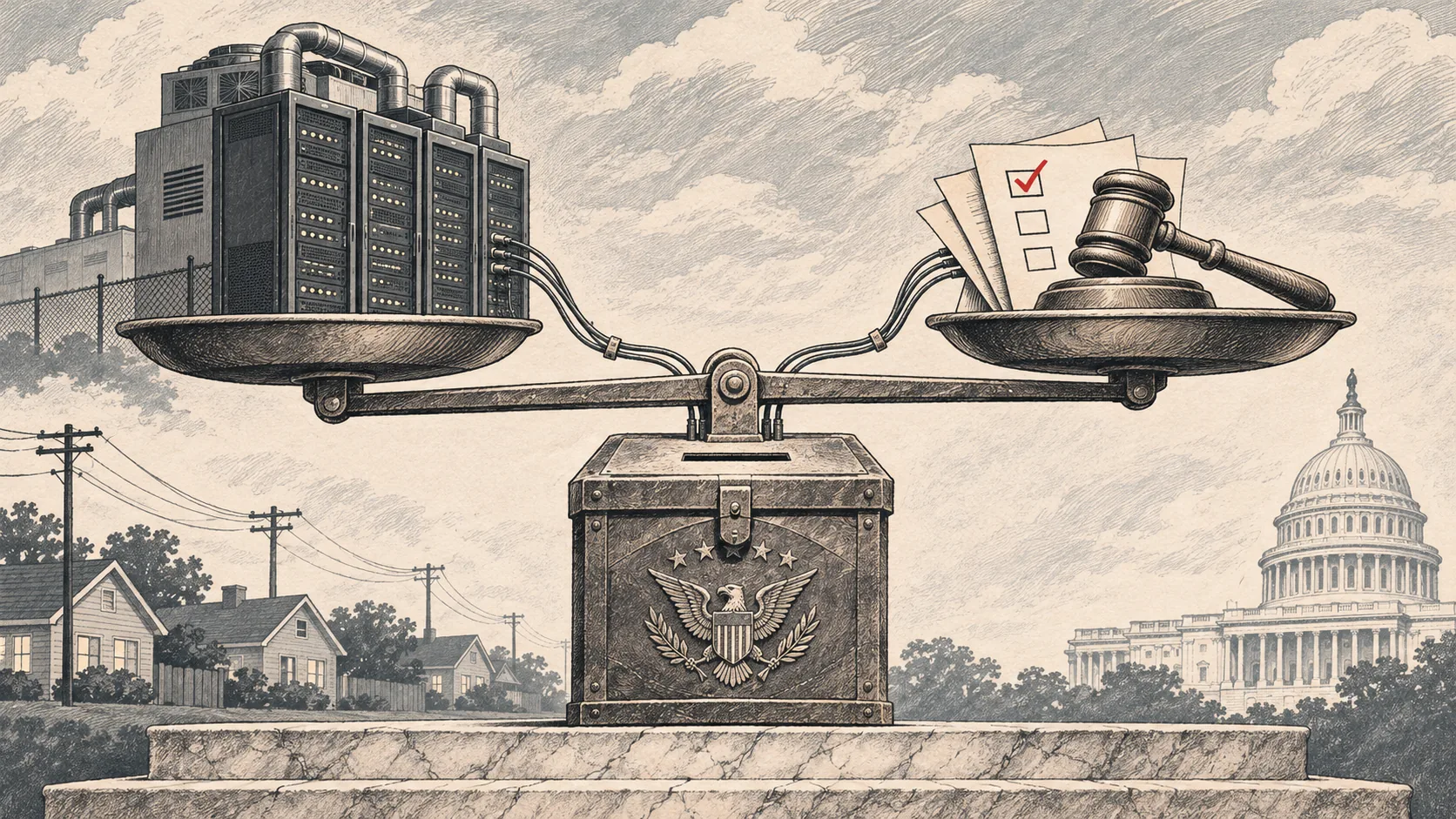
- •U.S. voters consider at least 41 data center ballot measures amid local opposition to major projects.
- •Ohio lists 21 measures; Piqua voters weigh recalling officials backing Meta’s $1 billion data center.
- •Midterm outcomes could shape federal AI regulation, congressional investigations, and responses to election manipulation.
Voters in dozens of U.S. states and municipalities are deciding on at least 41 ballot initiatives involving data centers, amid disputes over projects worth hundreds of billions of dollars. Ohio has 21 measures, including 11 that would ban construction or pause further development. In Piqua, a city of 20,000, voters are deciding whether to recall the mayor and two city commissioners who supported Meta’s planned $1 billion data center, with capacity of up to 1.4 gigawatts and a promised 1,000 construction jobs. Ballots also cover a $2 billion AWS project in Sunbury and a $10 billion AWS project in Adams County.
Opposition has already disrupted at least 45 data center projects worth about $68 billion in the second quarter of 2026, according to Data Center Watch, a research project run by 10a Labs. The article cites a recent Pew Research Center poll finding that more Americans are fearful than hopeful about AI. It says project delays could affect AI companies seeking computing capacity and neocloud firms that provide it. Nvidia CEO Jensen Huang said communities should be consulted before large investments, and developers should seek other locations if residents oppose a project. OpenAI has promoted the name “compute campuses” for data centers, though the article says it is unclear whether the rebranding will change local views.
The election could also affect federal AI policy. If Democrats control Congress, the article says they are more likely to pursue federal AI regulation; a new Congress could change the prospects of the bipartisan Frontier Act or other bills. Any law would face a likely veto from President Donald Trump and would need a two-thirds majority in both chambers to override it. A Democratic-controlled Congress could also investigate AI companies’ safety and security practices. Senator Elizabeth Warren has already asked Anthropic CEO Dario Amodei about risks disclosed in the company’s IPO prospectus.
The article also examines possible election interference. AI-generated political ads and satirical memes are increasingly used for persuasion, while deepfakes have not proved decisive in U.S. elections so far. Anthropic’s Claude produced an 11-page dossier on an AI-powered influence campaign intended to suppress turnout when asked by The Transformer how it might manipulate the midterms. Experts have also warned about poisoning chatbot data to distort answers about candidates or voting procedures, and about misinformation claiming polling-place problems. OpenAI and Anthropic said they set up war rooms to guard against political misuse of their models.
Anthropic’s infrastructure commitments are another concern raised in the article. Its updated IPO prospectus disclosed about $895 billion in infrastructure and compute commitments. The company said it spent $5 billion in the third quarter on short-term computing capacity, contributing to its adjusted operating margin falling to 15% from 19% in the previous quarter. Anthropic plans longer-term capacity purchases and may build data centers through its Anthropic Direct project, while the article notes uncertainty about whether needed facilities can be built and connected to the grid on schedule.