Researchers Introduce VidUEU-Agent Video Data Pipeline
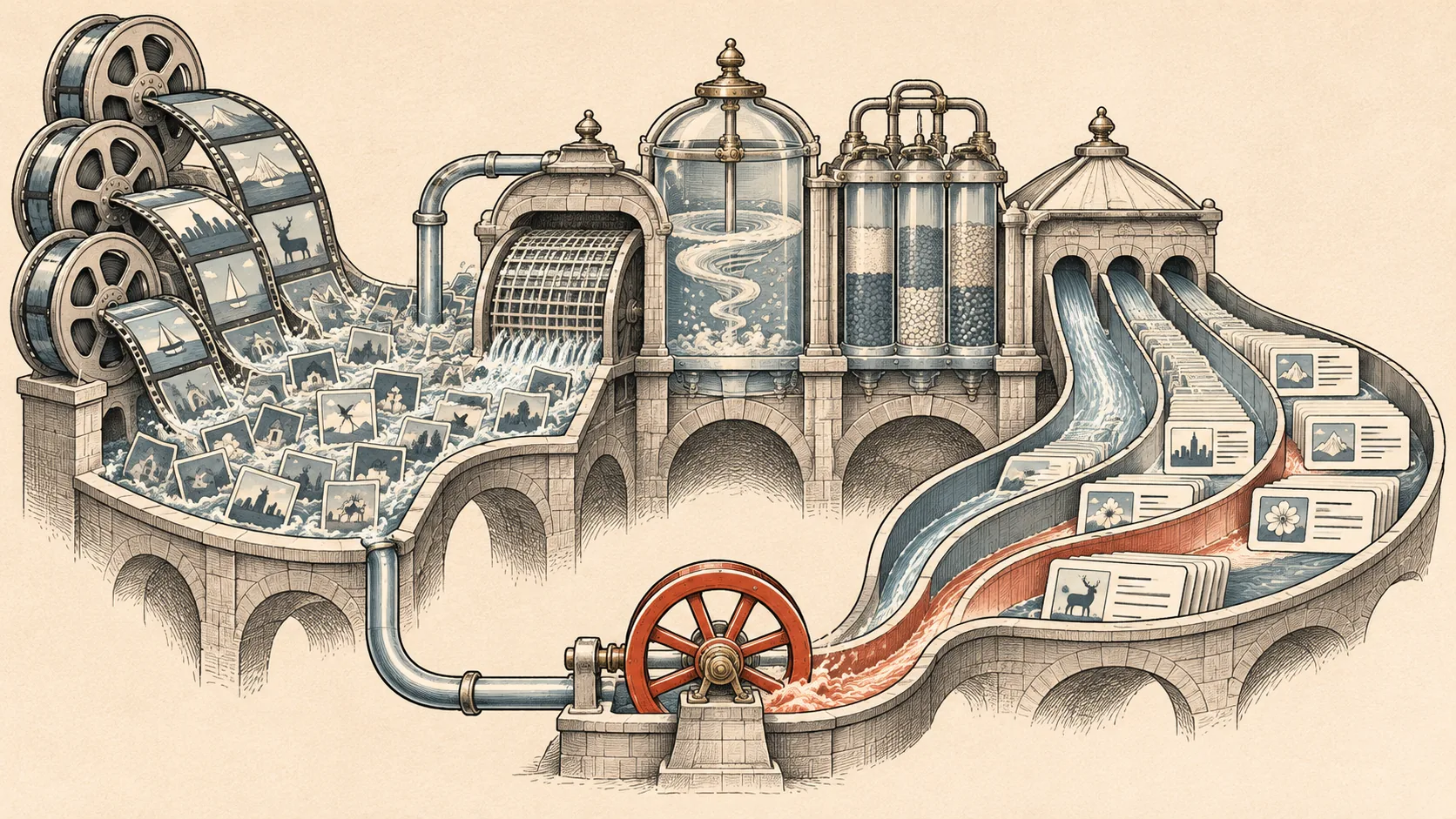
- •Researchers introduce VidUEU-Agent to synthesize multimodal instruction data from raw videos
- •Four-stage pipeline iterates on data distribution using downstream training and evaluation feedback
- •VidUEU-100K contains 100,000 samples from 8,268 videos across nine task paradigms
Researchers introduced VidUEU-Agent, an automated pipeline that turns raw videos into instruction data for multimodal understanding, image editing, and unified understanding-and-generation tasks. The authors say the system addresses the scarcity and high annotation cost of high-quality instruction data. The paper was published on November 3 and submitted to Hugging Face on November 4.
The pipeline has four stages: it analyzes videos to filter low-quality shots, selects keyframes and multimodal signals, builds structured metadata, and routes that metadata to suitable tasks for instruction synthesis. It uses vision-language models and visual tools for quality assessment, semantic analysis, and information verification. During synthesis, it cites the evidence signals used, which the authors say improves traceability and factual consistency.
VidUEU-Agent also uses downstream training and evaluation results to refine the distribution of data across capabilities, domains, and task types. The authors report overall improvement on three feedback benchmarks across four iterations, each using 30K samples to fine-tune BAGEL from the same initial checkpoint. The resulting VidUEU-100K dataset was built from 8,268 videos and contains nearly 20,000 dense metadata annotations and 100,000 instruction samples: 40K for understanding, 30K for editing, and 30K for unified tasks. It spans nine task paradigms and five scenario categories. The authors say fine-tuning baseline models on the dataset produced consistent gains across representative benchmarks, but the page does not provide individual scores.