Recursive Self-Improvement: What Future Could Self-Evolving AI Create?
What happens if an AI creates a more capable AI—and that AI creates one that is more capable still?
Such a cycle could help researchers solve scientific problems that have challenged humanity for decades. It also raises a concern: AI might advance faster than people can understand or manage, eventually becoming difficult to control.
In 2026, researchers including Geoffrey Hinton and Yoshua Bengio published a paper examining whether the automation of AI research and development could lead to capabilities improving faster than expected. They argued that while the timing and form of such a future remain uncertain, it could have major consequences for human control and society’s ability to respond.
The idea that AI could contribute to its own advancement, then use the results to drive further progress, is called recursive self-improvement, or RSI.
At DEEP DIVE INTO 2026 in Seoul on November 11, Sakana AI researcher Stefania Druga discussed work toward AI systems that discover, learn, and evolve. Her presentation offers a starting point for understanding how RSI might work, what it could make possible, and the questions it raises.
What does it mean for AI to evolve?
Today, creating a new AI model takes the work of many people. Researchers design model architectures, change training methods, and compare experiments to find better approaches.
RSI describes a cycle in which AI performs part—or eventually a substantial share—of that work, and the resulting improvements help it contribute to its own next round of development.
Imagine an AI finding a more efficient way to train a model. Researchers use that method to create a more capable AI, which then studies how to improve training again. Repeated over time, this creates a process in which an improved AI helps drive the next improvement.
The key is that the process goes beyond revising a single answer. The improvement must carry forward into the AI’s capabilities or the research that follows.
Self-improvement can happen at different levels. Some research focuses on changing the tools or programs an AI uses; other work searches for better ways to train models. AI that continually advances its own underlying technology across a broader range remains a research goal.
What is Sakana AI?

Sakana AI is an AI research and development company founded in Tokyo in 2023 by David Ha, Llion Jones, and Ren Ito.
Sakana means “fish” in Japanese. The name reflects the company’s interest in collective intelligence: the capabilities that can emerge when individual agents interact and cooperate, much like fish moving in a school.
Sakana AI also draws inspiration from evolution in nature. Alongside developing powerful models, it studies ways to generate and combine diverse AIs and ideas in search of useful results. Examples include The AI Scientist, a system for AI-assisted scientific research, and the Darwin Gödel Machine, which improves by modifying its own code.
In June 2026, the company established RSI Lab to study how AI could help advance AI development itself. At the Seoul event, Druga explained that the lab is interested in whether AI can adapt and improve using fewer computational resources.
How can AI improve itself?

The Darwin Gödel Machine, developed by Sakana AI with researchers at the University of British Columbia, offers a concrete example of self-improvement.
It is an AI coding agent. The researchers designed it to read and modify its own program, then test whether the modified version solves programming problems more effectively.
For instance, it might change a tool for inspecting files or add a step that generates and compares several possible solutions. Each new agent is evaluated on coding problems, and the results can inform subsequent versions.
The system does not follow just one path. It keeps a collection of different versions and explores improvements from them. A version that performs less well at first may still provide a useful starting point for a later discovery.
| Step | What the Darwin Gödel Machine does |
|---|---|
| Modify | Changes an existing agent’s code or tools. |
| Evaluate | Tests how well the modified version solves coding problems. |
| Keep | Retains multiple versions and their evaluation results. |
| Repeat | Uses retained versions as starting points for new changes. |
In an experiment reported by Sakana AI, the system’s score on SWE-bench, a software engineering benchmark, increased from an initial 20% to 50%.
What improved in that experiment was primarily the coding agent’s code and workflow, rather than the intelligence of its underlying language model. Even so, the system’s ability to modify part of itself and use evaluation results for further changes makes it a useful research example on the path toward broader self-improvement.
AI for Science: AI joins the search for discoveries
For AI to advance AI, it must first be able to participate in research: forming hypotheses, designing experiments, interpreting results, and exploring new possibilities.
A related field is AI for Science, the use of AI in scientific research. Alongside Sakana AI, companies including OpenAI and Anthropic have published examples of AI contributing to mathematics, biology, and other fields.
Sakana AI’s The AI Scientist generates research ideas, writes code, runs experiments, and assembles results into papers. Its v3 system coordinates multiple coding agents and can also be used by human researchers as a collaborator.
A paper written by the earlier v2 system met the acceptance threshold in human review for an AI conference workshop. In line with a decision made in advance, the researchers withdrew it before publication. The result showed potential for automating parts of research, while underscoring the importance of checking scientific accuracy and value.
OpenAI has reported a mathematics result. In May 2026, the company announced that an internal model had produced a proof disproving a longstanding conjecture about distances between points in a plane. According to OpenAI, outside mathematicians checked the proof and wrote a separate explanatory paper.
Anthropic has reported a biology example. With high-level direction from researchers, Claude analyzed DNA data and identified an enzyme system with features reminiscent of CRISPR. Anthropic says the system’s function is not yet known and requires further study.
In each case, AI participated in searching for ideas or candidates relevant to research, in addition to tasks such as summarizing literature and drafting text.
But not every use of AI in science is RSI. An AI finding a new enzyme does not mean that the AI itself has evolved. If AI becomes more capable of conducting research, however, and those capabilities are applied to AI development, the cycle needed for RSI may become more concrete.
From digital systems to robots
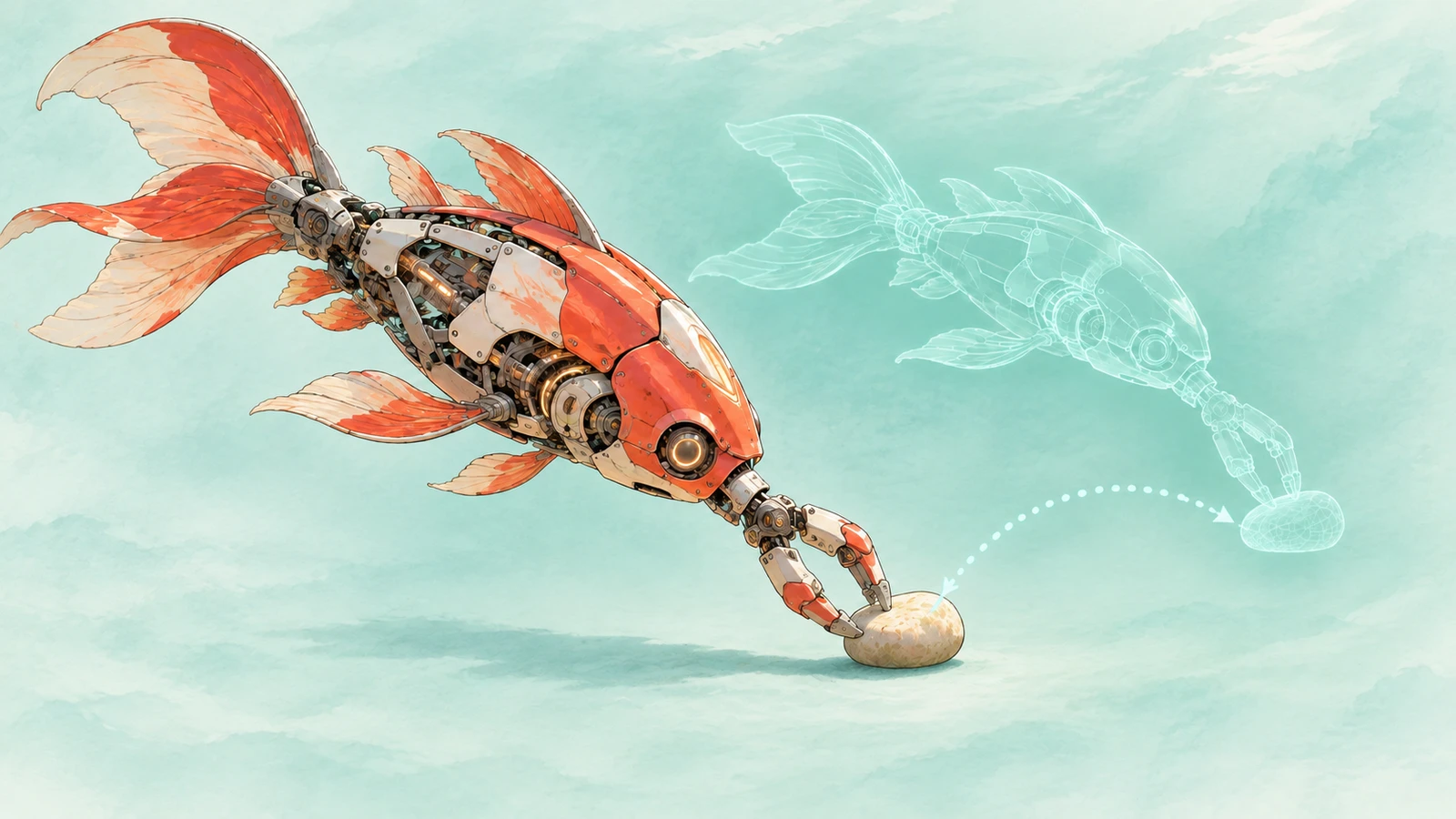
Druga also discussed how self-improvement research could extend to physical AI, including robots.
Robots must act in the real world, which presents challenges beyond those faced by software on a screen. A small change in an object’s position can cause a task to fail, and an incorrect action can lead to a real accident.
One technology researchers are exploring is the world model, which helps predict how an environment might change after an action. A robot could use a simulated environment to examine the result of moving its arm before making the real movement.
Druga described research in which she used records of a robot’s failures to improve its control policy and tested tasks such as opening drawers and placing objects in simulation. At the time of her presentation, real-robot validation was still pending.
The point is to make failures informative. Recording where a robot was, how it moved, and what its cameras saw can provide clues for improving the next attempt.
As this work develops, it could help robots in manufacturing or laboratory equipment adapt to a wider range of situations. A result that succeeds in simulation, however, still needs separate testing to establish whether it works safely in the real world.
AI’s evolution and the future we choose

AI that improves itself could help scientists test more hypotheses and businesses advance complex research and development. At the same time, there is growing concern about whether people will be able to understand and control the pace and direction of its progress.
The 2026 paper involving Geoffrey Hinton, Yoshua Bengio, and other researchers considered the possibility of an intelligence explosion: AI automating AI research and development, potentially compressing years of progress into a much shorter period. The authors warned that if AI capabilities grow faster than society can respond, it may become difficult to assess safety or maintain human control.
That future is not inevitable. How far self-improvement can go, and how quickly it might progress, remain open research questions. As AI participates in more research and decisions, however, the ways people verify its results and intervene when necessary must develop too.
In her presentation, Druga emphasized asking what improved, how that improvement was verified, and whether it holds in new situations. Alongside how quickly AI evolves, we need to consider which problems its evolution solves—and whom it helps.
Read Next
More posts related to AI Trends →
Teach Kids About AI, Limit Their AI Use: 6 Family Rules for Safe AI
In our last post, we looked at "What Should Kids Learn When AI Does the Work?" This time, let's look at what families can actually do at home. O…
AI Basics Through History: Does AI Have a Self?
AI is pretty amazing, isn't it? It can explain almost anything, and sometimes it talks so naturally that you forget you're not chatting with a p…

Decision AI After Jev: What OpenAI and Laya Could Change for Businesses
Does routing a customer inquiry really require an AI to write a long answer? That was the question behind our earlier article on Jev. OpenAI, Pe…

Who Will Control AI Agents: The AI Builders or the Platforms Holding the Data and Tools?
When a shopper tells an AI, “Find the right one and buy it for me,” who controls the customer relationship? The AI company that understands the…