Teach Kids About AI, Limit Their AI Use: 6 Family Rules for Safe AI
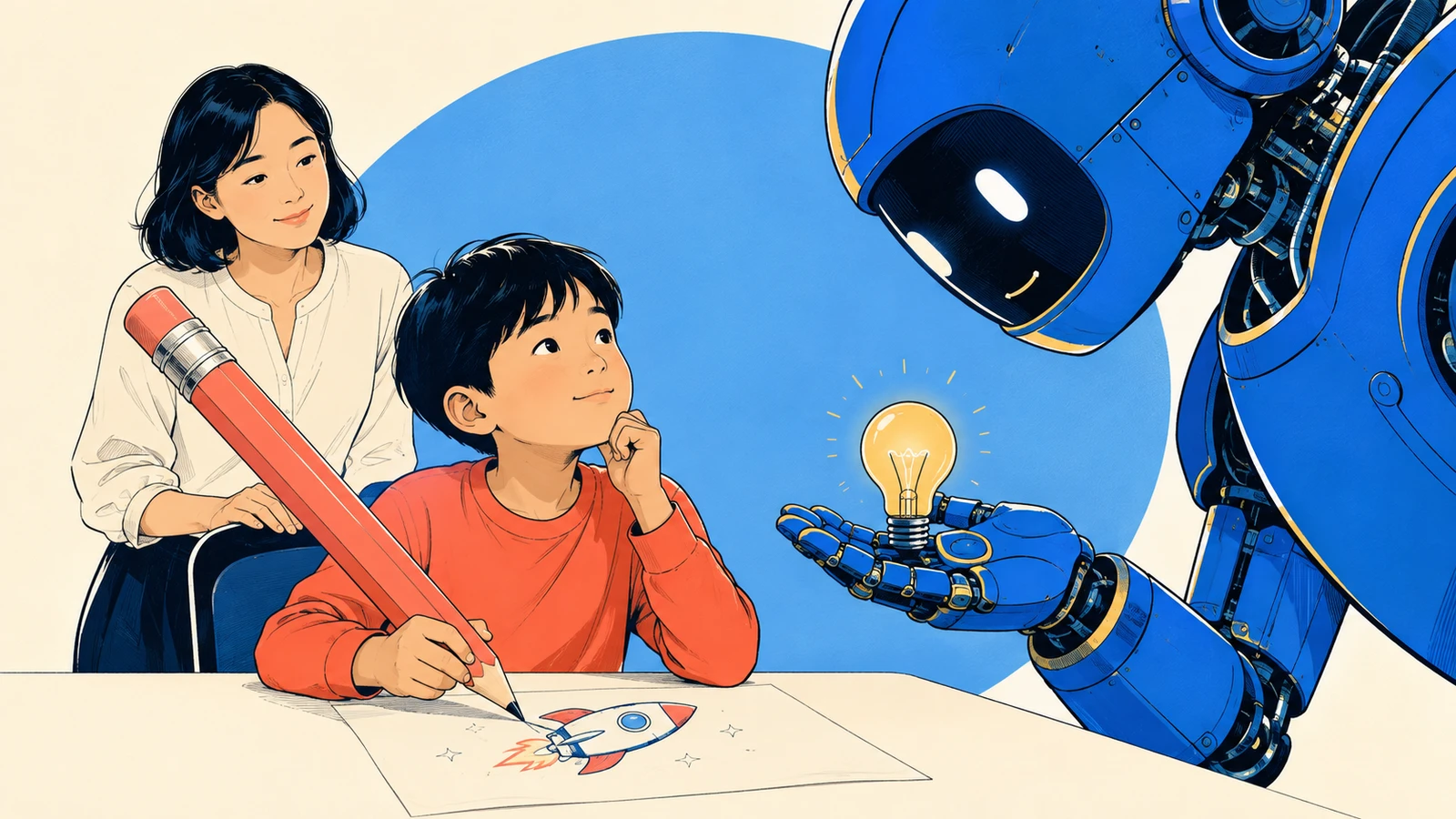
In our last post, we looked at "What Should Kids Learn When AI Does the Work?" This time, let's look at what families can actually do at home.
On September 4, 2026, US pediatrician Kristen Cook wrote an article for Psychology Today titled “Teaching Our Children How to Use AI Safely.” Her point: teach kids to use AI as a tool that supports learning, not as something that does their thinking for them.
This post builds on the six family rules Cook proposed. We checked related research and institutional resources and added examples you can use at home.
If your child is in the early elementary grades, start by checking the age requirements and terms for any AI service, then ask questions and review the answers together. If your child isn't old enough to use these tools directly, examples you show them or simple picture cards are plenty to get the conversation started.
1. Use AI for hints when you're stuck
 Let's compare these two questions.
- Question A: “I have to write a book report on a dinosaur book. Write the summary and my thoughts for me.”
- Question B: “I want to know why the dinosaurs disappeared. Explain it briefly so an elementary school kid can understand.”
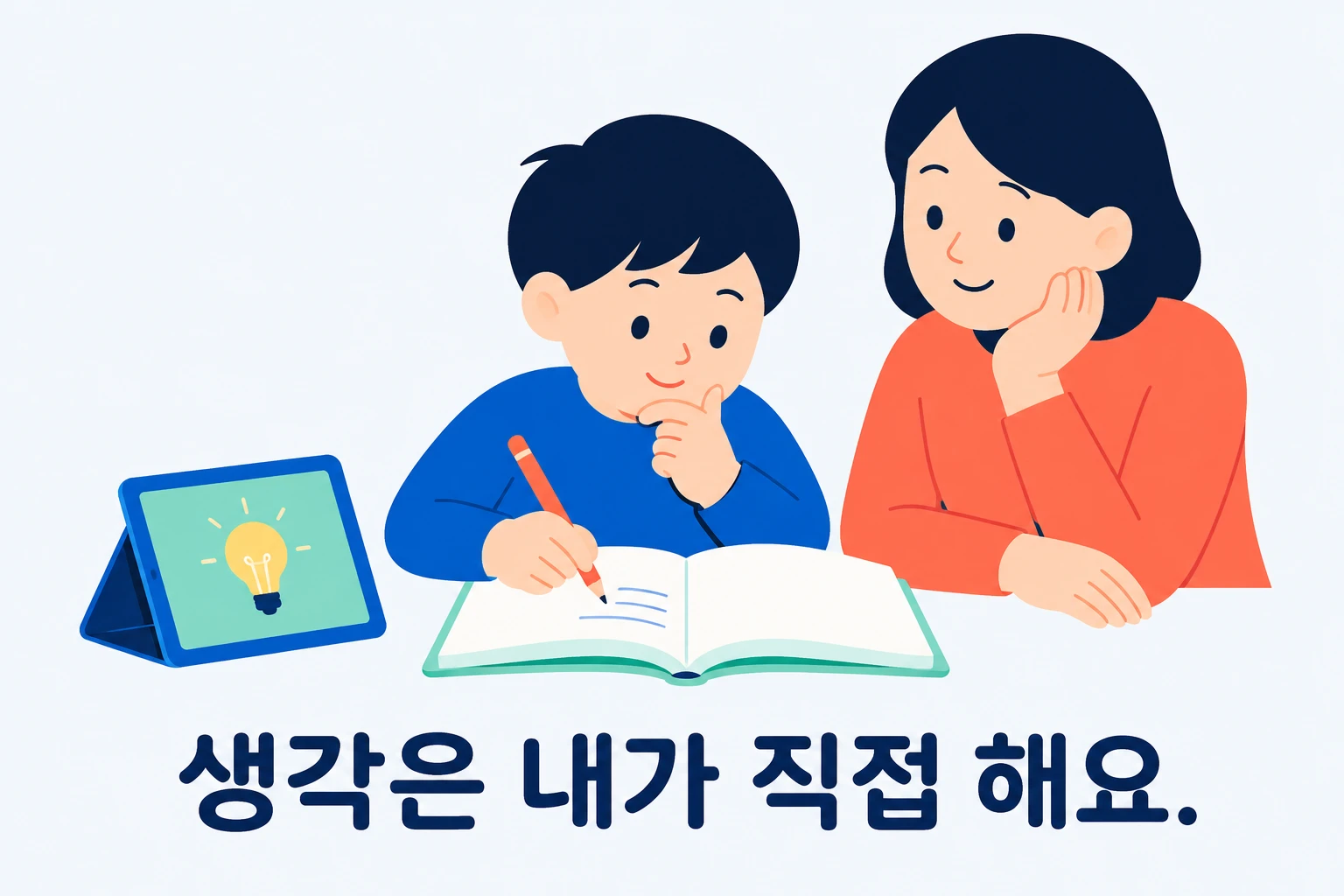
Question A hands off to AI even the thoughts and reactions a child should work out on their own. Question B asks for help understanding something they're curious about.
That said, reading an easy explanation doesn't instantly make it your own knowledge. After your child reads the answer, try asking, “Can you tell me that again in your own words?” or “What are you curious about now?” That helps them go beyond just taking in an explanation and connect it to their own thinking.
Another approach is asking AI to explain a hard word in simpler terms, or, after reading a picture book, asking, “Give me one question that helps me think about how the main character feels.” Instead of getting AI to write the answer, your child gets a clue to keep thinking.
If you're not sure which kind of use is a good one, try this question as your guide:
“Is AI helping my child think, or helping them skip the thinking?”
2. AI can sound confident and still be wrong
 AI answers often sound natural and confident. But a confident tone doesn't guarantee accurate content.
A 2026 research review published in Pediatrics, the journal of the American Academy of Pediatrics (AAP), also flagged “hallucinations,” where generative AI presents false information convincingly, along with bias, as problems to watch for.
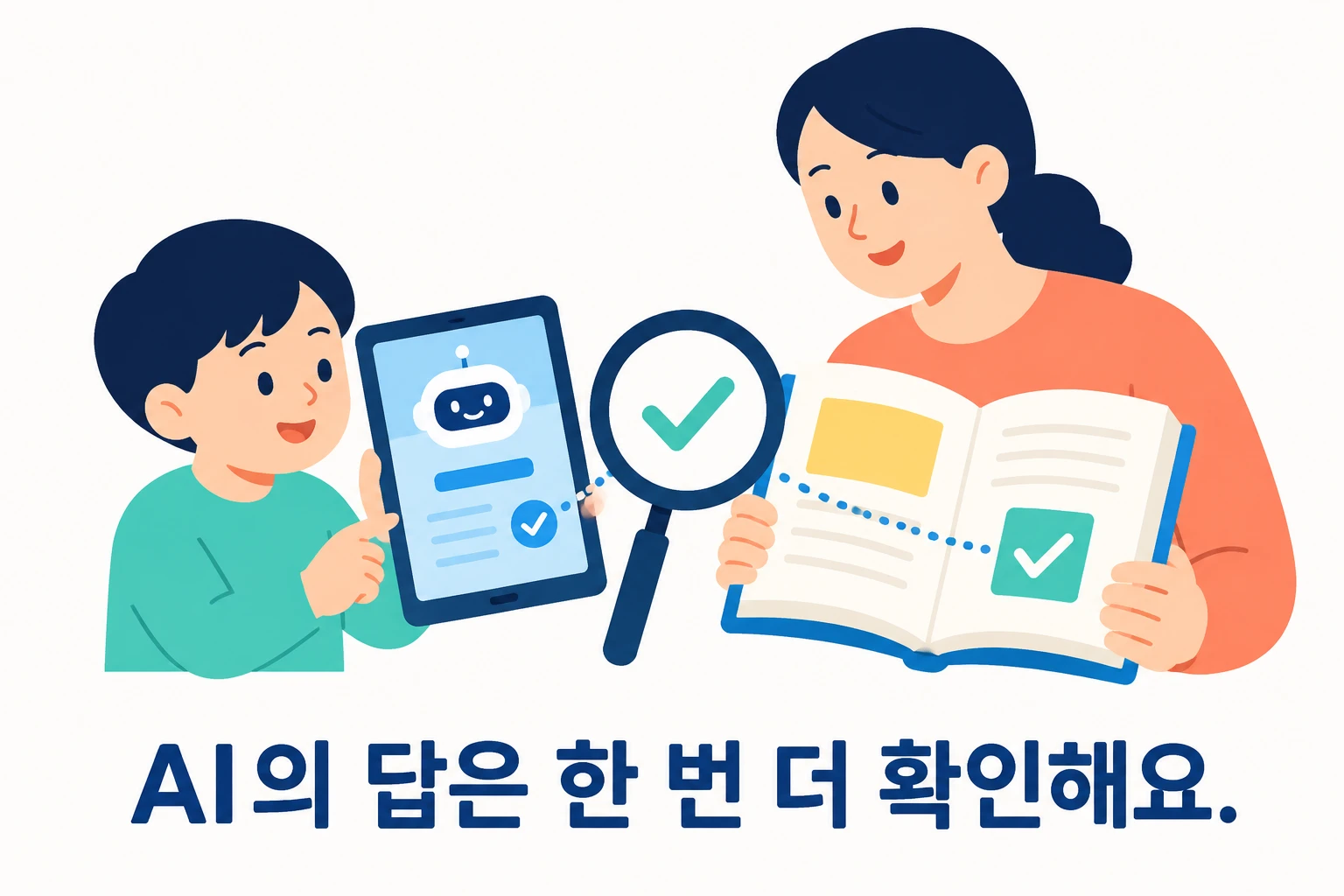
At home, you can practice this as three steps: “Stop → Check the source → Confirm with another source.” It's a simple routine designed to be easy for kids to remember.
- Stop: Take a moment to think, “Could this answer be wrong?”
- Check the source: With a parent, check whether the books or links AI mentions actually exist, and whether they really say the same thing. AI can even make up its sources.
- Confirm with another source: Compare with a separate, trustworthy source, such as a children's encyclopedia or materials from an expert organization. Remember that even if several places say the same thing, they may all have copied the same wrong information.
Your child doesn't need to verify every answer alone. It's enough to build the habit of checking the important things together with an adult.
“AI can be wrong, too. Let's double-check the important stuff.” Start with that one short line.
3. Don't share personal information or secrets with AI
 While chatting with AI, kids may naturally start typing in details about themselves or their family. But an AI chat window isn't a private diary only they can read.
How the information you enter is stored, and whether it's used for training, depends on the service and its settings. Even so, it's a good idea to set clear boundaries so your child doesn't type in personal information carelessly. UNICEF also emphasizes privacy protection as a core requirement for AI for children.
For kids, a concrete promise is easier to understand than a complicated explanation.
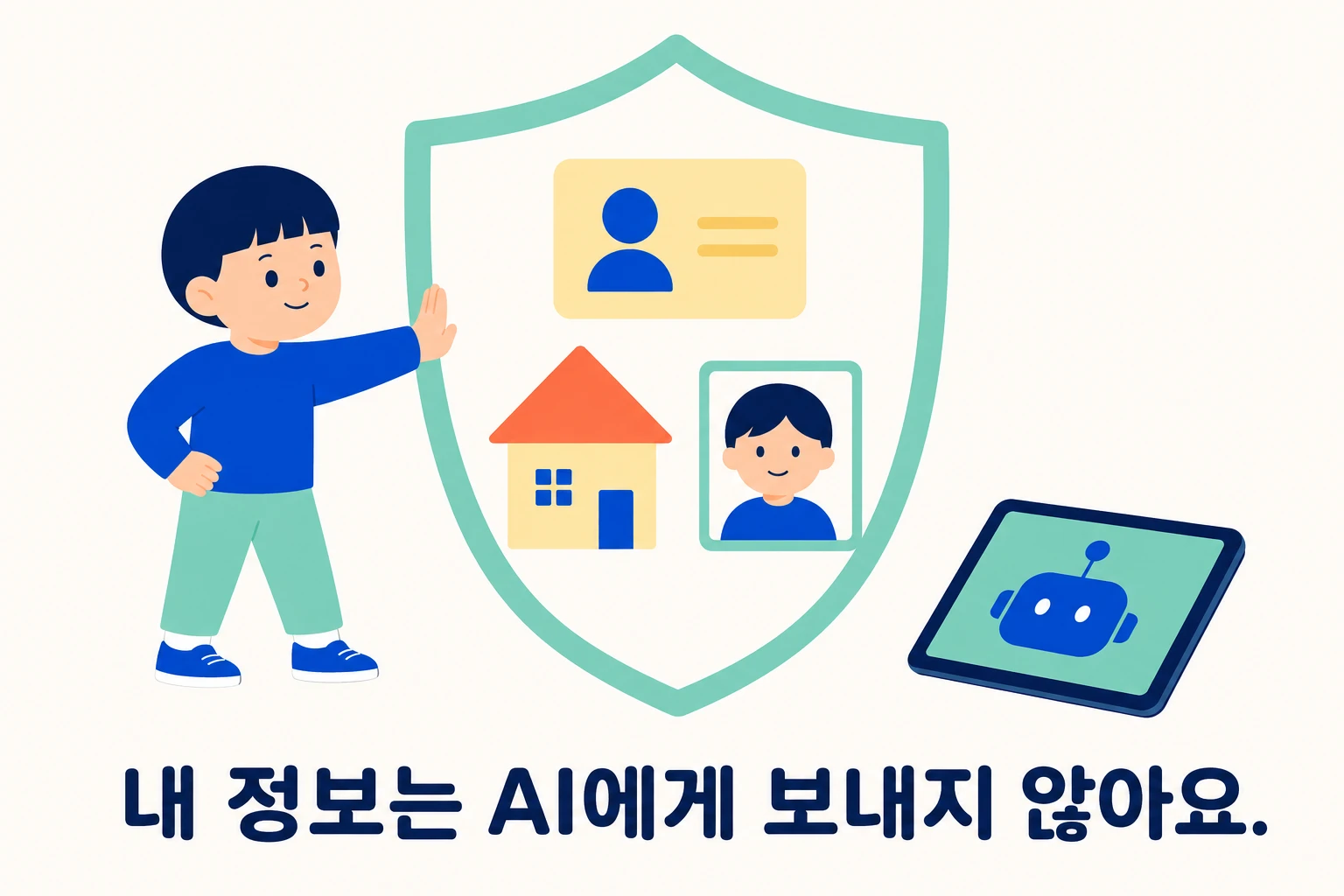
“I won't send AI my name, my school, my phone number, my home address, my passwords, or photos of me or my friends.”
Parents can add this:
“What we type or the photos we send can stay with the service. Let's not send anything that should be kept secret.”
If a question needs a name, practice together using a made-up name and leaving out the real school or address.
4. When something is upsetting or hard, talk to a person first
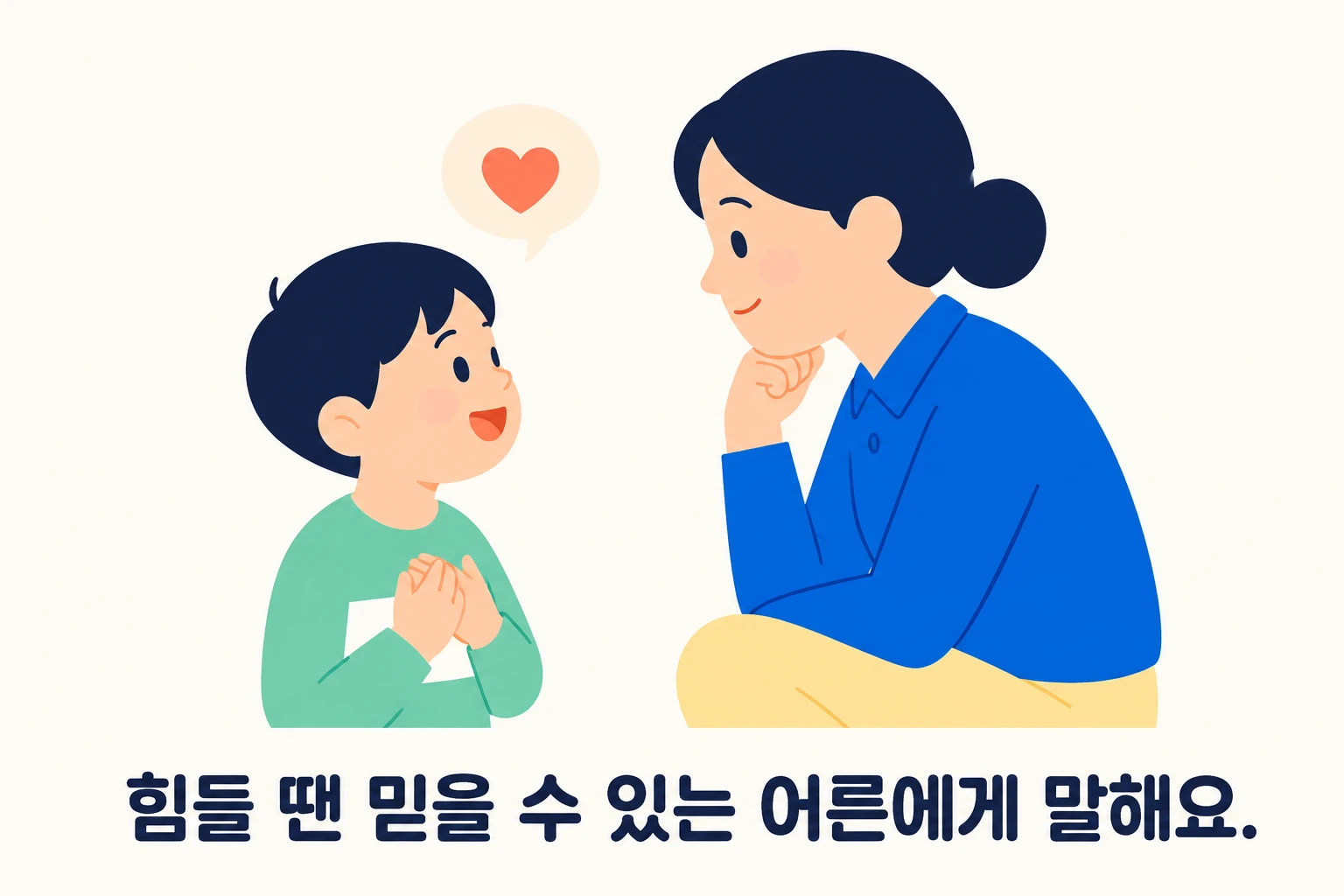 AI answers quickly and sometimes says things that sound empathetic. Because of that, kids may find these conversations comforting. But a kind tone is not the same as the ability to truly understand a child and take responsible care of them.
In a survey released by Pew Research Center in February 2026, 16% of US teens ages 13 to 17 said they had had casual conversations with an AI chatbot, and 12% said they had gotten emotional support or advice from one. The survey itself was conducted in fall 2025.
Separately, in a 2025 Common Sense Media survey, 33% of teens who use AI companions said they had discussed important or serious matters with an AI companion instead of a real person. “AI companions” here means services designed to chat like a friend and build a relationship. This figure isn't a share of all teens, and it doesn't mean they always turn to AI first.
UNICEF's 2025 updated guidance also points to cases where some AI chatbots gave dangerous responses in mental health crisis conversations. That's why it's hard to say a warm reply from AI is enough help on its own.
Make this promise with your child:
“When something upsetting or hard happens, I'll talk to a trusted adult, like my parents or a teacher, first.”
If it's hard to bring things up, it's fine to start by practicing one simple line: “I'm having a hard time right now.” What comes first is connecting with someone who can stay close, look at the situation together, and find the help that's needed.
5. Check whether photos and videos are real
 AI can turn imagined scenes into great pictures and fun videos. At the same time, it can make things that never happened, or a voice that sounds like a specific person, look real.
Tell your child, “Just because you saw it on a screen doesn't mean it really happened.” Sometimes it's hard to tell real from fake by looks alone.
Before sending a funny or surprising photo or video to someone else, ask these questions together:
- “Did this really happen, or did someone imagine and make it?”
- “Who posted it, and where?”
- “Why would someone make something like this?”
UNESCO's media and information literacy education likewise emphasizes the ability to evaluate information critically and look at its source, purpose, and context.
If your child wants to make a prank photo or video using a friend's face or voice, give them something to think about:
“How would you feel if someone made a picture like this with your face and spread it around?”
Don't use other people's faces or voices without permission, and don't make or share edited images or videos that tease or embarrass someone. Along with the habit of checking what's real, kids need a promise to respect other people.
6. If something strange happens while using AI, tell an adult right away
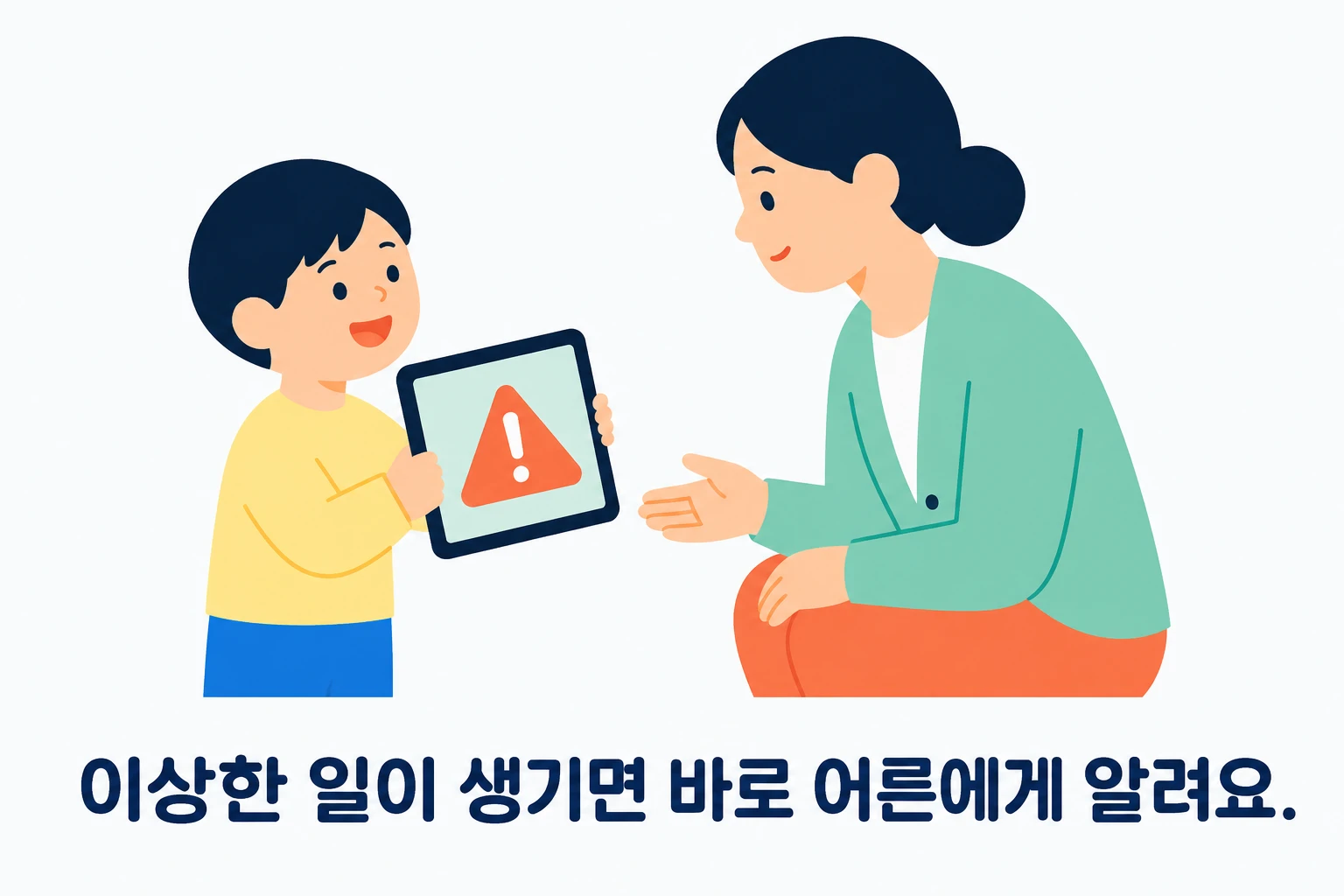 Even when kids know the rules well, they may get a strange answer, see content they didn't want to see, or accidentally type in personal information.
Whether your child asks for help in that moment depends on the promises you've made ahead of time and on your first reaction. If you start by scolding, they may hesitate to ask for help next time.
Tell them this in advance:
“If you see something strange or scary while using AI, stop and tell me. I won't get mad at you for telling me. We'll figure it out together.”
When your child actually comes to you, start with “Thank you for telling me.” You may still need to address any rule that was broken, but asking for help is itself something to encourage.
In a 2026 Common Sense Media survey, 44% of US kids and teens ages 9 to 17 said they had never talked with a parent or caregiver about AI safety. Meanwhile, 56% said they had learned how to use AI safely from their school or teachers.
Along with teaching the rules, it matters to be the kind of adult your child feels comfortable coming to when something goes wrong.
Our family's AI promises: decide them together
Read these six promises together, then have your child explain each one in their own words.
- I do my own thinking! I only ask AI for hints.
- Double-check it! I check with books and grown-ups to see if it's right.
- My information matters! I don't send my name, address, or photos.
- Hard times? Talk to a person! I tell my parents or teacher first.
- Is it real? I don't instantly believe or share photos and videos.
- Something weird? Say so right away! I don't worry alone; I tell an adult.
According to data released by Pew Research Center in 2026, 64% of US teens said they use AI chatbots. Meanwhile, 51% of parents said their teen uses AI chatbots, and 28% said they weren't sure. In other words, there's a gap between how parents picture their kids' AI use and what kids themselves report.
Depending on your child's age and situation, you may choose to hold off on letting them use AI directly for now. Even so, you can start teaching them what AI is, what to trust, and what to watch out for by talking about it together.
What we hope for isn't a child who simply follows AI's answers, but one who can get help when they need it while still holding on to their own thinking and judgment.
This weekend, try starting a conversation with one question: “What should we do if something AI tells you seems strange?” The small promises you make together can become a steady guide for your child as they meet new technology.
References and sources
-
Psychology Today · Kristen Cook — Teaching Our Children How to Use AI Safely
-
American Academy of Pediatrics (AAP) · Pediatrics — Generative Artificial Intelligence: Implications for Families and Pediatricians
-
Pew Research Center — How Teens Use and View AI
-
Pew Research Center — What Parents Say About Their Teen’s AI Use
-
Common Sense Media — Talk, Trust, and Trade-Offs: How and Why Teens Use AI Companions
-
Common Sense Media — The Common Sense Media Census: AI Use by Tweens and Teens
-
UNICEF — Guidance on AI and Children 3.0