AI Raises the Average—and Pulls Everyone Toward It
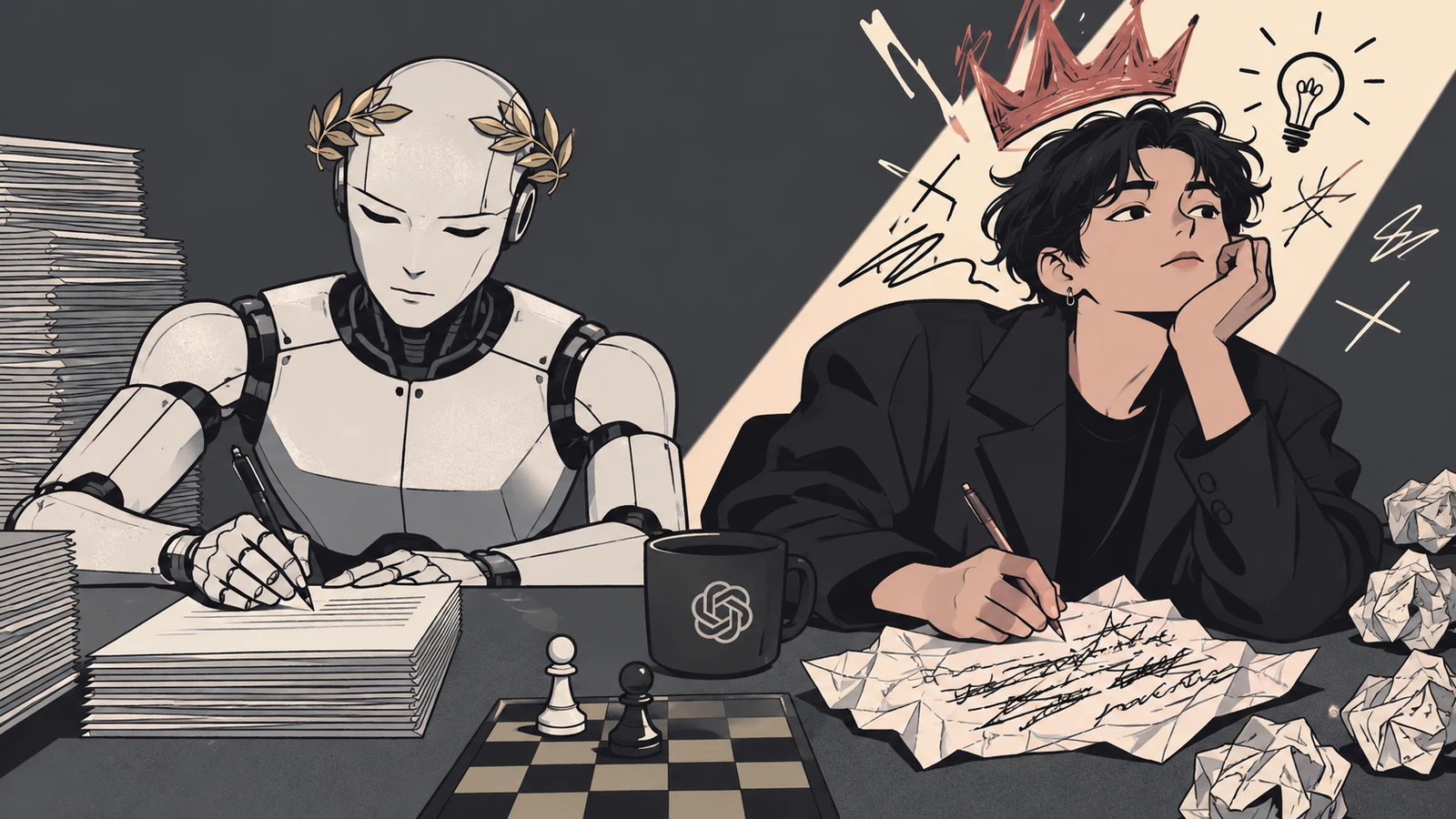
It has been about three and a half years since ChatGPT set off the generative AI revolution. Many of us no longer read long texts line by line or do quite as much writing ourselves.
Using AI for parts of our daily lives and work has become second nature.
AI writes well. Almost unnervingly well. Within seconds, it produces arguments so neatly structured that you might catch yourself wondering, “Who am I to edit this?”
And it keeps getting better. Its once-awkward Korean now reads quite naturally, and the falsehoods it used to serve up so casually seem less frequent. Ask it to write about a specialist subject, and it will even search the web and check its sources.
But something still feels off, doesn’t it?
The writing feels distinctly “AI.”
Somehow, it is not that interesting.
It is like a professor with a brilliant mind and an extraordinary research record whose lectures somehow leave you struggling to stay awake. Perhaps you have felt it too.
So what makes writing compelling in the first place? What makes it move people—or persuade them to buy?
Much of the appeal seems to lie somewhere between the familiar, which is easy to connect with, and the unexpected, which gives us a reason to pay attention. Too familiar, and we get bored. Too unfamiliar, and we turn away.
People with a good feel for writing seem to find that balance instinctively, even though it is difficult to put into numbers.
Could AI learn to do the same?
AI excels at estimating what is likely to come next in a given context. Yet the turns of phrase we find inspired are not always the most likely choices. Nor are they simply random.
AI Keeps Asking: What Comes Next?
A core training objective for generative language models is to predict the next token—a small piece of text.
When AI generates a sentence, the conversation so far is represented internally as numbers. The model calculates which information matters in the current context, then uses what it has learned to assign scores to possible next tokens.
One token might have a 20% probability of coming next, another 8%, and another just 0.01%. Once a token is selected, it becomes part of the context, and the process repeats.
Even a long essay is built through this sequence of steps.
That does not make AI merely an autocomplete tool, as some critics suggest. Through training, models develop complex internal representations of concepts, relationships, grammar, and knowledge about the world. More recently, they have also become capable of working through extended reasoning processes, checking and revising their work along the way.
But when a model actually produces text, its output still passes through a probability distribution over the next possible tokens.
This helps explain that recognizable AI voice: logical and plausible, yet somehow predictable.
Getting Better at Finding the Most Plausible Sentence
Generative AI also receives additional training.
It learns which answers people prefer and is encouraged to follow instructions and produce useful responses. One approach asks people to compare several AI answers and choose the ones they like, then feeds those preferences back into training.
Models are getting better at filtering out things that sound odd or out of place. This works particularly well for tasks such as coding or business documentation, where literary flair, personality, and an individual voice are often less important.
Writing without a correct answer or a fixed format is a different matter.
A study published in Nature Human Behaviour on August 24, 2026, analyzed more than 880,000 texts. When human writing was polished or rewritten by large language models, its core content was largely preserved, but differences in individual writing styles diminished. The writing became more polished, while the distinctive qualities separating one writer from another became less pronounced.
A 2024 experiment published in Science Advances found a similar pattern. Participants who used AI-generated ideas produced stories rated, on average, as more creative, better written, and more enjoyable. The benefits were especially pronounced for participants with lower initial creative ability. Yet when the AI-assisted stories were compared with one another, they were also more similar.
AI raises the average while drawing everyone closer to it.
The Most Effective Approach: Be Specific
Understanding how AI works changes how we use it.
In the early days of generative AI, much of the discussion focused on adjusting settings such as temperature, top-k, and top-p to produce more varied responses. Raising the temperature gives lower-probability tokens a greater chance of being selected, while top-k and top-p control the pool of candidates available for selection.
These settings can widen the range of possibilities. They do not, however, tell the model which surprises are worth making.
The most effective practical approach still comes down to writing a specific prompt.
You might expect that adding constraints would restrict the model’s freedom and make its answers more predictable. Interestingly, the opposite can happen.
A vague request leaves an enormous range of possible answers open, making it easy for the model to fall back on familiar, broadly acceptable language. Specify the purpose, context, perspective, facts that must be included, and expressions to avoid, and you give it conditions that pull it away from the default.
Those conditions change the probability distribution over the next tokens, making a generic response less likely.
A good prompt, then, goes beyond “Make it more creative.” It tells the AI exactly where you want it to depart from the ordinary.
Read Next
More posts related to Writing →
Teach Kids About AI, Limit Their AI Use: 6 Family Rules for Safe AI
In our last post, we looked at "What Should Kids Learn When AI Does the Work?" This time, let's look at what families can actually do at home. O…

Who Will Control AI Agents: The AI Builders or the Platforms Holding the Data and Tools?
When a shopper tells an AI, “Find the right one and buy it for me,” who controls the customer relationship? The AI company that understands the…

How Do You Build and Connect AI Agents? Notes from Google Agentic AI Night
How do you build AI agents and connect them so they can take on a task together? Start by defining each agent's role, the instructions it should…

AI-powered hacking: how to use AI to help protect an older website
Attackers are using AI to find weaknesses and revise attack code. Is your online shop or booking site still running much as it did years ago? As…