Jensen Huang’s Exit Puts Korea–Nvidia Ties in Focus
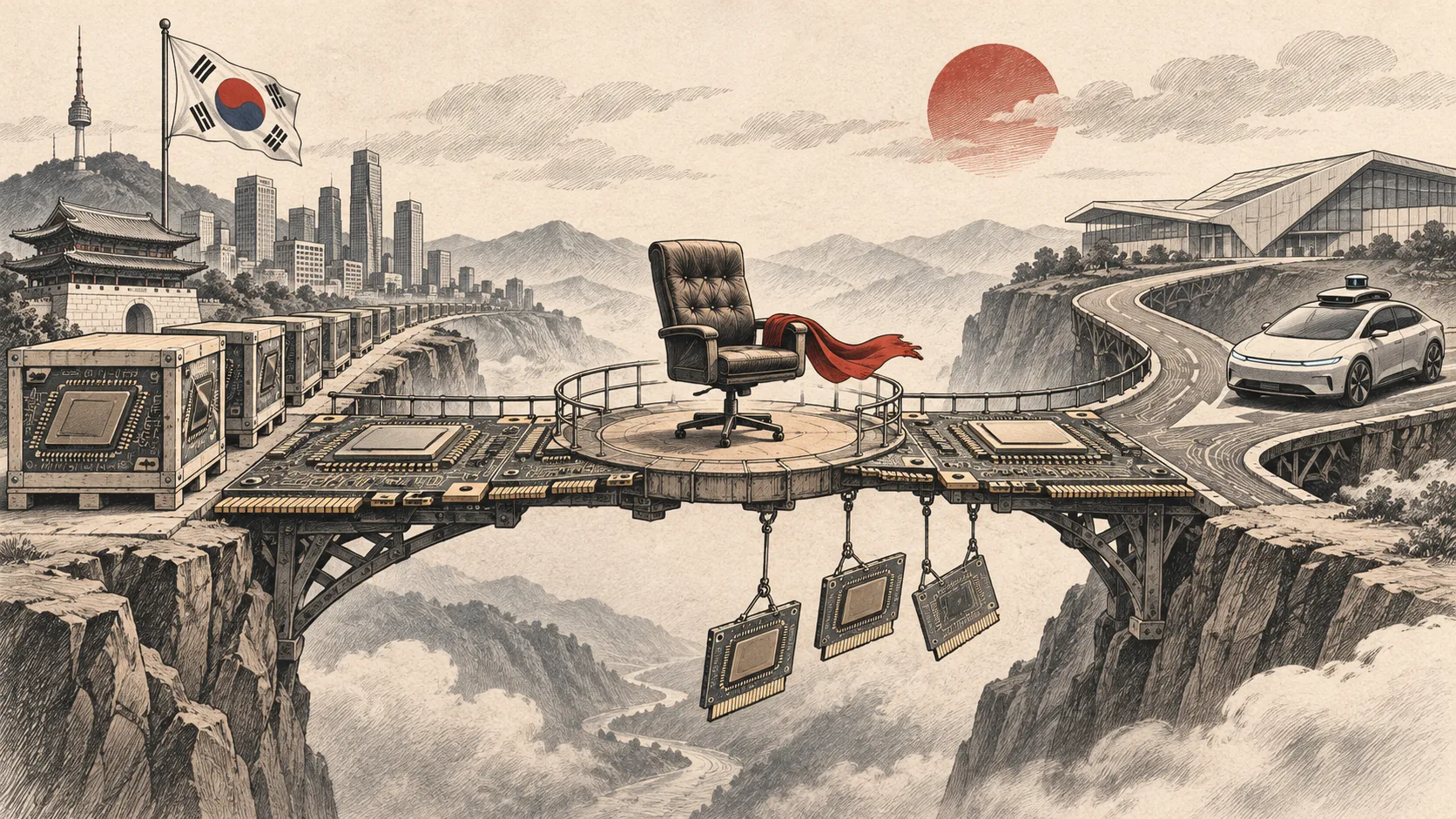
- •Korean companies are watching for effects on Nvidia GPU supplies and AI partnerships after CEO Jensen Huang’s departure.
- •South Korea plans to secure more than 260,000 GPUs; already contracted supplies are expected to face limited disruption.
- •Allocations of next-generation GPUs, further investment and Hyundai Motor’s autonomous-driving work may depend on Nvidia’s new leadership.
Nvidia announced that Jensen Huang stepped down immediately as president, CEO and board member on the 12th local time. South Korean businesses are watching for effects on GPU supplies, AI infrastructure investment, and autonomous-driving and robotics partnerships. Chief Financial Officer Colette Kress became interim CEO. Nvidia said it would honor commitments to existing customers and keep product development on schedule. Korean companies expect confirmed GPU contracts and ongoing projects to face no major immediate impact, but industry observers say the new leadership could change the timing and priorities for next-generation GPU allocations, additional investment and technical support.
GPU acquisition plans announced during Huang’s visit to South Korea last year total more than 260,000 units: 50,000 each for Samsung, SK Group and Hyundai Motor Group, 60,000 for Naver Cloud, and more than 50,000 for the government. The government expects existing contracted supplies to arrive without disruption. It said about 13,100 Nvidia B200 GPUs secured through a supplementary budget last year are installed and in use, as are about 8,500 GPUs for the National Supercomputer No. 6. It expects this year’s planned purchases, including Vera Rubin GPUs, to proceed as scheduled. Industry officials say written contracts are unlikely to be easily unsettled by a leadership change. They also describe AI data centers as long-term projects that take 10–15 years from equipment procurement and financing through construction, capacity expansion and customer acquisition. Korean companies are interdependent with Nvidia: Samsung and SK hynix supply high-bandwidth memory (HBM), a type of memory used for fast data access, for its AI accelerators.
Industry concerns center on priorities for next-generation GPU supply, new investment and the pace of strategic partnerships. The limited availability of Vera Rubin GPUs could affect delivery schedules, and AI startups and research institutions with little ability to secure GPUs independently may be sensitive to supply policy changes. Naver, which recently received an Nvidia investment, signed a deal last month with global asset manager Brookfield to secure computing infrastructure worth up to $9 billion. On the 6th, it secured a $1 billion investment from Nvidia. Through a private placement, Nvidia acquired about 4.13% of Naver and became its third-largest shareholder. Under the arrangement, Naver Cloud will operate the business, Brookfield will provide funding, and Nvidia will supply GPUs and technical support to build a 1-gigawatt (GW) global AI factory. Naver plans to start operating its Gak Sejong data center in Sejong at 55 megawatts (MW) in the first half of 2027 and expand it to 200 MW by 2028. The completed investment and infrastructure agreements are expected to continue, while further investment and technical support may depend on the new leadership.
Nvidia announced cooperation with South Korea’s Ministry of Science and ICT to build a physical AI ecosystem. It also signed a memorandum of understanding with SK Telecom and Rebellions to apply a heterogeneous AI computing system, which combines different processor types, to data centers using GPUs and neural processing units (NPUs). Nvidia is pursuing autonomous-driving and mobility AI work with Kakao Mobility and has announced investment plans for Upstage, Motif Technologies and Realworld. Joint development requires ongoing agreement on schedules, technical support and additional investment, so later decisions could affect the pace of commercialization. Industry observers also worry that decision-making could slow after a leadership transition, because a small group of executives has handled key issues by reporting directly to Huang. So far, there are no specific signs of plans to withdraw or scale back announced partnerships or investments with Korean companies.
Hyundai Motor Group formed a mobility innovation partnership with Nvidia in January last year. In October that year, the companies agreed to build an AI factory based on Nvidia Blackwell and develop South Korea’s physical AI ecosystem. They are also developing technology using Nvidia’s autonomous-driving platform, and Hyundai and Kia’s plan to mass-produce autonomous vehicles in 2028 is based on their Nvidia partnership. Early this year, Hyundai Motor Group hired Park Min-woo, an autonomous-driving expert formerly with Nvidia, as head of its Advanced Vehicle Platform (AVP) division and CEO of 42dot. Existing projects are expected to proceed as planned, but the new leadership’s willingness to continue discussions is uncertain on a Saemangeum data center proposal Huang and Hyundai Motor Group Chair Euisun Chung discussed, and joint development of a Genesis autonomous vehicle; neither project’s terms or execution plan has been formalized. Huang received the Saemangeum data center proposal in June and said he would do it if there were “excellent samgyeopsal.” In July, he told Pr
Companies related to this article
See the overall AI model ranking