The GPT-6 Astra Boom: How Much Compute Does AI Really Need?

GPT-6 Demand Forces Sign-up Limits Just One Week After Launch
OpenAI’s latest model, GPT-6 Astra, has attracted intense interest since its release just a few days ago. Since late last year, OpenAI had appeared to be losing some ground to Anthropic’s Claude among developers and AI power users. Astra seems to have reversed that narrative, giving OpenAI its strongest momentum in nearly a year.
OpenAI has now announced that it is temporarily pausing new subscriptions and upgrades to its $200-a-month ChatGPT Pro 20X plan to maintain reliable access to Astra. Because the plan offers relatively generous usage limits, its subscribers place a particularly heavy load on the system. OpenAI is therefore prioritizing existing customers while it adds more capacity.
Current Pro 20X subscribers can continue using the service. Other plans, including the $100-a-month Pro tier, and the API are not affected. OpenAI says it is working to expand its computing capacity as quickly as possible.
The decision reflects Astra’s popularity, but it also highlights a constraint facing the entire industry: even the largest AI companies cannot instantly secure enough computing power to make their newest models widely available.
How AI Uses Compute: Training and Inference
AI workloads fall into two broad categories: training and inference.
Training is the process of creating a new AI model. Large numbers of GPUs work together to process enormous datasets and solve problems repeatedly, gradually shaping the model’s capabilities. Training typically runs for weeks or months, but once it is complete, that particular workload ends. Adding more users later does not increase the amount of compute already spent on training. GPT-6 Astra reportedly used more than 100,000 GPUs during training.
Inference begins after the model has been trained. Every time the AI answers a question, writes a document, searches for information or runs a program, it performs a new set of calculations. Total inference demand therefore keeps rising with the number of users and the amount each person uses the service.
The relationship can be simplified as follows:
GPUs required ≈ requests per second × GPU time per request ÷ operating efficiency
The GPU time required for each request depends on the size of the model, the length of the input and output, the number of reasoning steps and the duration of the task. Reading a long document or working through a complex problem in several stages requires far more compute than answering a short question.
Modern AI agents increase that demand further. A single assignment may require the model to create a plan, gather information, operate tools, review the results and make corrections. Each stage can trigger another round of inference. If a task runs for tens of minutes, the compute required continues to accumulate throughout the process. As AI systems take on longer and more sophisticated work, the amount of computing power needed for each assignment is also rising.
How Big Is a 100,000-GPU Cluster?
According to NVIDIA CEO Jensen Huang, GPT-6 Astra was trained using more than 100,000 Grace Blackwell GPUs. It was the first OpenAI model to cross the 100,000-GPU mark for a single training run.
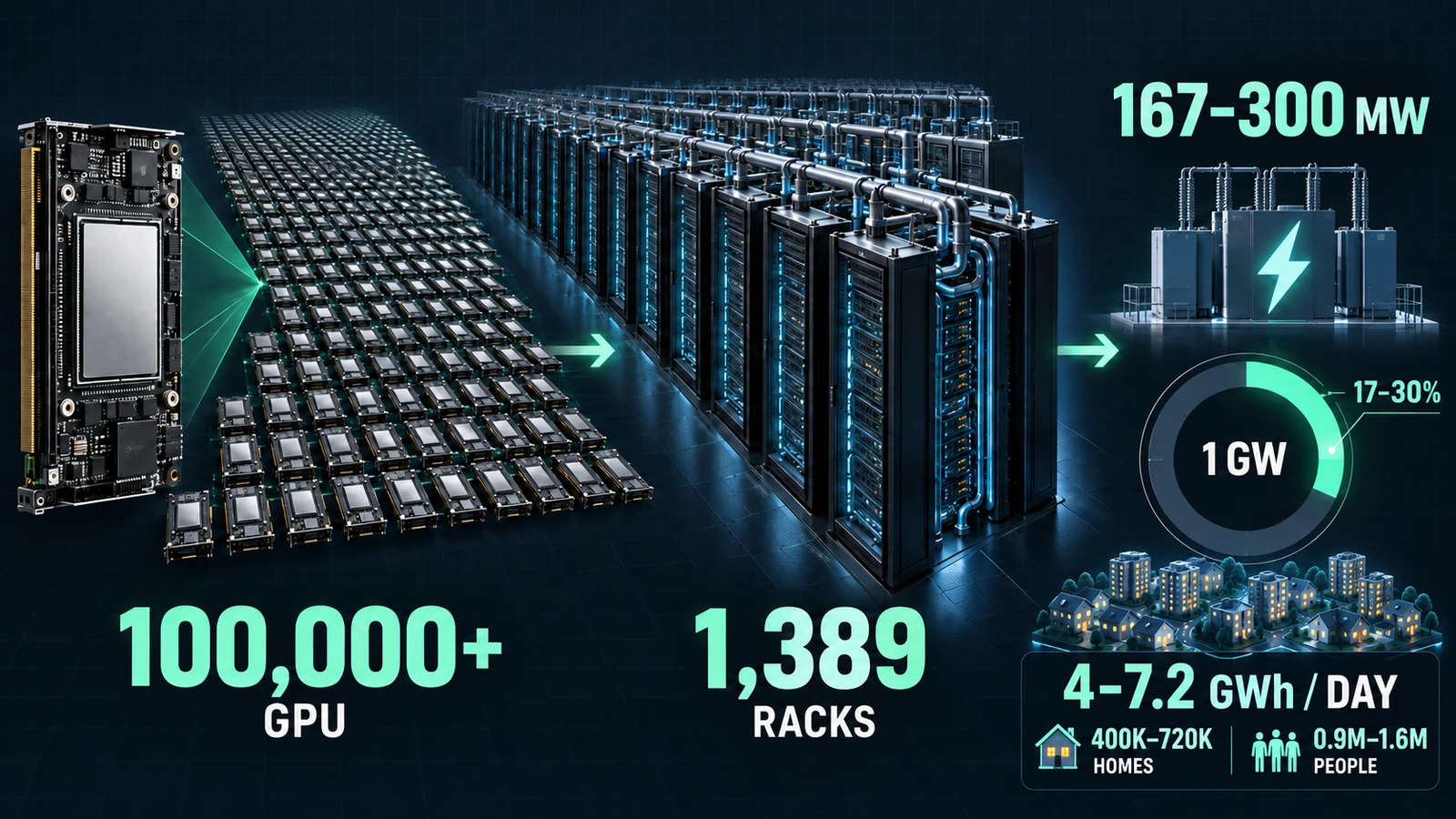 Putting a Price on 100,000 GPUs
-
GPU chips alone: approximately $3–4 billion
-
Fully configured servers and racks: approximately $3.9–4.7 billion
-
Data center construction: approximately $1.7–4 billion
- Total initial investment: approximately $5.6–8.7 billion
-
Electricity: approximately $500,000–$900,000 per day, or $46–84 million over 90 days
- Daily electricity use: roughly the same as 400,000–720,000 households, or a population of about 900,000–1.6 million people
The AI Race Is Becoming an Infrastructure Race
OpenAI is developing more than 5GW of Stargate data center capacity across the United States. Once completed, these facilities are expected to run more than two million chips. The longer-term goal is to build 10GW of AI infrastructure—equivalent to the generating capacity of ten large 1GW power stations.
OpenAI is far from alone. Google continues to pour capital into data centers and AI computing equipment. Meta is building its $27 billion Hyperion data center, while Oracle is working with OpenAI to expand Stargate across multiple US locations. SpaceX is also increasing its AI computing capacity through xAI and the Colossus data center network.
The AI race is no longer just about developing better algorithms. Companies must secure enormous quantities of advanced GPUs, connect thousands of server racks with high-speed networks, and build the data centers, cooling systems and reliable power supplies needed to keep them running.
The next phase of competition will be shaped not only by who can build the best models, but also by who can secure enough computing power and electricity to make those models available to millions of people.
Read Next
More posts related to AI Trends →
GPT-6 Astra: How Much Can We Really Understand AI?
As AI tackles increasingly complex problems, it is becoming harder for people to verify every step of the process. Yet human judgment and oversi…

Teach Kids About AI, Limit Their AI Use: 6 Family Rules for Safe AI
In our last post, we looked at "What Should Kids Learn When AI Does the Work?" This time, let's look at what families can actually do at home. O…

AI Basics Through History: Does AI Have a Self?
AI is pretty amazing, isn't it? It can explain almost anything, and sometimes it talks so naturally that you forget you're not chatting with a p…

AI That Does More Than Just Answer — A 2026 Beginner's Guide to Agentic AI
You've probably asked ChatGPT or Gemini to "summarize this" or "give me some ideas" at some point, right? In 2026, AI has evolved beyond just an…