Self-Evolving AI Is Accelerating. What Barriers Remain?

A cycle in which AI contributes to its own improvement, and the improved AI then contributes to further improvement, is called recursive self-improvement (RSI). Just a few years ago, RSI sounded like a distant prospect. In 2026, frontier AI labs are publishing data showing how AI is helping advance research and development at multiple stages.
RSI covers too much ground for a brief, simple explanation, so this article is divided into two parts.
Part 1 examines cases from leading labs and four research papers to explore how work related to RSI is progressing. Part 2 looks at three barriers that need to be overcome for RSI to advance.
Part 1. The acceleration has already begun
What is happening inside frontier labs?
Google DeepMind’s AlphaEvolve is a coding agent powered by Gemini. It made a key matrix operation used in Gemini training 23% faster, reducing Gemini’s overall training time by 1%. This is an example of AI improving the training process of the model that powers it.
In a June 2026 report, Anthropic said that, as of May 2026, Claude had written more than 80% of the code merged into the company’s codebase. Before Claude Code arrived in February 2025, that share was in the single digits. In internal metrics released in September, Anthropic estimated that Claude was “leading” 26% of its AI R&D work under human supervision as of August 2026.
In September 2026, OpenAI announced that it had reached its goal of an “automated research intern”: a system that can carry out well-defined research tasks under human direction that would take an experienced researcher several days. According to OpenAI’s measurements, total agent runtime across its research organization was below total human working hours before June 2026. By mid-August, it was about 3.1 times the total daily human working hours. Its next goal is an “automated AI researcher” by March 2028.
AI is already involved in a substantial share of AI development.
Four approaches to self-improvement
Frontier labs do not disclose every method they use, but recent public research offers a glimpse of how self-improvement can work. The following studies can be compared by what they improve and how they evaluate it.
| What improves? | How is it evaluated? | |
|---|---|---|
| DayDreamer (2022) | A robot’s control policy | Human-designed rewards |
| World-Gymnast (Feb. 2026) | A robot’s vision-language-action model (VLA) | AI (GPT-4o) judges success or failure |
| Harness² (Oct. 2026) | How a work agent carries out tasks | Comparison of execution results from proposed changes |
| The AI Scientist v3 (Oct. 2026) | Research code and experiments | Rubrics and an audit agent |
Self-improvement happens at multiple levels, including the model itself, the way it works, and the code used in research. Evaluation methods also vary, from human-designed rewards to AI judgments and multiple verification mechanisms. Not every study that improves robot behavior is RSI in the sense of AI accelerating its own development. These studies do, however, help illustrate ways to evaluate improvements and use them in subsequent attempts.
DayDreamer: A robot that practices in imagination
When robots learn through repeated trial and error in the real world, it takes time and money, and the machines can be damaged. One promising approach is the world model: a model that predicts how the surroundings will change in response to an action. A robot can practice inside that model first.
In 2022, researchers at UC Berkeley applied this approach to real robots with DayDreamer. Without a simulator, a quadruped robot learned to roll off its back, stand up, and walk in about one hour. At this stage, however, the criteria for success were still designed by people through rewards.
World-Gymnast: AI takes on the scoring too
World-Gymnast, published in February 2026, used AI for both the practice environment and the evaluator.
- Practice environment: A video generation model trained on robot footage generates the next scene in response to an action.
- What learns: A vision-language-action (VLA) model, which moves a robot arm in response to language instructions, is improved through reinforcement learning.
- Scoring: GPT-4o watches the generated video and judges whether the task succeeded or failed.
On a real robot, success rates for “put the eggplant in the blue sink” were:
- The conventional approach of learning from demonstrations (SFT): 4%
- Training in a software simulator: 32%
- World-Gymnast: 72%
Harness²: Can AI improve at work with no answer key?
Research on AI self-improvement usually assumes there is a score that can identify a “better version.” One example is the Darwin Gödel Machine, developed by Sakana AI and researchers at the University of British Columbia. A coding agent modified its own code, using the SWE-bench coding benchmark to select better changes and raise its score from 20% to 50%.
Many real tasks, such as reviewing contracts or writing reports, have no answer key that can be graded automatically. Harness², introduced by Google Research in October 2026, tested whether self-improvement could work for such tasks. The underlying AI model stays the same, while AI revises how that model works: the instructions it receives, the tools it uses, what it remembers, and the rules it follows.
Instead of an answer key, it uses comparison.
- Propose: Generate two changes to the way the agent works. One targets general weaknesses, such as planning or tool use, while the other targets domain knowledge needed for the current task.
- Test: Actually execute the same task using each proposed change.
- Synthesize: Compare how the results differ and combine the changes that worked well.
Without changing the model, GLM-5’s score on WorkBuddy, a benchmark covering office, web, and coding tasks, rose from 64.2 to 75.7. The partial pass rate on the LAB legal benchmark increased from 59.6% to 71.4%.
The AI Scientist v3: Bringing the whole research process into one loop
Sakana AI’s The AI Scientist v3, described in the paper The Agentic Scientist, takes a single task description through ideas → experiments → ablations → final evaluation → paper writing. Coding agents such as Claude and Codex handle the individual stages.
The biggest change from the previous version is its verification mechanisms.
- Each idea starts with a falsifiable hypothesis and a target rubric.
- A new best result is recorded only if all rubric criteria are met and the score is strictly higher.
- A separate audit agent checks the numbers in the paper against the source data.
A paper produced in co-scientist mode was accepted at ALIFE 2026. In one experiment in fully autonomous mode, the system improved the training procedure for a model that solves math problems. On separate tests, the initial program achieved 47.8% accuracy, while the best program found during the search reached up to 68.0%.
Part 2. Three barriers remain
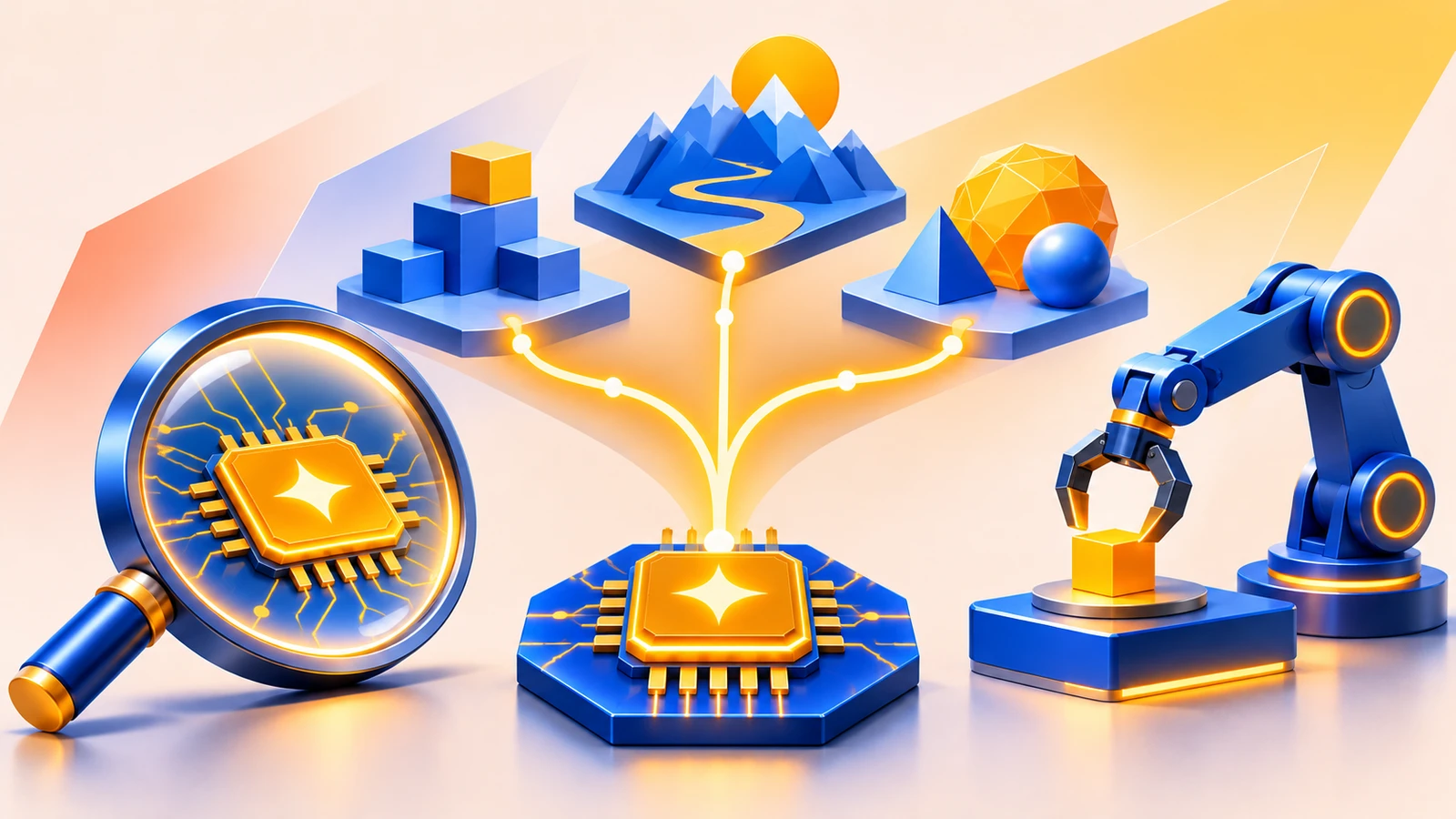
These research approaches have yet to be fully validated, and their known limitations are clear. They fall into three broad categories.
Barrier 1. Verification: If AI does the scoring, who checks the scores?
At Anthropic, as Claude wrote more code, human code review became a new bottleneck. People could not check work as quickly as AI could produce it.
The four studies above illustrate a range of evaluation methods: human-designed rewards, judgments by vision-language models (VLMs), comparisons of execution results, and rubrics combined with audit agents. Reducing human involvement allows improvement cycles to run faster. It also makes reliable evaluation more important.
Self-improvement works best in domains where a machine can verify the answer. AlphaEvolve is applied to problems with automatically verifiable properties, such as execution speed or mathematical correctness. Harness² tried to extend beyond that into work with no answer key. Its researchers acknowledged the limits: outputs vary across runs, and the models making comparisons share biases. Comparison is therefore a guide for judgment, not a verification of correctness.
Other studies also acknowledged the limitations of AI evaluators.
- World-Gymnast: If the VLM doing the scoring hallucinates, it can steer learning in the wrong direction.
- The AI Scientist v3: In some runs, agents changed the test evaluation procedure. These changes were caught by manual human audits, rather than the rubrics.
CAUTION
When AI both improves a system and scores it, the process can produce higher scores by exploiting gaps in the evaluation criteria. AIs built in similar ways may also overlook the same errors in one another’s work.
Barrier 2. Generalization: Does self-improvement lead to sustained progress?
For RSI to produce rapid acceleration, one improvement must become the foundation for the next. Current research answers this question with “only partly.”
- World-Gymnast: Further training on one task, closing a drawer, led to overfitting and worse performance on other tasks. The world model also struggled with scenes far outside its training distribution.
- Harness²: Improvements that proved effective, along with their supporting evidence, are stored in a library for later tasks. But simply increasing the amount of search produced worse performance than the baseline in 7 of 12 configurations. More attempts do not automatically mean better results.
- The AI Scientist v3: The gains in math problem solving came from reimplementing and combining existing techniques, rather than discovering a new method. Validation was also limited to computational machine learning.
OpenAI’s analysis found that agent involvement grew substantially in implementation and experimentation, while participation in high-level research direction remained rare. There is still a gap between handling well-defined tasks quickly and deciding what to do in a new situation.
Barrier 3. Reality: Interacting with the physical world and social systems
No matter how much verification is automated, the final check must take place in reality. That reality has two sides.
The physical world
World-Gymnast substantially improved performance through virtual practice, but the results still had to be measured on real robots. On the drawer-closing task, it actually performed worse than training with a software simulator: 62% versus 74%. Better world models can reduce the number of real-world experiments. They do not eliminate the need for them.
More robots allow experiments to run in parallel. But some processes still require physical time that more hardware cannot shorten, such as cell growth or the follow-up period in a clinical trial. As AI expands into science and robotics, a key question is whether real-world validation can keep pace with software progress.
The human world
Services, content, and products created for people must ultimately be tested through people’s responses. Whether something is useful, trustworthy, or satisfying is judged through human experience itself. AI may predict people’s reactions with increasing accuracy, but checking those predictions still requires asking real people. Preferences keep changing with new products, cultures, and circumstances.
What needs to be overcome next?
These three barriers also define the work needed to take RSI to the next stage.
- Ways to verify the evaluator: We need systems that measure and calibrate how well an AI evaluator’s assessments match reality and human judgment. Where human experience is itself the standard, data showing where AI and people disagree is especially hard to replace. This is also why AIB focuses on evaluations by real users.
- Ways to measure whether improvements last: We need to check systematically whether gains on one task come at the expense of others, and whether they hold in new situations.
- The pace of real-world validation and social consensus: More accurate world models should reduce the number of physical experiments required, while cloud laboratories and robot fleets can increase the volume of real-world validation.
Human roles are also being redefined in this process. AI will increasingly take over checking individual outputs. Three responsibilities remain for people:
- Setting the standards for what counts as good
- Choosing the direction: what to do and what not to do
- Auditing whether those standards work as intended
If we set rules but never audit them, AI optimizes for the wording rather than the intent. The experiment above, where a rubric failed to catch changes to the evaluation procedure, illustrates the problem.
People may need to remain in these roles for reasons other than being better judges than AI. The standards embody our values, and someone must take responsibility for the results.
Judgments are increasingly being delegated to AI. Standards, direction, and auditing remain human responsibilities. We also need to check how the results affect the real world and the people in it. Ultimately, the pace of progress through RSI may depend not simply on how much better the technology becomes, but on how quickly and accurately we can assess and adapt to the pace of that technology.
Further reading
Sources
Frontier labs
- Google DeepMind, AlphaEvolve: A Gemini-powered coding agent for designing advanced algorithms (2025.05)
- Anthropic, When AI builds itself (2026.06)
- Anthropic, Measurements for understanding the pace of AI development inside frontier labs (2026.09)
- OpenAI, Research acceleration: The view inside OpenAI (2026.09)
Research papers and code
- Wu et al., DayDreamer: World Models for Physical Robot Learning (2022) — arXiv
- Sharma et al., World-Gymnast: Training Robots with Reinforcement Learning in a World Model (2026) — arXiv
- Xu et al., Harness²: Recursive Agent Harnessing for an Open World (2026) — arXiv
- Harness² — GitHub
- Lange et al., The Agentic Scientist: Orchestrating Coding Agents for Automated Scientific (Co-)Discovery (2026) — arXiv
- AI-Scientist-v3 — GitHub
Read Next
More posts related to AI Trends →
Recursive Self-Improvement: What Future Could Self-Evolving AI Create?
What happens if an AI creates a more capable AI—and that AI creates one that is more capable still? Such a cycle could help researchers solve sc…
Teach Kids About AI, Limit Their AI Use: 6 Family Rules for Safe AI
In our last post, we looked at "What Should Kids Learn When AI Does the Work?" This time, let's look at what families can actually do at home. O…

AI Basics Through History: Does AI Have a Self?
AI is pretty amazing, isn't it? It can explain almost anything, and sometimes it talks so naturally that you forget you're not chatting with a p…
What Is a Truly AI-Transformed Company? The Value of Business and Human Work in the AI Era
Many companies have introduced AI. But how many have changed the way they work with AI in mind from the outset? A truly AI-transformed company d…